

Mining innovations implemented in Bisbee enhanced century-long metal production.
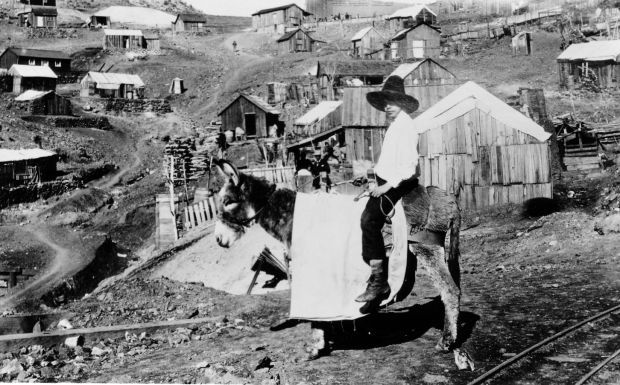
To transport water, canvas bags with up to 25 gallons of water each were evenly distributed for balance on either side of a burro. Each bag sold for 25 cents to miners — no small expense when their daily earnings averaged $3.50.
Contaminated water and dry wells resulting from excessive ground water pumping from the mines forced the Copper Queen Consolidated to run the first water line from deep wells in Naco, Mexico to the Bisbee community in 1902.
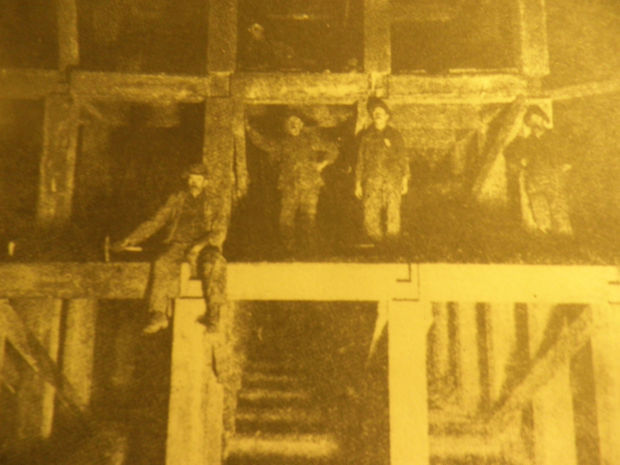
From the early 1880s until World War I, the Copper Queen Mining Co. used a square-set stoping method to support heavy ground. The technique, borrowed from the German mines and proven effective in the Nevada Comstock, used cubic lattice-work of timbers that were mortised together.
Although square-set stoping proved susceptible to earth movement, fire and dry rot, its economic benefit supplanted the previous method of cribbing, which supported the ground with timbers piled in a log-cabin style.
People are also reading…
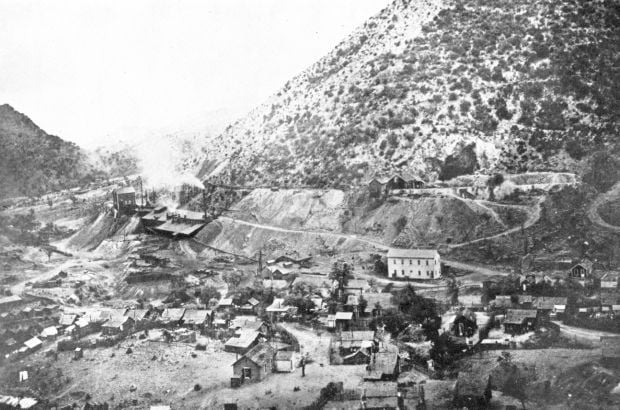
Phelps Dodge added social innovations to Bisbee with its financial contributions toward a school (1883), Copper Queen Mercantile (1886), a library (1887) and a company hospital (1890). Early twentieth-century modernization followed with the 75-room, Mediterranean-style Copper Queen Hotel in 1902, as well as street lighting, flood control and roads built by the Bisbee Improvement Co. By 1919, Bisbee boasted a population of 25,000.
Between 1880 and 1933, the renowned Copper Queen Mine produced $2.8 billion pounds of copper with 100 million pounds of lead, $11.2 million in gold and $15.5 in annual income. Additional rich loads included the Shattuck-Denn and Campbell shafts, which kept mining profitable in the Warren District through World War I. However, open-pit mining would inevitably supersede underground mining.
Phelps Dodge initiated exploratory churn drilling. It also began underground exploration accessible from drifts from the Holbrook and Sacramento shafts, confirmed in 1914, which were two low-grade ore bodies beneath Bisbee’s Sacramento Hill. The richer, western ore body was mined first, averaging 1 to 1.5 percent copper.
Plans to get that copper through open-pit mining — the first time it had been tried in Arizona — began in 1917. Active surface stripping by seven steam shovels and fifteen locomotives created a series of benches ranging from 35 to 60 feet wide.
Removal of 5 million cubic yards of overburden, coupled with 33 million tons composed of 2/3 waste rock and 1/3 ore, reduced Sacramento Hill 605 feet below the surface.
By 1928, the Sacramento Pit was running out of significant ore deposits. Furthermore the Great Depression dropped the price of copper to an all-time low, under five cents per pound. Then the advent of World War II revived the fortunes of the Warren district, with a call for strategic wartime metals including the production of 105 million pounds of lead and 235 million pounds of zinc.
In 1951, stripping began to access the eastern ore body, which averaged 1 percent copper. It was called the Lavender Pit after Phelps Dodge General Manager Harrison Lavender, who initiated the operation.
The Lavender Pit played out in December 14, 1974, having created a 950-foot-deep terraced hole in the ground 10 times the size of the Sacramento Pit — 300 acres, 1 mile long and 1/2 mile wide.
Total extraction at the site exceeded 380 million tons of material, including 94 million tons of copper ore, 111 million tons of leach material and 175 million tons of waste rock.
Bisbee’s legacy for innovation yielded 8 billion pounds of copper during its 100 years of mining history.
Sources
Lynn R Bailey, 1983, “Bisbee: Queen of the Copper Camps”; James Douglas, 1899, “The Copper Queen mine, Arizona”; William C. Epler, 1978, “Bisbee Vignettes”; R.W. Graeme, 1987, “Bisbee, Arizona Dowager Queen of Mining Camps: A Look at Her First 50 Years”; Richard V. Francaviglia, 1982, “Copper Mining and Landscape Evolution: A Century of Change in the Warren Mining District, Arizona”



 Tucson official: Air Force won't pay for D-M groundwater cleanup now


