

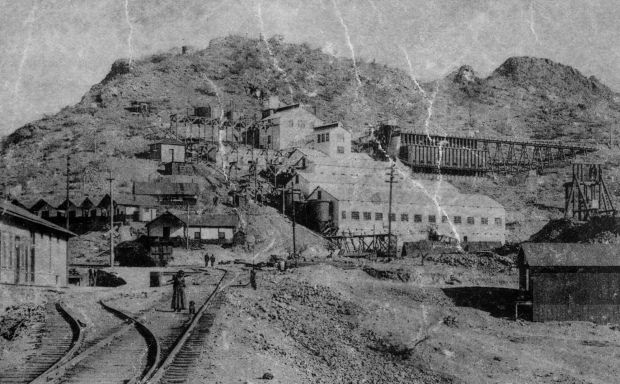
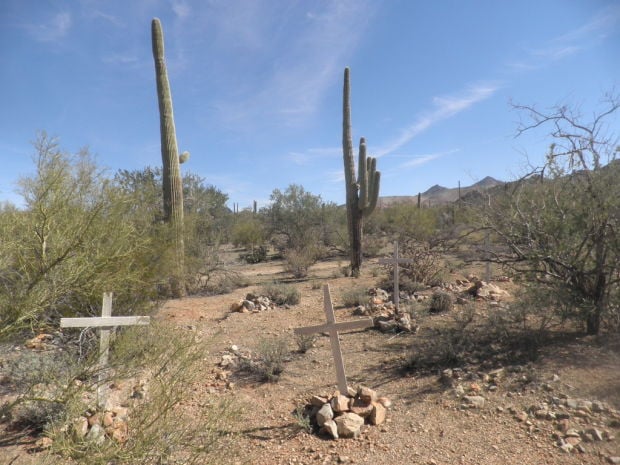
The earliest recorded mine in the Silver Bell Mountains was the Old Boot Mine in 1865. The mine, later renamed the Mammoth Mine, was developed by prospectors and financed by a group of Tucson merchants including Zeckendorf and Steinfeld, who were drawn to the heavy, black garnet-stained rock formations in the mountains.
Several small rich pockets of lead silver ores were discovered in the area over the next several decades. Other mines later developed included the Young America Mine, Imperial and El Tiro.
By 1904 the Silver Bell district was mined in earnest by the Imperial Copper Co., whose interest included 61 claims. The Oxide Copper Co. also developed claims.
Mining was challenging due to lack of water and high transportation costs involving ore shipments hauled by mule-drawn wagons to the main line of the Southern Pacific Railroad at Red Rock. From there it was transported to El Paso or the Copper Queen smelter at Douglas.
People are also reading…
That was remedied in 1904 when the Imperial Copper Co. — a subsidiary of the Development Company of America — built the Arizona Southern Railroad from Silverbell to the town of Red Rock.
Eleven million pounds of copper were mined in 1909 and shipped to the Sasco smelter along the route of the Arizona Southern Railroad, seven miles west of Red Rock near the Samaniego Hills and two miles from a water source — the Santa Cruz River.
Known at one time as “The Toughest Town in Pima County” or “The Hell Hole of Arizona” the company town of Silverbell reached a population of 1,200 during World War I.
A post office established in 1904 was followed by several grocery stores, saloons, Wells Fargo, barber shops, a dairy, a hospital and a school with 75 students.
E. Glen Baker owned one of the more prominent saloons, with a billiard parlor and general merchandise. Drinking water was imported — guarded by law enforcement — and rationed in the town.
The townsite that started a year earlier consisted of shacks, tents and lean-tos. The early years were rife with murders and lawlessness.
The town doctor, Mead Clyne, reportedly had a glass jar over half-full of lead bullets he had removed from his patients.
Deputy Sam McEven is credited with taming the town. He even went so far as using an ore car as a shield to catch a fugitive, Ramon Castro, in an abandoned mine tunnel.
There are many stories regarding the origins of the name Silverbell: It may have been derived from a desert flower, or originated from Belle Carruthers, who rode through the area on a silver horse. Another story mentions a dancehall girl named Belle whose hair was prematurely gray. It also may have been named for the Silver Bell Mining and Smelting Co. Ltd., an English mining company that operated in the district in the 1890s.
In 1911, a bankrupt Development Company of America and Imperial Copper Co. leased its assets to Asarco (American Smelting and Refining Co.).
By 1917, Asarco had acquired most of the Imperial Copper Co. claims at Silverbell along with the Sasco smelter and town. By 1936 the Silver Bell district had produced nearly 86.8 million pounds of copper, along with marginal quantities of lead, silver and gold, for a total value of more than $15.5 million.
William Ascarza is an archivist, historian and author. His latest book, “The Chiricahua Mountains: History and Nature,” is available at Barnes and Noble online.
Email him at
Sources: “The History of Silver Bell or the Taming of the Toughest Town in Pima County,” Asarco Inc., Silver Bell Unit, Arizona; Morris J. Elsing and Robert E.S. Heineman, “Arizona Metal Production,” Arizona Bureau of Mines, Economic Series No. 19, Bulletin No. 140; Tom Phillips, Weishi Mang, Mathew Soderstrom and Keith Cramer, “Optimizing Metallurgical Performance at Asarco Silver Bell Mining LLC.”; James E. and Barbara H. Sherman, “Ghost Towns of Arizona” (1969); Silver Bell Complex, Vignettes in Time Exhibit, Bureau of Land Management; Charles A. Stewart, “The Geology and Ore Deposits of the Silver Bell Mining District, Arizona,” American Institute of Mining Engineers bulletin (1912).


 Analysis: These 9 TUSD schools are at highest risk of merging or closing


