

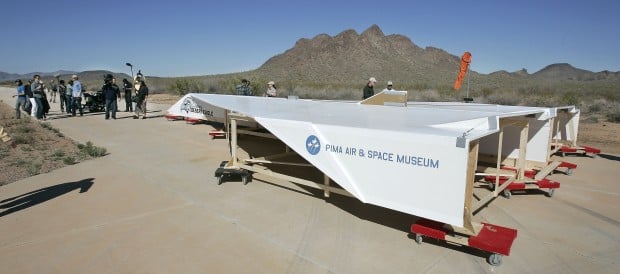
The Pima Air & Space Museum, which has been preserving the history of flight since 1976, decided to make some history of its own Wednesday by flying the largest paper airplane ever built.
It discovered how hard making history is.
Art Thompson, who designed the 45-foot-long, 800-pound paper plane, identified the possible weak point shortly after the plane was dollied into place on a private airstrip east of Eloy. "Our biggest problem is getting it off the ground," Thompson said.
Indeed, when the "Great Paper Airplane Project" team did a test lift with a crane, the wings of "Arturo's Desert Eagle" began to fold and the fuselage buckled.
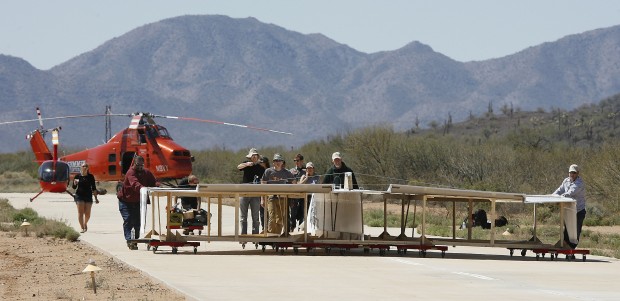
It wasn't ready to withstand being lifted to 4,500 feet with the prop wash of a huge Sikorsky helicopter beating down on it.
They wheeled it back to the tent hangar for repairs, hoping a sandwich patch on the fuselage and a more widely dispersed lifting point would solve the problem.
People are also reading…
"I'm not giving up yet," said Yvonne Morris, the museum's executive director, who said crashes and catastrophes were always a possibility. "We don't get anywhere if we don't try," she said.
By one measure, the program is already a success, Morris said.
The goal of the project, in addition to generating publicity for the museum and its supporting foundation, was to "inspire kids to pursue careers in science and engineering."
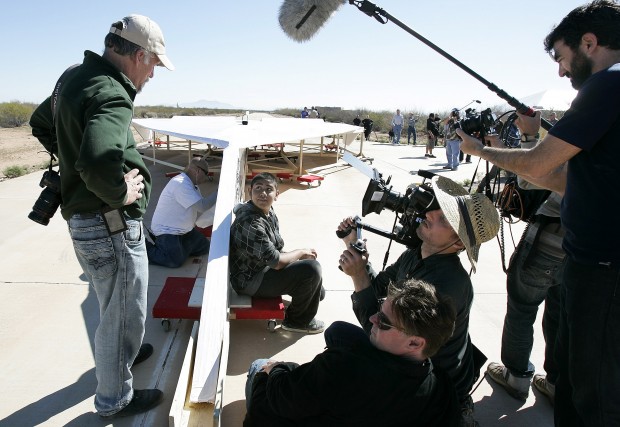
Arturo Valdenegro, whose much smaller airplane inspired the design of the big one, is already hooked.
Valdenegro, 12, a seventh-grader at Santa Cruz Catholic School, won the honor of working with Thompson on the plane's design by beating out 150 other Tucson-area students in a paper-plane competition at the museum in January.
Valdenegro said his teacher, Jeremy Moreno, was teaching the class about aerodynamics when he mentioned the contest.
Valdenegro went home, looked it up on the Web and began folding sheets of paper into test models, perfecting the design until he could routinely fly his planes about 75 feet.
Valdenegro's strategy was to make a tight, heavy nose that he could heave a long distance, rather than going for glide.
His mom said folding paper comes naturally to Arturo. He has been making intricate objects from folded paper since he was about 7, she said. He recently made a "Fighting Irish" leprechaun mascot for teacher Moreno, who is a Notre Dame graduate.
After winning the flight contest in January, Valdenegro was flown to Los Angeles, where he consulted with Thompson, who formerly worked on the B-2 Stealth bomber for Northrop Grumman and for NASA and the U.S. Air Force, on the design of the bigger model.
Valdenegro's goal in life was altered. "I want to be an engineer - kind of like what Art does," he said.
Valdenegro, who witnessed a crash during a test flight of a 15-foot model, was prepared for the worst.
He told a film crew documenting the day that a crash is always a possibility in a test flight. "You can always make another one," he said.
Late in the day, Arturo's Desert Eagle flew, lifted not from the midsection but from the nose.
The craft made it to about 4,000 feet before afternoon winds began to buffet it and endanger the helicopter to which it was tethered, said Tim Vimmerstedt, spokesman for the museum.
Helicopter pilot Aaron Fitzgerald cut the paper airplane loose and it leveled out and flew - for about six seconds - before crashing into the desert.
"For several shining moments, our huge, beautiful, silly, hubristic 45-foot paper airplane soared," Vimmerstedt wrote on the project website.
"Our biggest problem is getting it off the ground."
Art Thompson, airplane designer
DID YOU KNOW?
Pima Air & Space Museum, 6000 E. Valencia Road, says it is one of the largest air and space museums in the world, and the largest non-government-funded aviation museum.
Contact reporter Tom Beal at tbeal@azstarnet.com or 573-4158.


