

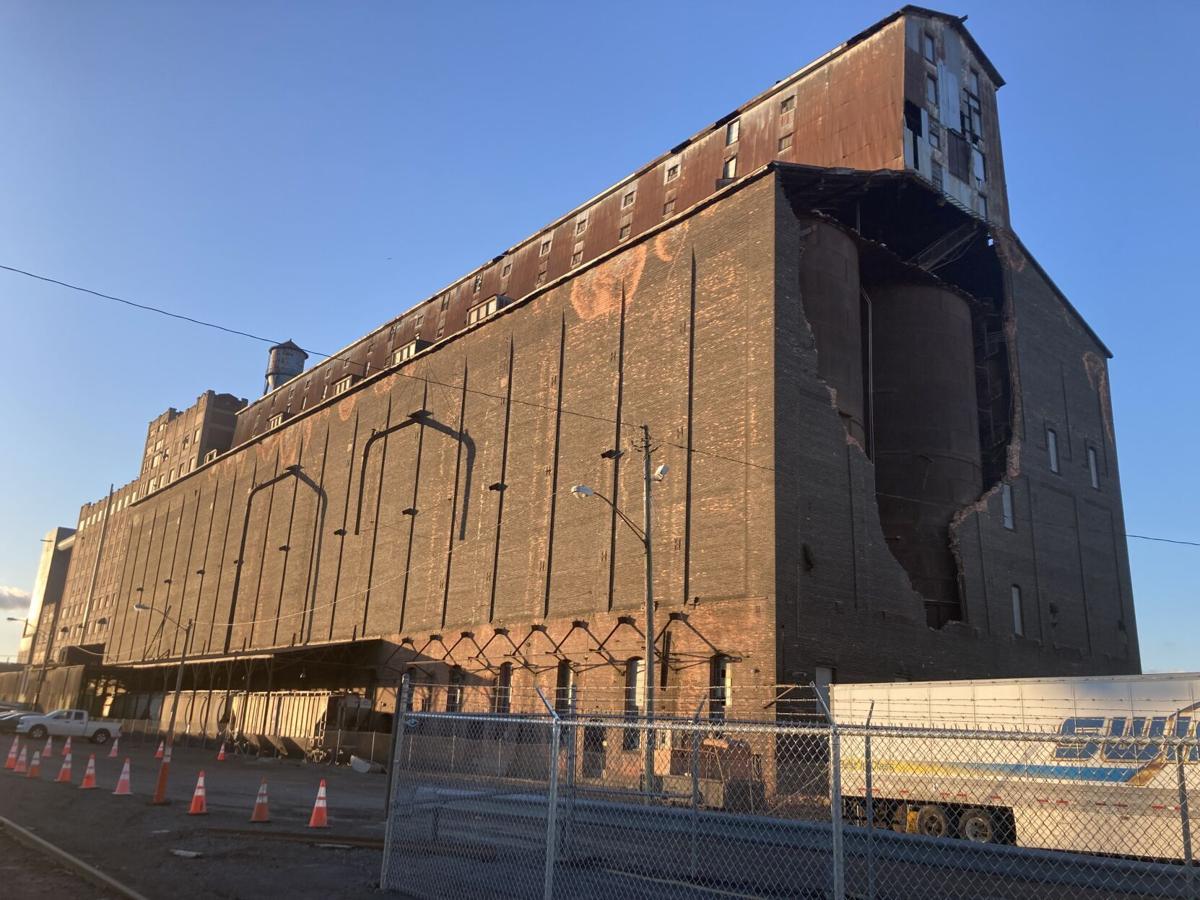
Buffalo's inspections commissioner ordered the emergency demolition of the weather-damaged Great Northern grain elevator.
But even as the commissioner announced that decision Friday, Mayor Byron Brown appealed to the historic grain elevator's owner, Archer Daniels Midland, to save as much of the structure as possible.
"I am asking ADM to quickly consider preserving all or a portion of the structure because of the historic significance we know exists," Brown said.
After last Saturday's windstorm damaged the structure, ADM asked for the city's permission to demolish it.
The order to demolish the structure from James Comerford, commissioner of the Department of Permit and Inspection Services, came as a union local asked the city to delay a decision so it could explore buying and repairing the property. The demolition order prompted an outcry from preservationists and the urging by Rep. Brian Higgins for the city to force ADM to repair the structure.
People are also reading…
"We determined the building is not safe and have given the order of an emergency declaration to ADM to tear the building down," Comerford said.

The City of Buffalo landmark was built in 1897 and operated for nearly a century. Saturday's windstorm tore a hole in the northern wall, but the grain elevator is not in danger of collapse.
Given the demolition order, why would ADM agree to the mayor's appeal to save the grain elevator?
"I don't know what they're going to do," Brown said. "They are aware of the public requests to salvage the structure."
Brown said ADM has "the resources and means to consider preservation if they want to."
Higgins said he is "disappointed" by the city's demolition decision.
"I think it rewards ADM's negligence and their indifference toward our community," Higgins said.
"My Washington and Buffalo folks will try to come up with something that has the goal of buying a period of time in which we can make a rational decision," he said.
The reaction from preservationists was swift.
"It's an outrage and unnecessary," said Tim Tielman, executive director of the Campaign for Greater Buffalo. "Architects and engineers have told us there is no need for an emergency demolition."
Tielman said he has notified the city that the Campaign for Greater Buffalo will seek a temporary restraining order to halt the demolition.
The city has the power to require an owner to make emergency repairs, and "we can't think of a better application of that legal standard than in one of the most unique structures on North America," said Jessie Fisher, executive director of Preservation Buffalo Niagara.
"Buffalo is a city that is known for its grain elevators and historic architecture," she said. "We have the legal mechanisms to protect them. The fact we consistently fail to protect what makes us special and important is a huge disappointment."
Concern for public safety
Comerford said he reached his decision after reviewing the building's exterior after a drone inspection on Wednesday.
A large hole in the flat brick northern wall exposes large steel bins, posing a safety hazard, including to workers in its flour mill next door, ADM said.
"We're very nervous about other parts of the building coming down," Comerford said. "The wall is very weak right now."
Comerford noted stress cracks in the brick wall on the eastern wall facing the street, and corrugated metal from the building landed on the guard house and by Wonder Coffeehouse across the street.
"I'm not a seer. I can't predict when a wall is going to come down," he said. "My main concern is the public safety. There are over 100 people employed at ADM and over 400 at General Mills."
ADM sought to demolish the Great Northern in 1996, three years after acquiring the structure that was locally landmarked in 1990 and again in 2003.
Comerford said the company again approached him last year to see if he would grant an emergency demolition. He said he declined.
Comerford said the building was never written up for any violations in the 31 years it has been landmarked until last weekend, despite visible signs of minimal maintenance.
"We never had one complaint on that building," Comerford said.
'Bringing it back to life'
Before news of the demolition permit, a 600-member labor union had asked the Brown administration to hold off making a decision.
Bakery, Confectionery, Tobacco Workers and Grain Millers Local 36G wants to explore the feasibility of reusing the structure as a union hall, credit union office and public museum.
“This building represents a profound part of Buffalo’s place as a center of grain milling, and it's the last of the brick box-style elevators that originated here in Buffalo," said Anthony Barker, president of Local 36G.
Flour mill workers are among those represented by the local.
"We would love to be part of bringing it back to life for a new use to serve Buffalo’s future," Barker said. "We wouldn’t be able to do it on our own, but with the right community support, we think we can be part of the solution for saving this part of Buffalo’s history for future generations.”
A message to Chicago-based ADM's corporate headquarters seeking a response was not returned.
The Great Northern, 250 Ganson St., was the largest grain elevator in the world when built in 1897.
The local needs time to evaluate the building and is already in touch with architects, Barker said.
"We are going to explore every avenue," Barker said. "Our roots are there. It would be great to own a part of our history and have the building functioning in some capacity once again."
The building's sheer size – it's 400 feet long, 120 feet wide and 165 feet tall – is challenging but also presents opportunities, Barker said.
Replacing the north wall with glass to reveal the large steel bins is a possibility, he said.
Barker said the building needs a lot of work. ADM's maintenance of the Great Northern when he worked there, Barker said, was "mainly anchoring down any loose roofing panels."
He's not worried about the hole in the wall.
"There was a large hole in 1907, ten years after being built, and it was repaired," he said.
Barker said workers in the flour mill don't believe they are threatened by the damaged grain elevator.
"No, not at all," he said. "If they were in danger, ADM would shut the mill down and transfer the work to another facility in the region."
Mark Sommer covers preservation, development, the waterfront, culture and more. He's also a former arts editor at The News.


