

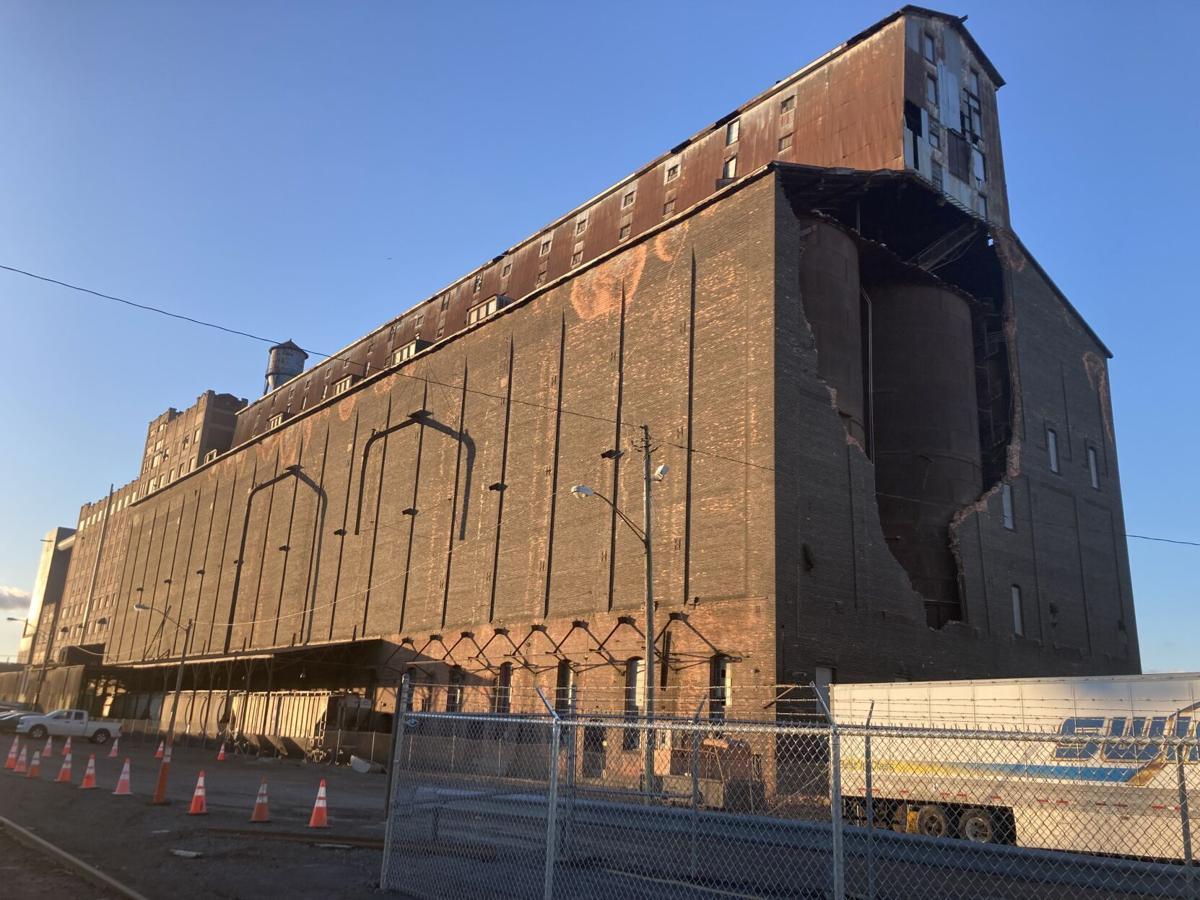
Archer Daniels Midland called Tuesday for demolition of the historic Great Northern grain elevator after it was damaged in Saturday's windstorm.
Rep. Brian Higgins said minutes later that it shouldn't happen, and he called on the City of Buffalo to require the Chicago-based commodities giant to make the necessary repairs.
"They should hold firm and hold ADM to what their responsibilities are as a property owner with a significant historic designation," Higgins said.
ADM, in a statement, said the large hole in the flat brick northern wall, exposing large steel bins, posed a safety hazard, including to workers in its flour mill next door.
"The structure suffered substantial and extensive damage from the wind and storms over the weekend, and now poses significant safety concerns on-site and at adjacent properties and roadways," ADM spokesperson Jackie Anderson said.
People are also reading…

The City of Buffalo landmark was built in 1897 and operated for nearly a century. Saturday's windstorm tore a hole in the northern wall, but the grain elevator is not in danger of collapse.
"Our primary concern is always the safety of the public, our neighbor and our employees," Anderson added. "Under the circumstances, we have submitted an emergency demolition application to the city."
Higgins said the storm gave ADM a pretense to demolish a building they've never wanted, even though the company knowingly purchased the building three years after the city designated it a local landmark.
ADM tried to demolish the Great Northern, at 250 Ganson St., in 1996 and again in 2003.
"This is a great opportunity for ADM to do what they've wanted to do for three decades," Higgins said.
The demolition application cited a recent engineer and others over the years who have voiced concerns that the structure is unstable and a safety hazard.
"All of the engineers have concluded that the structure was not designed or built to withstand what are now understood to be wind loads in its location, and that there is no safe or feasible way to remedy those design deficiencies," the application said.
"The brick exterior walls are far too high, too thin and are unsupported," it said. "And because the building is over 120 years old, the mortar throughout has degraded. In addition, the corrugated panel sheeting on the cupola is corroding and pieces are being periodically blown off the structure by the wind, causing potentially life-threatening debris falls.
"The unavoidable conclusion is that the only way to protect the public from the dangers of an inevitable further catastrophic collapse, or the ongoing scattering of debris being blown off the structure by high winds, would be a safe and immediate demolition."
The Great Northern, which began operation in 1897 and was last used in 1981, suffered a similar-sized hole in the north wall in 1907 from 84 mph winds that was safely repaired, according to the Buffalo Courier-Express.
The grain elevator is celebrated by grain elevator enthusiasts and preservationists for being a rare steel-bin elevator and the only brick-box elevator believed to be standing. It once was the largest grain elevator in the country.
"There is no justification for taking down the steel bins, the steel framework or the roof, or much of the brick walls," said Tim Tielman, executive director of Campaign for Greater Buffalo.
Tielman, who has written about the city's grain elevators, said the brick wall was weather-protective sheathing and the damage to it doesn't threaten the building's structural integrity.
"The brick doesn't support the elevator structurally," he said. "The steel bins support themselves, and they and the framework are structurally independent, so the elevator itself is in no danger of collapse."
Tielman said he hopes the city will use its own review process for historic properties in considering the demolition request.
"There has to be time for independent evaluations of this to happen, which is why the Preservation Board review process exists," Tielman said.
ADM said in the statement that it would "look for ways to preserve the legacy of the structure, such as donating artifacts to a local museum."
But Higgins said ADM should take advantage of historic tax credits and other resources available to the company to make the necessary repairs.
"They have to fix what they own, and what they own right now is a liability," Higgins said. "That liability has to be repaired."
Jessie Fisher, executive director of Preservation Buffalo Niagara, said the demolition of the Great Northern would be a terrible mistake.
"The grain elevators are one of Buffalo's key defining characteristics, and the Great Northern is completely unique," said Fisher, co-author of "Reconsidering Concrete Atlantis," a publication about grain elevators.
Repeated requests to speak with Jim Comerford, Buffalo's commissioner of Inspections and Permits, went unheeded.
In the early evening, Mike DeGeorge, Mayor Byron Brown's spokesman, said in a statement that "Commissioner Comerford is reviewing the company's statement along with a drone inspection video to assess the extent of the damage."
Mark Sommer covers preservation, development, the waterfront, culture and more. He's also a former arts editor at The News.


