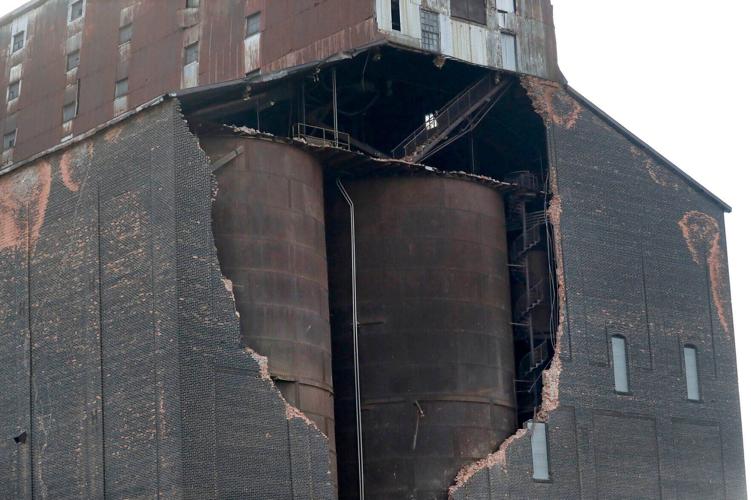
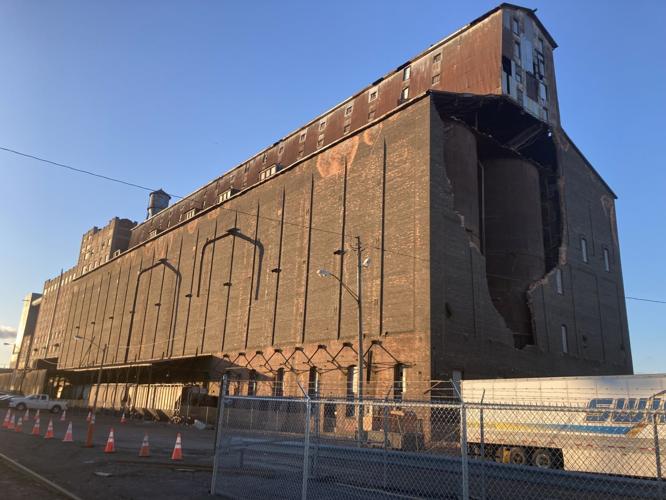
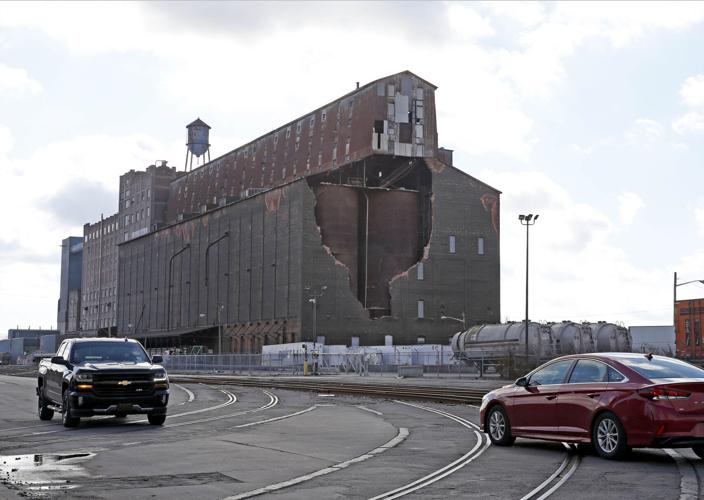
The Brown administration is planning a drone inspection Monday to evaluate damage done to the historic Great Northern grain elevator after powerful winds Saturday tore a large hole in the northern wall, knocking out a significant part of the flat brick shell that covers the building's steel bins.
The grain elevator, owned by ADM Milling Co., a division of commodities giant Archers Daniel Midland at 250 Ganson St., opened for business in 1897 and was last used in 1981. It sits next to a flour mill that was added later and is still in operation.
The Great Northern is celebrated by elevator enthusiasts and preservationists for being a rare steel-bin elevator and the only brick-box elevator believed to be standing. It once was the largest grain elevator in the country.
"To some it's just a hulking brick building," said Gwen Howard, who chairs the Buffalo Preservation Board. "But it is critically important in terms of the architectural legacy of our community."
People are also reading…

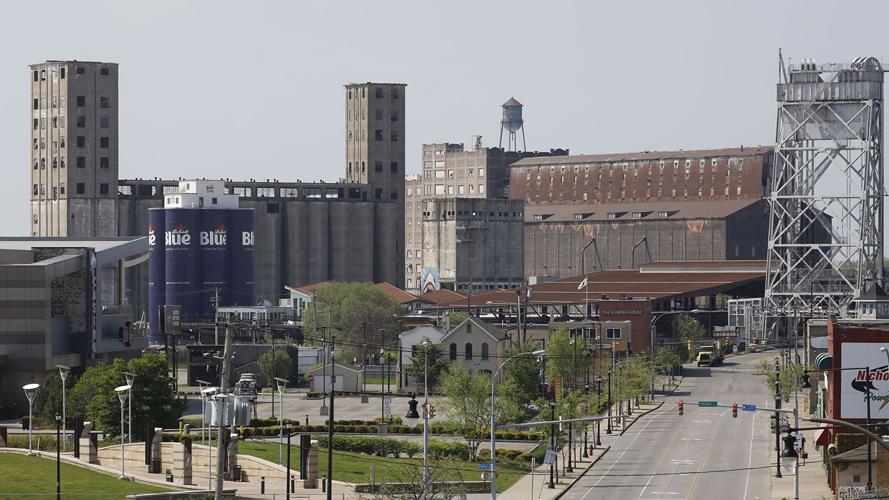
Grain elevators, including the Great Northern (center right), which was the largest in the world when it was built in 1897, fill the skyline at the end of Michigan Street near the Seneca Buffalo Creek Casino. Photo taken May 31, 2020.
A similar-sized hole in the north wall from high winds occurred once before – on Jan. 20, 1907, from 84-mile-per-hour gusts, and was safely rebuilt. That occurred during a period when the grain elevator was known as the Mutual Elevator, according to the former Buffalo Courier-Express.
James Comerford, who heads the city's Department of Inspections and Permits, said in a statement Sunday that "we were out there yesterday and today. We are having a drone inspection tomorrow to determine the extent of the damage."
Tim Tielman, who edited the 1990 book "Buffalo's Waterfront: A Guide" that highlighted the grain elevators and wrote the landmark application when the Great Northern was locally landmarked, said the brick wall was weather-protective sheathing and the damage to it doesn't threaten the building's structural integrity.
"The brick doesn't support the elevator structurally," Tielman said. "The steel bins support themselves, and they and the framework are structurally independent, so the elevator itself is in no danger of collapse."
The one-of-a-kind colossus was locally landmarked in April 1990 by the City of Buffalo in response to an attempt by Pillsbury Co. to tear it down. ADM acquired the building in 1993 and tried to have it demolished in 1996 and again in 2003. A spokesman for Illinois-based ADM did not return a message to comment on Sunday.
The Great Northern is considered eligible for listing on the National Register of Historic Places.
Any modification to the property needs to come before the Buffalo Preservation Board, with the exception of an emergency demolition, which could be ordered by the city's Department of Inspections and Permits.
It's up to that department to maintain vigilance on inspections and citations and then the court process, but with the office closed until Monday it wasn't possible to find out what the inspection record has been there.

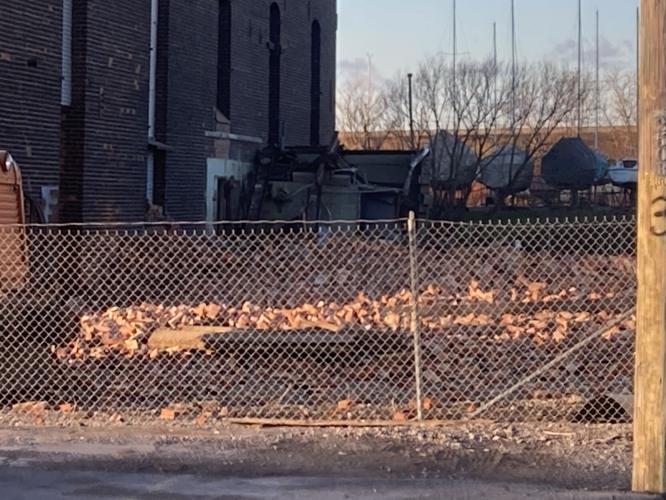
Bricks strewn from the Great Northern grain elevator after 70-mph winds battered the building.
"ADM bought the complex with full knowledge and eyes wide open that it was a City of Buffalo landmark," said Tielman, who is also executive director of the Campaign for Greater Buffalo. "They are aware of the rarity of the building and consequently that when it was built it was an American engineering marvel.
The City of Buffalo shared video of the damage caused by the windstorm on Saturday, Dec. 11, 2021. In the clip, Department of Public Works deputy commissioner Andy Rabb speaks on the cleanup of a tree that toppled on two houses on Lakeview Avenue in Buffalo. Main still photo taken by Mark Mulville/Buffalo News.
"They have a civic responsibility and they need to fix the building," Tielman said.
Howard, on the Preservation Board during her first go-around with the board when ADM tried to demolish it, said the demolition of the building would be a real loss.
"It's unique, the last of its kind and it set the stage for every other grain elevator that is a symbol of how we in Buffalo became who we are," she said.
Mark Sommer covers preservation, development, the waterfront, culture and more. He's also a former arts editor at The News.