

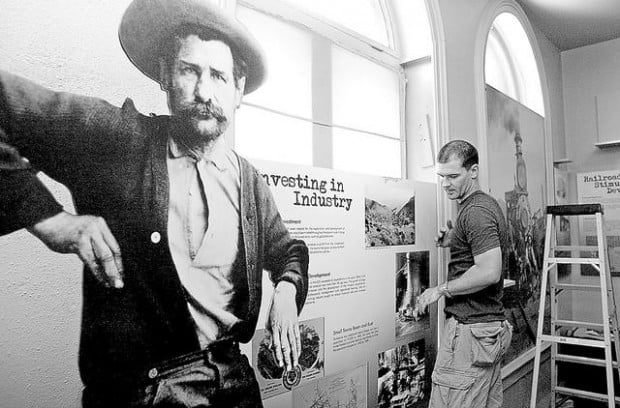
For the past few weeks, work has been feverish on a face-lift for the downstairs exhibit, "Bisbee: Urban Outpost on the Frontier," at the Bisbee Mining and Historical Museum.
Museum Director Carrie Gustavson has been waiting to bring the exhibit up to the same standards as the award-winning upstairs exhibit, "Digging In," which was accomplished through a partnership with the Smithsonian and funded with grants.
"The challenge has been to find the funding," Gustavson said.
But thanks to her efforts, a grant of $50,000 from the Arizona Office of Tourism's Rural Development Grant Program was awarded last October.
While most donors want to be a part of new endeavors, this grant allows for repair, maintenance and upgrade of existing facilities.
"This program helps with grants for rural sites that serve the tourism industry," Gustavson added.
People are also reading…
With the required match of $15,000 that came from museum admissions, the 18-year-old exhibit is getting a new color scheme, carpets, text panels and, "just for fun," creative interactive stations. The ideas for the interactive stations came from a group of future teachers who were students at the University of Arizona.
The walls have been painted the color of the antique blue-glass insulators that were mounted on Bisbee power poles.
The whole deportation history of Bisbee miners has been revamped and is now contained inside a mock-up boxcar that shows a brief video explaining the situation that affected 1,200 workers in 1917.
Gustavson was impressed with the work performed by Manuel Meniola of Scenic Industries on "Digging In," and she contracted with him and his team to handle "Urban Outpost."
To keep costs down, some things have been recycled, such as the larger mining photos of bygone days, and the story line that tells how Bisbee came to be America's largest copper town.
It took a group effort, though, to get all the information going in the revamped presentation. Board members played an important role in text editing, Gustavson said.
All that material contained in two large notebooks was handed off to Scenic's Todd West, who redesigned the text panels and all the displays.
Last year, around 23,000 people came through the museum. In years past, most of the visitors have been senior couples who enjoy the walk through Bisbee's history.
But this year, the museum is seeing an influx of families, Gustavson said.
Though the number of visitors is remaining relatively constant, families pay less for the children, which does hit the museum's bottom line. Looking on the bright side, though, she believes the more parents take their children and teens to museums, the more appreciation they will have for history and art.
Though a grand opening for the public has not been announced just yet, Gustavson said an opening for members of the museum's board of directors will take place Sept. 5.
Gustavson also has initiated work on an interactive station at the Lavender Pit that will involve informative panels explaining open-pit mining and current environmental issues. The Smithsonian also has a hand in that.
The center will address the benefits of copper and what one would give up to reduce copper demand and weighing the benefits of copper mining.
"If copper mining comes back to Bisbee, this station will explain what regulations have to followed. That will complete the whole visitor experience," Gustavson said.
The museum's next project is already in the works.
Attention is turning to cataloging, collection management and digitizing many old cassette tapes containing interviews with former mine workers.
It will require help from many volunteers to go through them all and transcribe them.
"There are 450 cassette tapes from the 1970s that contain an oral history of Bisbee. When that project is completed, we may look for more oral histories from residents to fill in some gaps," Gustavson added.


 Hotel on the rise at Tucson’s Uptown project


