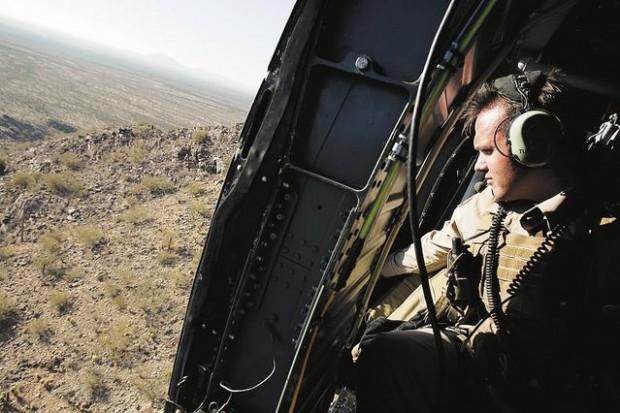
The radio call comes crackling into the headsets of four uniformed agents aboard a Black Hawk helicopter flying southwest of Tucson.
On a peak in the Patagonia Mountains near the Arizona-Mexico border southeast of Tucson, agents are calling for help to get confiscated bales of marijuana out of a remote area.
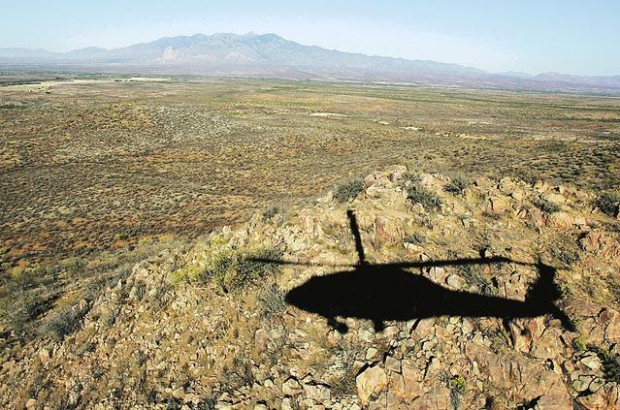
The helicopter crew has spent the past hour flying over rocky hills about 45 miles from Tucson, helping other Border Patrol agents search for bandits and marijuana.
Matt Bentson and Gavin Grisham, U.S. Customs and Border Protection Air and Marine helicopter pilots, radio to agents on the ground near them to make sure they don't need any more help. With an "all clear" from them, the pilots turn the powerful Black Hawk helicopter to the east and head toward the Patagonia Mountains.
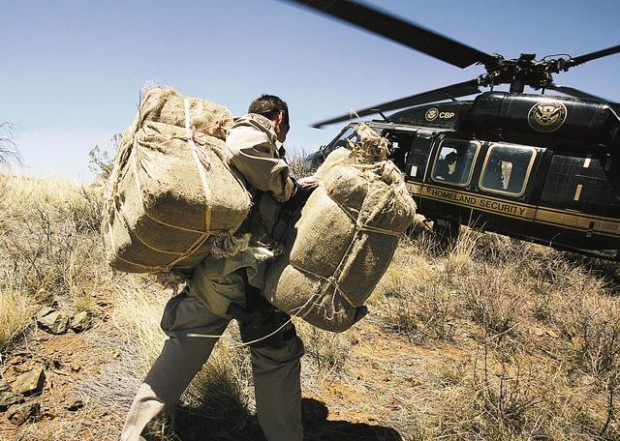
About 20 minutes later, the UH-60 Black Hawk has covered about 30 miles, and Grisham and Bentson are landing it on a slope on the 6,000-foot peak in the Soldier Basin area in the Patagonias. Abel Flores — an agent with the Border Patrol's Search, Trauma and Rescue team, known as Borstar — jumps out and helps three fellow agents haul six burlap bales of marijuana up the hill and onto the helicopter.
People are also reading…
The assistance with the bales of marijuana on this hot June day proves a big help to the agents who found the drugs hidden in brush about an hour earlier. The trio of agents had been following footprints since the night before as they hiked up the rugged mountain about six miles north of the border.
Without the helicopter, it would have been a long and arduous four-mile trek down to the nearest road. The helicopter flies the bundles, weighing a total of nearly 300 pounds, and one of the agents to the Nogales International Airport, where they drop them off.
Along Arizona's stretch of the U.S.-Mexico border — the busiest for illegal immigration, drug smuggling and border deaths — a fleet of helicopters and small planes flown daily by Customs and Border Protection Air and Marine pilots plays an important role in security, law enforcement and rescues.
"It's just a huge part of securing the border," said Jose A. Gonzalez, Border Patrol Tucson Sector spokesman. "These guys are too often the overlooked part of securing the border."
The Air and Marine Tucson branch is the busiest in the nation, said Lavon Duncan, Air and Marine operations supervisor in Tucson.
Even though the 262 miles of international border the branch covers — from the New Mexico-Arizona line to Yuma County — is a fraction of the total miles the agency patrols along the southern, northern and coastal borders, nearly one-third of all flight-hours logged by Air and Marine pilots nationally occur here, Duncan said.
The Sikorsky Black Hawk and Eurocopter AS-350 A-Star helicopters are two of the most commonly flown aircraft by the Air and Marine unit. With the ability to cover long distances quickly, the crews track down smugglers, find illegal immigrants and look for illegal border crossers in distress, especially during the summer.
In addition to a pilot and co-pilot, one or two other agents usually are aboard the copter to observe and get out to help if needed. In the summer, Borstar agents often are aboard.
The Arizona fleet also includes a Hughes OH-6 helicopter, a Cessna C-550 Citation interceptor plane, a Cessna C-210 surveillance plane, a Piper PA-18 Super Cub observation plane and the MQ-9 Predator B unmanned aircraft system operated out of Sierra Vista.
Three-way assistance
The Air and Marine helicopters and planes help the border-security effort in three main ways, Border Patrol officials say:
● Speed. The Black Hawk and A-Star helicopters are capable of flying as fast as 170 mph and can stay in the air for four hours or more. That allows them to cover large swaths of terrain otherwise impossible for agents to cover on the ground.
The helicopters can refuel at stations throughout the region to extend missions even longer.
"The area is so wide, and there are some places that vehicles can only get to a certain point," Gonzalez said. "The speed in which they can get to those types of areas helps."
Added Air and Marine pilot Bentson: "We can hop around and respond to multiple locations in one patrol."
● Eyes in the sky. The crews in the helicopters get a completely different angle from above, which often helps agents discover hidden people and drugs. The copters often are used in search-and-rescue missions because their crews can scan more ground, and they have powerful spotlights to use at night. The helicopters also can be used to provide security to agents on the ground during violent incidents, Gonzalez said.
"They have got this vantage point that you cannot get from the ground," Gonzalez said. "They can see if somebody is coming or running away."
● Deterrence. Smugglers and illegal immigrants tend to surrender when they see the helicopter above, especially the menacing Black Hawk, he said.
"The Black Hawk is an intimidating aircraft," Bentson said.
Air and Marine pilots and air interdiction agents get involved in a little bit of everything on the border, and like agents on the ground, they can quickly transition from enforcement duties to rescue operations.
Air and Marine's primary purpose is protect the country and prevent acts of terrorism. Secondly, the goal is to stop illegal entries of people, drugs and other contraband.
Homeland Security officials formed the Air and Marine branch in October 2005, when they consolidated all helicopters, planes and pilots in Customs and Border Protection. The next year, they did the same with their marine vessels and sailors, creating the agency that exists today.
Air and Marine now has more than 700 pilots and 267 aircraft of 20 types, figures show. It's the largest law-enforcement air force in the world, the agency says.
Diverse missions
A recent Black Hawk flight in the desert west of Tucson demonstrated the diverse missions the Black Hawk crews perform.
After taking off in the late afternoon from Davis-Monthan Air Force Base in Tucson, Air and Marine pilots Ron Moerkerken and Trent Thomas are peering out the windows of the Black Hawk as they maneuver the helicopter within mere feet of a rocky hill about 70 miles southwest of Tucson.
They are searching for a pair of suspected illegal immigrant guides, known as "coyotes," who fled when ground agents caught a group of illegal immigrants.
Richard Van Heemst, a veteran Air and Marine air interdiction agent, sits in the left gunner seat, stretching his head out an open window.
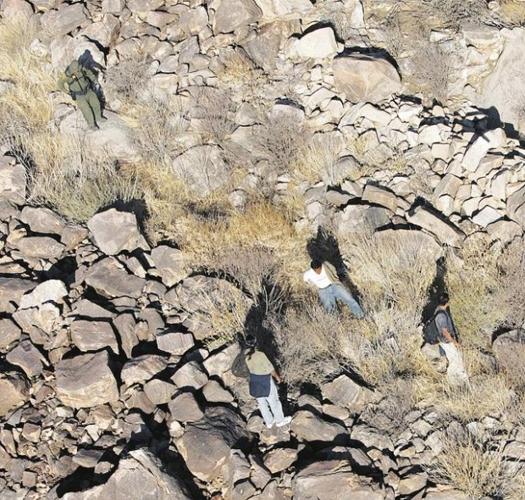
"There, under the large boulder," Van Heemst says into the microphone in his helmet. He has spotted two men hiding.
The illegal immigrants cover their faces to protect themselves from the helicopter's down-draft. The crew radios to Border Patrol agents on the ground and directs them to the hill where the Black Hawk hovers.
The agents apprehend the two illegal immigrants and walk them down to their vehicles.
As the Black Hawk flies away, a dispatcher instructs the crew to head northwest to help search for illegal immigrants in distress in the Gila Bend area south of Interstate 8. After landing in Why to refuel at the Border Patrol station and get more information about whom they are looking for, the crew hops back in the Black Hawk and heads northwest as the sun sets.
Once in the search area, Moerkerken and Thomas fly the Black Hawk back and forth for more than two hours on the Barry M. Goldwater Air Force Range.
Van Heemst controls a giant spotlight that lights up the ground. Borstar agent Perry Dickinson peers out a window and talks on a radio with agents searching on the ground.
Without some way of seeking help — such as a signal fire — by the people in distress, it's going to be tough to find them, Van Heemst says.
He's right.
Despite their extensive efforts, they don't find anything. By the time the crew flies back to Tucson at about 9:30 p.m., it has come to the conclusion that the people in distress were either drug smugglers who don't want to be found or they have died.
The next morning — after a search that started the day before and included three helicopters, 24 Border Patrol agents, all-terrain vehicles and a horse patrol — an agent finds one man dead about a half-mile south of I-8, west of Gila Bend. The man, from Sinaloa, Mexico, probably was walking north while the Black Hawk searched farther south the night before, said Gonzalez, the Border Patrol spokesman.
The six others in the group of admitted drug runners were caught farther west on the Goldwater Range southeast of Dateland in good condition later that day, Gonzalez said.
The agents who found them? A crew aboard an Air and Marine helicopter.
Did you know
The Department of Homeland Security's Customs and Border Protection agency has three branches in its mission to stop terrorism, illegal immigration and drug trafficking:
• Border Patrol: Agents patrol areas of the border between the ports of entry.
• Field Operations (commonly known as Customs and Border Protection): Officers work at official ports of entry.
• Air and Marine: Pilots in aircraft such as helicopters, planes and unmanned aircraft systems fly missions in support of border security efforts. Mariners in vessels do the same on rivers, lakes and along coastal borders.
Source: Department of Homeland Security