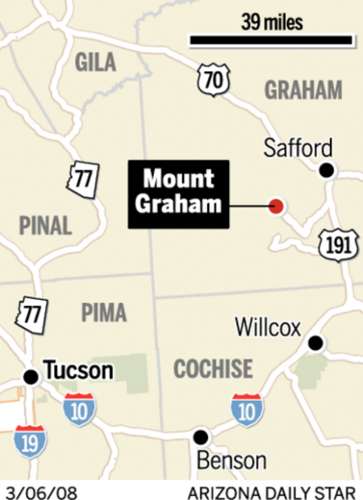
Mount Graham's newly completed Large Binocular Telescope is now the most powerful optical telescope on — or off — Earth.
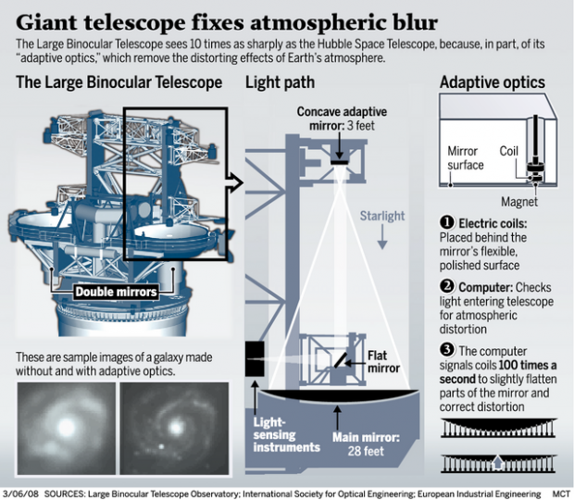
With the combined resolution power of its two mirrors — cast and polished at the University of Arizona's Steward Observatory Mirror Lab — and its adaptive optics, LBT experts say it has 10 times the resolution of the Hubble Space Telescope.
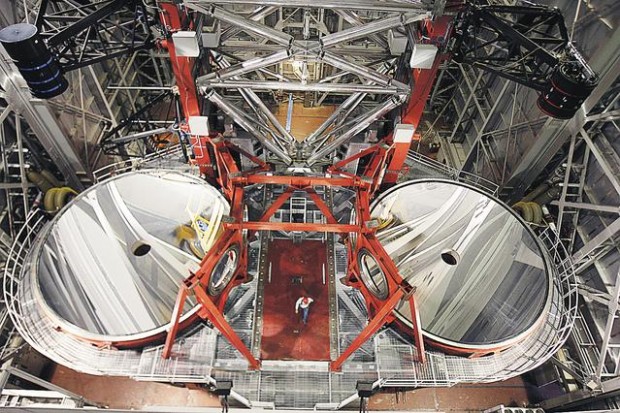
The LBT, the $120 million crown jewel of the UA's often-controversial and hard-fought Mount Graham International Observatory, is now doing real science with both of its 8.4-meter-diameter mirrors That's just under 28 feet.
There are massively powerful telescopes that operate in other parts of the spectrum — from low-frequency radio waves to far beyond visible light. But, for now, its builders, backers and users say, LBT is the act to beat.
"For five to 10 years, we will be in the business of taking the sharpest pictures from the ground," astronomer Hans-Walter Rix said Tuesday night just after the sun set atop 10,500-foot Emerald Peak and astronomers and technicians waded into a night of observations.
People are also reading…
Rix is on the LBT Corp.'s board of directors, is director of the Max Planck Institute for Astronomy in Heidelberg, Germany, and is a working astronomer who has a keen self-interest in this powerful scope because he specializes in galaxy formation and "the big black holes in the center of galaxies."
"I need to look at incredibly high-resolution because galaxies are always farther away than you would like. Why do we have black holes in the middle of galaxies and why do they grow? How does it work?"
He also represents a group of German institutions that have a 25 percent share of the truly international LBT. Another group, made up of Italian institutions, has a 25 percent share, as do Arizona's three state universities. Ohio State University has a 12.5 percent share, as does Tucson-based Research Corp., which includes the universities of Notre Dame, Minnesota and Virginia in its share.
Viewing time is apportioned among the groups based on their share size. And each group has its own committee to divvy up its share among group members.
But while "first light" with both mirrors has been achieved two decades after the struggle to build the LBT began, the work is not over.
"See, telescopes are never finished," says John Hill of the Steward Observatory and technical director of the LBT.
First light, when the LBT first "looked" into space as a completed two-mirror telescope, occurred in December or January, depending on who is counting. First light for the one-eyed version of the LBT, when it was actually the large monocular telescope, took place in late 2005.
In fact, this telescope will not be complete for many years, as new instruments — cameras, spectrographs and other devices — are added to analyze the images seen by the telescope.
The first of many instruments, the prime focus digital camera, is up and running but still being dialed in. Another instrument, a German spectrograph named Lucifer, is expected to be hooked up to the LBT later this year.
Eventually, there may be a dozen or more instruments — think of them as specialized accessories — that can be attached to the LBT.
At roughly $85,000 an hour for viewing time, being able to rapidly switch attachments is a big deal, say Rix and Hill.
Rix said the hourly rate is not billed to astronomers using the telescope, but is based on the cost of building the scope, its instruments and operation costs for 10 years and dividing that by the number of viewing hours available. While it isn't billed, he said it is used to make astronomers and observers understand they must be well-prepared and work efficiently.
Another time-saving feature is the ability to resurface the telescope's mirrors in place. Most mirrors have to be removed every couple of years and put in a separate chamber to have their reflective aluminum surface coatings replaced.
Recoating a mirror is no laughing matter when it involves two 8.4-meter mirrors, each weighing many tons and costing roughly $15 million .
The routine for Southern Arizona's observatories is to do the recoating during the summer rainy season, when night viewing is diminished or impossible because of rain and lightning.
Cleaning the mirrors is also a serious chore. The LBT's mirrors already look like they were driven down a Florida interstate in the summer. They're spattered with bugs, bird poop and oil.
The mirrors can be cleaned between recoatings, but it's no small task, says telescope manager John Little.
Dust can be removed by spraying the mirrors with chilled carbon dioxide, which comes out of the nozzle as snow and evaporates. And Little said there are special liquids that can be used to safely clean off the other substances.
To point the telescope from straight up to either horizon, the mirrors ride in a huge metal frame supported by an oil bearing track on either side. And, despite the wall-to-wall high-technology employed in the LBT, Little said there's still no way to keep some of the oil from winding up on the floor.
As part of the new design, which attempts to minimize the distorting effects of temperature changes and differentials between the telescope's parts and the cold night air, nearly the entire top of the 180-foot tall building folds open up for viewing. It's a departure from what one astronomer called the old "peep-show astronomy" in which only a slit opened in the dome of an observatory.
The entire top of the huge building turns, remarkably quickly and silently, to rotate the mirrors 360 degrees.
Building the LBT was an uphill battle for the UA and partners. Besides the trend of funding space telescopes (operating outside the Earth's distorting atmosphere) and on much higher mountaintops in Chile (minimizing the Earth's distorting atmosphere), there were battles with environmentalists trying to protect the endangered Mount Graham red squirrel's habitat and charges that the observatory was being built on a sacred Indian site.
More telescopes were planned for the site, but just three have been built: The LBT, the Heinrich-Hertz Submillimeter Telescope and the VATT (Vatican Advanced Technology Telescope — aka "The Pope Scope").
All the statistics aside, many of the astronomers affiliated with the LBT see it first and foremost as a time machine — it has the ability to look farther out, and therefore further back in time, than lesser telescopes.
"We're looking back at the time when the very first objects in the universe were lighting up," said LBT Director Richard Green, a former director of Kitt Peak National Observatory and an astronomer specializing in quasars and massive black holes.
"It's like a searchlight cutting through the fog, the mist of dispersed of gas at the time (just after the big bang)," Green said.
It is among the goals of the LBT to search for the most distant quasars in the universe, and he said Arizona astronomers have already used some of their viewing time to "search for the unique pattern of colors that these high-red- shift quasars have."
Green said the LBT's power may call into question some things thought to be known.
"If we start to find a lot of these very large quasars, we get into sort of a pickle because the time scales are too short to form them in the way that we understand. There wasn't enough time to put that much mass into a black hole because the universe was so young," he said.
Stay tuned.
On StarNet: To see more images, as well as a video of the telescope, check out the online version of this story at azstarnet.com/science