For the next 20 years, the path to continued subdivision growth on the edges of Tucson and Phoenix and parts of Pinal County now appears to be clear, as the state is likely to approve a plan to replenish groundwater supplies pumped out to serve that growth.
But for 80 years after that, the prospect for continued approvals of the suburban-growth water plan is murkier. That’s due in large part to likely short- and long-term cuts to Colorado River supplies that until now have been the backstop supply used to support suburban growth in Southern and Central Arizona.
Officials who oversee groundwater replenishment obligations point to other potential supplies as an alternative to Colorado River water, including a complex system of long-term storage credits they have built up. But if they can’t continue acquiring the credits and can’t find alternative supplies, future subdivision approvals could grind to a halt.
People are also reading…
At issue is the plan of operations for the Central Arizona Groundwater Replenishment District. It’s a three-county agency operating as part of the overall Central Arizona Project canal system. By state law, it must win approval of its plan from the Arizona Department of Water Resources every 10 years, to show it meets an earlier law requiring the replenishment of aquifers for all groundwater pumped to serve new homes.
The plan allows growth to continue in fringe suburban areas that have no available renewable supplies from CAP.
Its most recent version shows district officials expect to have enough water supplies available through 2044 to replace groundwater that’s pumped to serve subdivisions lying as far south as Green Valley to as far north as SaddleBrooke in the Tucson area.
In all, 134 subdivisions within the Tucson metro area, which includes southern Pinal County, depend on the district to replenish aquifers to compensate what’s pumped to serve their homeowners, district records show.
The plan contains similar findings for the availability of groundwater replenishment supplies for the Phoenix area and Pinal County.
Even one of the district’s fiercest critics, water researcher and former state water chief Kathleen Ferris, said she believes it’s likely the Arizona Department of Water Resources will approve the plan.
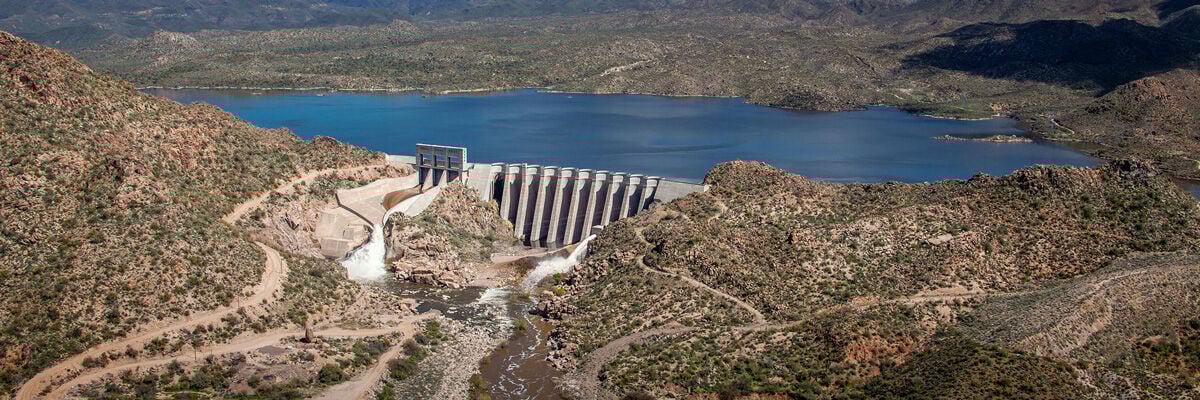
Many water agencies including the Central Arizona Project are interested in a proposal to build a newer, taller Bartlett Dam on the Verde River northeast of Phoenix. The hope is that the bigger dam will store more water to support future growth across the state, particularly in the Phoenix area.
The ADWR held public hearings on the plan this past week and by law must decide on a new plan by the end of 2025, when the district’s current plan expires. If the department doesn’t approve a new plan, the district can’t take on any additional replenishment obligations and therefore can’t support any additional subdivision growth. That would mean no new homes could be built that depend on groundwater.
Relying on credits that allow pumping elsewhere
But unlike previous plans, this one doesn’t rely mostly on renewable CAP supplies for replenishment. Unless the district can find and purchase other water supplies besides CAP, nearly 40% of the water the district will use to compensate for pumping over the next two decades could come from assets far less visible and unknown to most people outside the rarefied world of water policy wonks.
By 2044, as the amount of water the district is obligated to replenish more than doubles compared to today, due to continued growth, the district could be drawing on these assets to meet at least half its obligations.
They’re called long-term storage credits. Put simply, the credits represent water that has already been recharged into an aquifer by its owner. Most commonly, the water just sits there and is never pumped out.
But its very presence in the aquifer typically gives the holder of the credits the right to pump an equal amount of groundwater elsewhere to serve subdivisions, mines or other economic activities.
In the years after 2044, the three-county groundwater replenishment district could be drawing on its credits to meet even more of its replenishment obligations. That’s because as growth continues, its replenishment obligation will increase from about 40,000 acre-feet this year — enough to serve about 160,000 Tucson homes — to more than 85,000 acre-feet by 2044 and to about 104,000 by 2124.
But the district, unlike many other water suppliers, won’t be pumping out any other groundwater supplies despite its recharge activity. It will simply leave the replenished water in the ground and “extinguish” the credits. That means they will no longer exist once they’ve been applied to meet their obligations to replenish the water.
The supply of credits available to the district is plentiful — 1.4 million acre-feet that belong to the district and its parent agency, the Central Arizona Water Conservation District.
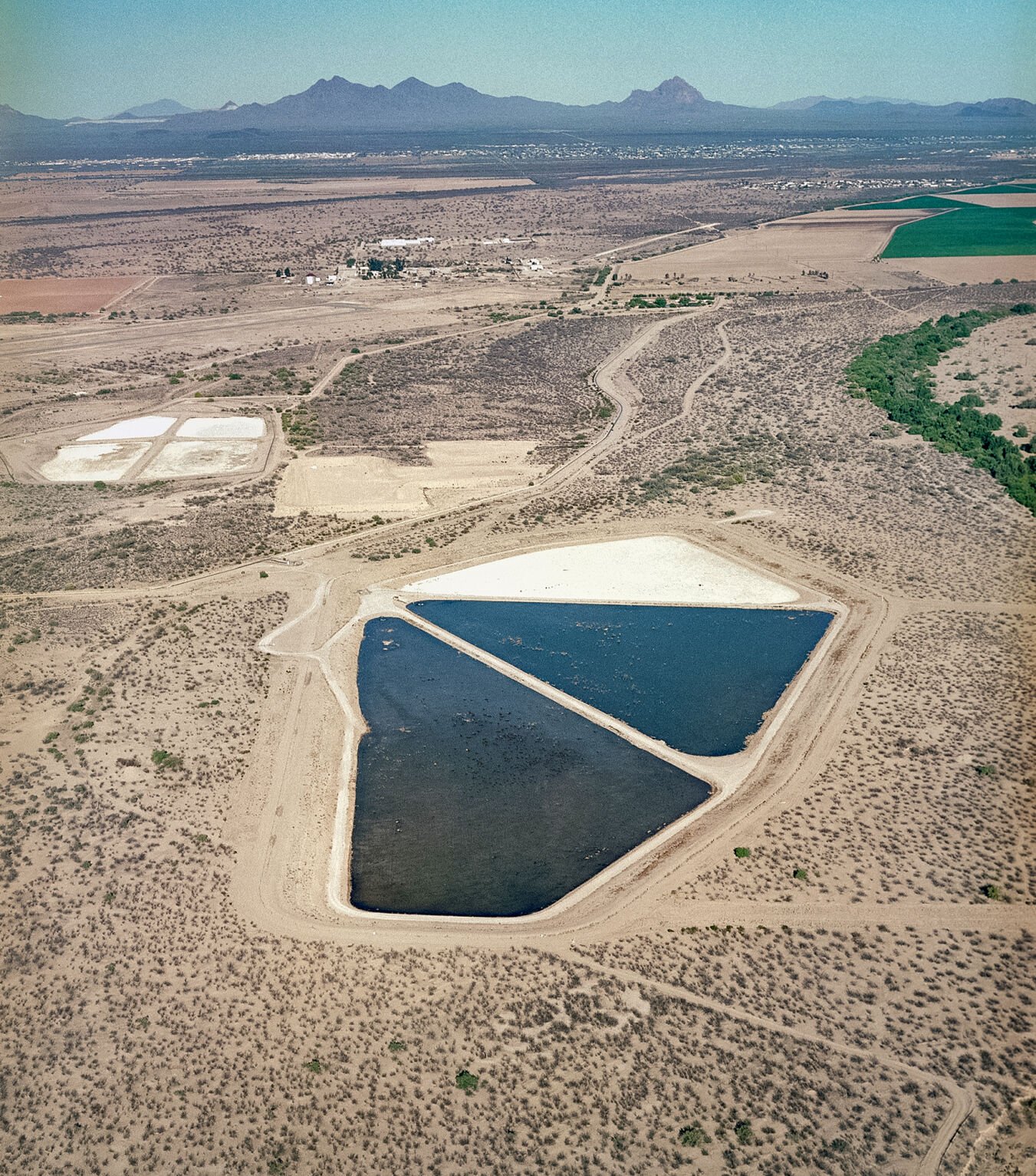
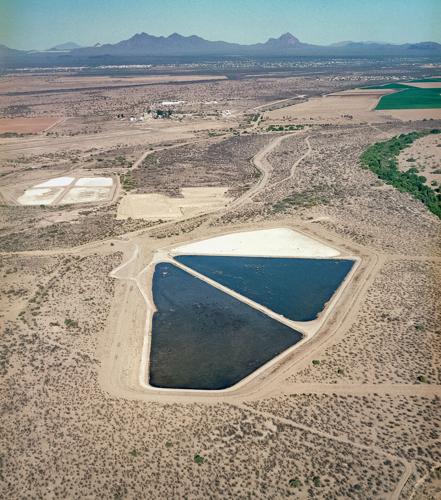
The Lower Santa Cruz River Project, a series of recharge basins where effluent and Central Arizona Project water are recharged for future use and storage. The three-county Central Arizona Groundwater Replenishment District recently purchased 4,500 long-term storage credits that were based on effluent that is being stored in this recharge project’s basins.
Statewide, about 14.5 million acre-feet of such credits exist, says a report from Arizona State University’s Kyl Center for Water Policy. That includes 550,000 acre-feet belonging to Tucson Water — or a little more than five years’ worth of Tucson’s annual drinking water use.
“The market for purchasing them is well-established, with predictable prices and administrative simplicity,” the district said in its proposed plan of operations.
Acquiring these credits in sites near where its members are pumping groundwater in excess of natural recharge makes the credits “an excellent fit” for meeting replenishment obligations, the district said.
Wants to buy other water supplies
But the credits are not infinite, and more important, unlike CAP supplies, they’re not renewable with each year’s run of the Colorado River. Once the district dips into credits to satisfy replenishment obligations, they’re gone.
Because of that, the district wants to buy other water supplies both for the short and long terms to prevent it from becoming too reliant on the credits, its current plan shows. That includes buying non-CAP supplies from water rights holders along the Colorado River; building a new, bigger dam on the Verde River to capture more water to serve growth; and importing pumped groundwater from rural groundwater basins in central and western Arizona.
Also in the mix is buying rights to treated sewage effluent produced by cities; buying still-unused CAP water from cities and tribes; and building a highly expensive plant to desalinate seawater from the Gulf of California or highly saline groundwater existing in parts of Arizona, including the Yuma and Buckeye areas.
In its proposed plan of operations, the groundwater replenishment district expresses strong confidence in its ability to keep acquiring new supplies to meet its replenishment obligations, noting the wide availability of credits and the broad array of potential supplies.
Outside experts such as Ferris and Sarah Porter, the Kyl Center’s director, are more skeptical, citing the growing competition for all future supplies, including credits, their increasing costs, and the enormous number of legal and environmental uncertainties involved in bringing in new supplies.
Where no one disagrees is that buying more credits or new supplies is going to grow increasingly expensive.
“People don’t necessarily want to accept the fact that water is going to be more expensive due to its scarcity and due to the increased bidding for it,” said Sharon Megdal, director of the University of Arizona’s Water Resources Research Center and a CAP board member for 12 years through 2020. “The fact water will cost more is a sure thing.”
But Megdal said she has no basis for saying the agency will ever fail to meet its legal obligation to replenish groundwater supplies.
“These public bodies, they don’t want to fail. There are terrible ramifications for them failing,” said Megdal. “I think they are out there trying to make deals and trying to be part of things. I can’t predict that things won’t be dicey in the future.
“They’re likely to meet their obligations. It’s how fast the obligation grows. They say they have enough for 2044. That’s less than 20 years from now.”
Ferris, however, said the challenges and potential water shortfalls facing the district over the next 20 years and beyond offer continued evidence backing her longstanding view that the state needs to halt its practice of supporting new growth with groundwater and turn exclusively to renewable supplies.
She and Porter have co-authored two papers, one published last May, arguing that the replenishment district’s practices are unsustainable or at least questioning their sustainability.
Because of expected competition from cities for long-term storage credits, the most likely place the district will be able to get them in the future is from speculators who can charge much higher prices, Ferris said.
“They’ve been confident from the get-go,” said Ferris of district officials. “I think they do a good job of what they do. We have seen how quickly things have changed. Who is to say there will be this kind of supply available in 20 or 100 years?”

This is an aerial view of the current Bartlett Lake Reservoir, located 48 miles north of downtown Phoenix. If this reservoir and the accompanying Bartlett Dam can be expanded and raised, that would store more water that the Central Arizona Project’s replenishment district could use to recharge into local aquifers to compensate for groundwater pumped elsewhere.
New law adds to replenishment needs
The replenishment district was created by the Legislature in 1993 to give developers and cities a way to meet the state’s law requiring developers to have an assured, 100-year water supply without having to pay top-dollar costs to bring in Central Arizona Project water from the Colorado River.
But it was set up under a different standard than the 100-year supply law passed in 1980. That law required homebuilders and cities to prove they have a physically and legally available supply that will last 100 years to be able to build or allow new subdivisions to be built.
The replenishment district, by contrast, is only required to show it has enough available supplies for recharging aquifers for 20 years. For the next 100 years from now, it must only show it has enough “potentially available” supplies that would last that long. And while the plan covers 20 years’ worth of expected groundwater use and replenishment, it has to be renewed every 10 years.
For a long time, the plans relied heavily, if not exclusively, on CAP water to fulfill the need to replenish pumped groundwater. In fact, in the 1990s, when the district was created, a lot of the CAP water was going unused, and one of the district’s goals was to get that water put into the ground so it wouldn’t be available for California or other states to get first.
From those earlier years into the 2010s, much of what the district recharged was excess CAP water — water that nobody else in the state wanted to buy. Eventually, as population and demand for CAP water grew, the excess supplies disappeared.
In earlier versions of the current plan, the district relied heavily on a class of CAP water called non-Indian agriculture supplies. Such supplies represented nearly half of the 80,000-plus acre-feet of replenishment water the district was then counting on for use through the plan’s term of 2025 to 2044.
But such supplies have had lower priorities during CAP water shortages, and in the past year, the ADWR ordered the replenishment district to not rely on them in its plans because of the increasing likelihood of major cuts.
At the same time, a new state law, passed in summer 2025, added significantly to the amount of water the district must legally replenish, by opening up hundreds of thousands of acres of farmland in the Phoenix area and Pinal County to new subdivisions. Over time, that will mean additional groundwater pumping and an obligation for the district to replenish more water.
‘Water we’ve relied on is going away’
In the latest version of its plan of operations, the district says it’s still confident of meeting its legal requirements.
As a substitute for CAP, for instance, long-term storage credits can play a huge role in ensuring adequate supplies, it says. in its plan. The plan says it has identified a potential 100-year supply of such credits that ranges from 14,200 to 49,700 acre-feet per year. Depending on a variety of circumstances, there could be 1.4 million to almost 5 million acre-feet of such credits available today in the Tucson, Phoenix and Pinal County areas, the district said.
The credits are “highly fungible,” meaning they can be easily transferred within the district’s supplies and can be easily mixed with other water sources, the district says.
Buying and selling them is “a straightforward transaction process,” which is why large volumes are transferred within each of the three urban areas, including Tucson, the plan says.
“Because they represent renewable water that has already been recharged, they are a suitable resource for CAGRD to use to meet its replenishment obligations,” it adds.
But a suburban water manager isn’t so sure. “I would say it’s going to be very challenging for (the district) in the long, long term to be able to find water resources for replenishment,” said Wally Wilson, water resources manager for the Metro Water District that serves much of the Tucson area’s northwest side and other areas of suburban Tucson. “By then, we know the availability of renewable supplies will be much more scarce.”
Metro Water has an agreement with the replenishment district to sell it at least 250 or more credits a year, but it sold much more of them in the past than it does now, Wilson said.
“Our long-term storage credits are our customers’ future. As renewable supplies become scarcer, relying on the investment we put into long-term storage credits is our backstop,” Wilson said. “Only because we are in an agreement with CAGRD are we selling them credits. Otherwise, we are not in the market to sell our long-term storage credits to anybody.”
Porter, the Kyl Center director, agreed. “I think what we know for sure is that value of the credits is likely to go up. Most of the long-term credits have been created using extra CAP water. We won’t have that supply of water to create long-term storage credits in the future.”
“There will still be a market for long-term storage credits but it’s going to be a very different market,” she said. “The water we’ve relied on is going away. What CAGRD is going to need is another water supply.”
Kathryn Sorensen, the Kyl Center’s research director, said she believes the replenishment district will be able to buy credits for “quite a long time,” given the current abundant supply. She cautions, however, that not all of the 14 million acre-feet in long-term storage credits will be available to the district, including 4.4 million worth owned by the Arizona Water Banking Authority, which will eventually use them to bail out cities that lose their own CAP supplies.
But she’s concerned about what happens to the aquifers due to the groundwater pumping done by water utilities that the district is supposed to replenish. Just like groundwater pumping anywhere, if it’s done in an area away from the replenishment, it can still lead to land subsidence and creation of earth fissuring, she noted, adding that this problem is “not unique to CAGRD.”
Increased competitition for future supplies
Summing up, the district says it expects to mix three sources of supplies for replenishment over the next 20 years. They include about 23,000 acre-feet of CAP supplies that have higher priority during shortages than the “non-Indian agriculture” or NIA water that it now won’t be using; long-term storage credits; and some unknown amount of water from the mix of alternative supplies it intends to pursue.
Overall, the district’s plan identified 303,000 to 780,000 acre-feet per year of supplies that are “potentially available” between now and 2044, and 256,000 to 686,000 acre-feet between 2045 and 2124.
The latter supply figure “far exceeds CAGRD’s projected additional demands after 2045,” even if you assume no NIA water will be available and that an existing lease the district has to use CAP water with the Gila River Indian Community is terminated after 2044 when it expires, the district said.
But in the Kyl Center’s May report questioning the district’s sustainability, it noted that back in 2022, a water augmentation and conservation committee appointed by former Gov. Doug Ducey warned that the amount and accessibility of renewable supplies that will realistically be available in the future are as uncertain for the replenishment district as for other water users in the state.
“Fewer available water supplies for acquisition will likely lead to increased competition among the CAGRD and other entities seeking additional supplies for future use, including large industrial users and municipal and private water utilities.
“The difficulties of acquiring these supplies beyond 2025 are compounded by the current complexities and contention surrounding the transfer of Colorado River water from the river to Central Arizona. Opposition from on-river interests to these Colorado River mainstem transfers and the increasing cost of such water supplies may also have an impact on future CAGRD acquisition activities.”
That warning from 2022 “is even more relevant today,” the Kyl Center report concluded.
Contact Tony Davis at 520-349-0350 or tdavis@tucson.com. Follow Davis on Twitter@tonydavis987.

Tony Davis
Reporter


 Groundwater replenishment left hanging by Arizona's new 'ag to urban' law