All the chairs in the waiting room were filled by dozens of newly arrived migrants waiting to be seen by a Cook County health worker at a clinic in Chicago. Julio Figuera, 43, was among them.
He didn’t want to talk much about traveling to Chicago from Venezuela, where a social, political and economic crisis has pushed millions into poverty and led 7 million to flee, Figuera and three of his kids included.
But somewhere along the way, he’d gotten pneumonia.
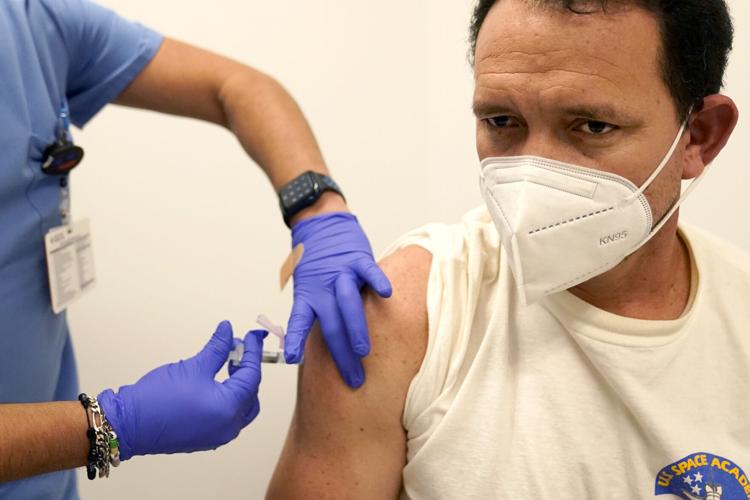
Figuera, who was living with hundreds of other asylum-seekers at O’Hare International Airport while waiting for more permanent shelter, returned for follow-up care at the county clinic. The stubborn cough came back, so he did, too. The staff checked his vitals, listened to his chest and gave him a hepatitis vaccine.

Julio Figuera, 43, receives a vaccine at the Cook County, Ill., medical clinic Oct. 16 in Chicago. “I rarely get sick,” he said. “It was the journey that got me sick.”
“I rarely get sick,” he said. “It was the journey that got me sick.”
People are also reading…
Tens of thousands of migrants who’ve come to the United States are navigating a patchwork system to find treatment for new or chronic health concerns.

Dr. Dan Vittum, one of the three doctors at the Cook County, Ill., health clinic, talks Oct. 16 about the clinic’s mission in serving the immigration population arriving from the southern border. “The bulk of the people who are coming through have had a traumatic experience, not only during the journey … but the reason why they left their homeland,” said Vittum.
Doctors across the country say it’s rare that migrants receive medical screenings or anything beyond care for medical emergencies when they arrive at the U.S.-Mexico border, and there’s no overarching national system to track the care, either. Migrants’ options dwindle or expand after that — depending on where they end up — with some cities guiding new arrivals into robust public health systems and others relying on emergency departments or volunteer doctors to treat otherwise preventable health issues.
“You have these little islands of care. You have these little islands of shelter,” said Deliana Garcia, of the nonprofit Migrant Clinicians Network, which supported more than 1,000 migrants in need of medical care in the first 10 months of this year. “But how does anyone know what’s going on east to west or north to south?”
More than 2 million people crossed the border illegally between October 2022 and September 2023, according to Border Patrol data. For the most part, doctors said, the migrants are healthy; they have to be to make the arduous journey. It’s the travel that can turn manageable health issues into emergencies.
Because of that, public health leaders across the country — from New York to Los Angeles, Boston to Denver — say there’s high demand for care. And providing it is central to their organizations’ missions.
“It’s so core to what we do that I don’t feel like anyone’s really hesitated around this is the right thing for the organization to do,” said Craig Williams, chief administrative officer of Cook County’s health system.
The work is not without a price: Roughly 14,500 migrants have visited the Cook County clinic this year for immediate care, vaccinations and a foothold into the public health care system. The county spends about $2.2 million a month — or nearly $30 million since it opened the clinic about a year ago.
New York City Health and Hospitals logged 29,000 migrant patient visits in the last fiscal year, which ended in mid-June. There, health workers have administered more than 40,000 vaccines and provide medical screenings for all new arrivals.
Other cities are trying to manage as best they can, like Denver, where nearly 26,000 migrants have arrived within the last year. Dr. Steve Federico, a director at Denver Health, said the city’s process is inadequate.
Migrants are asked by shelter staff if they need immediate medical attention. If they say yes, they’re either sent to an emergency room or connected by phone with a nurse through Denver Health, a public hospital and health organization.
There are no basic health screenings, Federico said, which can increase the risk of infectious disease outbreaks among those living in shelters. In Chicago, one shelter saw a small outbreak of chickenpox.

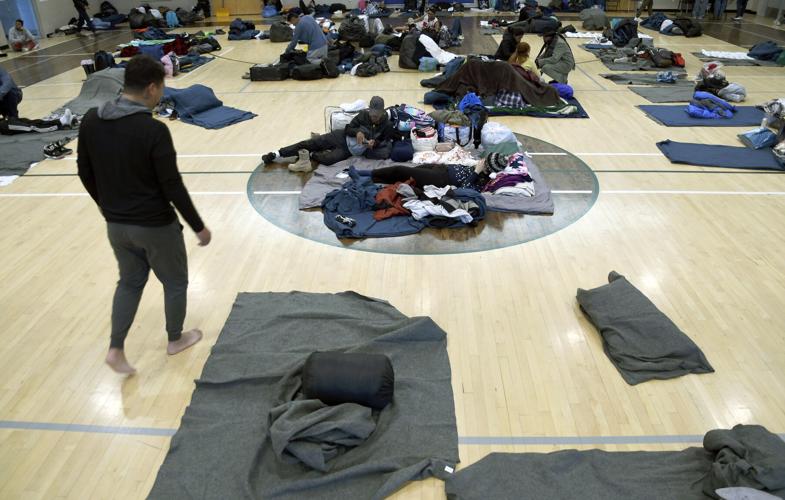
Migrants rest at a makeshift shelter Jan. 6 in Denver. Five mayors from around the U.S. — Denver, Chicago, Houston, New York and Los Angeles — want a meeting with President Joe Biden to ask for help controlling the continued arrival of large groups of migrants to their cities.
Migrants face a lack of access to steady medical care in the U.S., as well as healthy food and stable housing. It can mean that someone with a chronic medical condition, like diabetes or hypertension, can end up in the hospital simply because they lost or ran out of their medications, or had them confiscated during their travels. Doctors said they’ve also seen migrant children with asthma who need new inhalers.
“You have what were essentially healthy people put in really remarkable circumstances, where they are not able to survive thoroughly and then they come across (the border) in a really compromised state,” said Garcia, of the Migrant Clinicians Network.
Some women are arriving far along in their pregnancies, and never had prenatal care.
“We gave the first prenatal visit to a woman who was nine months pregnant just two weeks ago,” said Dr. Ted Long, senior vice president at New York City Health and Hospitals, where more than 300 healthy babies have been born to migrant mothers.

Even when care is available, migrants can have a hard time getting it. Some avoid asking for help entirely out of fear of a large bill or longstanding distrust of the medical system.
Dr. Stephanie Lee is the medical director of refugee resettlement and coordinator of the unaccompanied youth program at Penn State Health’s Family Practice Pediatrics Clinic. She said she sees many patients who don’t have health insurance or don’t know how to get it.
“The process is so broken that you can’t even do anything,” Lee said.
Americas reeling as flow of migrants reaches historic levels

A migrant who crossed into the U.S. from Mexico is pulled under concertina wire along the Rio Grande river Sept. 21, 2023, in Eagle Pass, Texas. Countries in the Americas are reeling as the flow of migrants reaches historic levels, but international “funds simply aren’t there” for humanitarian needs. Global crises — among them the war in Ukraine, conflict in Sudan, Morocco’s earthquake — have pulled global funds away, said Ugochi Daniels, deputy director of operations for the International Organization for Migration.

Migrants who crossed the Rio Grande river to the U.S. from Mexico seek direction from a guardsman Sept. 22, 2023, in Eagle Pass, Texas. A growing number of countries like Panama and Costa Rica are pleading for international aid in handling the flood of migrants passing through the Americas.

Migrants who crossed the Rio Grande and entered the U.S. from Mexico head to be processed by U.S. Customs and Border Protection Sept. 23, 2023, in Eagle Pass, Texas. As more than 7.2 million people have fled the South American nation's economic and political turmoil, the mass migration has received pennies on the dollar in aid compared to other global migration crises like Syria's.

A woman carries her child after she and other migrants crossed the Rio Grande and entered the U.S. from Mexico, to be processed by U.S. Customs and Border Protection Sept. 23 in Eagle Pass, Texas.

A young girl watches as she and other migrants who crossed the Rio Grande and entered the U.S. from Mexico are lined up for processing by U.S. Customs and Border Protection Sept. 23, 2023, in Eagle Pass, Texas. An emergency was declared when several thousand migrants crossed into Eagle Pass, Texas, over a few days.

Migrants sit atop a northbound freight train, in Irapuato, Mexico on Sept. 23, 2023.

Migrants sleep outside a train station as they wait for the arrival of a northbound freight train, in Irapuato, Mexico, on Sept. 22, 2023.

Migrants travel on a freight train, arriving in Ciudad Juarez, Mexico, on Sept. 28, 2023. Despite violence from drug cartels and the dangers that come with riding atop the train cars, such freight trains — known collectively as “The Beast” — have long been used by migrants to travel north.

A migrant man watches as a northbound freight train pulls into Irapuato, Mexico, on Sept. 23, 2023.

Guardsmen encourage migrants waiting on a sandbar to turn around as they attempt cross the Rio Grande from Mexico into the U.S. on Sept. 23, 2023, in Eagle Pass, Texas.

A U.S. Border Patrol agent in a vehicle watches a group of asylum-seekers at a camp after they crossed the nearby border with Mexico, on Sept. 26, 2023, near Jacumba Hot Springs, Calif. Migrants continue to arrive to desert campsites along California's border with Mexico, as they await processing.

Migrants walk beside a freight train they rode to Ciudad Juarez, Mexico, on Sept. 28, 2023. So many migrants are climbing aboard trains that Mexico’s largest railway company said it was suspending 60 freight train runs because of safety concerns, citing a series of injuries and deaths.

Migrants travel on a freight train, arriving in Ciudad Juarez, Mexico, on Sept. 28, 2023. A vast smuggling network can now get migrants from Venezuela to central Mexico in as little as just over two weeks, an odyssey that once could take months. Detentions along the U.S.-Mexico border soared 33% from June to July, according to U.S. government figures, reversing a plunge after new asylum restrictions were introduced in May.

Migrants travel on a freight train, arriving in Ciudad Juarez, Mexico, on Sept. 28, 2023.

Migrants walk beside a freight train that brought them to Ciudad Juarez, Mexico, on Sept. 28, 2023.

Migrants travel on a freight train, arriving in Ciudad Juarez, Mexico, on Sept. 28, 2023.