NEW ORLEANS — Sarah Lungwitz fretted over feeding not just her two teenage daughters with Supplemental Nutrition Assistance Program payments disrupted, but her family's cat and two dogs.
Help arrived for now, she said, after an Illinois nonprofit arranged for volunteers to give her a grocery gift card to buy food for herself and her pets. It's among the growing efforts to help struggling pet owners stretch their dollars as SNAP payments go out late during a government shutdown that is the longest on record.
"I don't even make enough money for all my bills let alone groceries," said Lungwitz, 46, an auto parts store worker who worried she might have to surrender her cat, Bambi, and two dogs, Spike and Chloe.

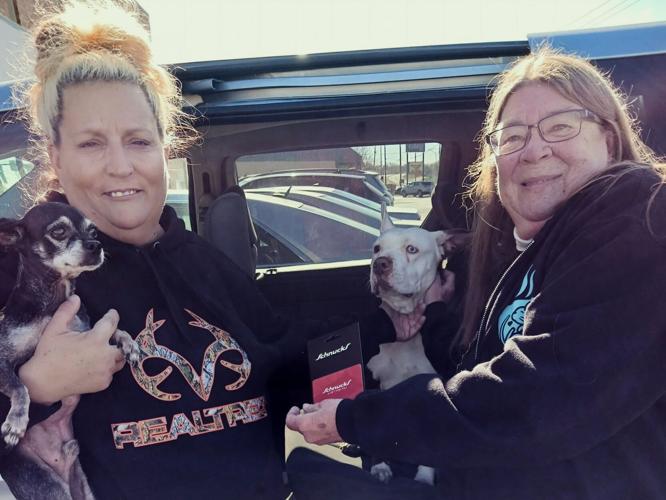
Teresa Paris, right, gives SNAP recipient Sarah Lungwitz a grocery store gift card Oct. 30 in Loves Park, Ill., part of a nonprofit's efforts to help struggling pet owners feed themselves and their animals amid disruptions in the food aid benefit.
The Supreme Court on Friday granted the Trump administration's emergency appeal to temporarily block a court order to fully fund SNAP food aid payments amid the government shutdown, even though residents in more than a half-dozen states already received the funds. The uncertainty is straining shelters.
People are also reading…
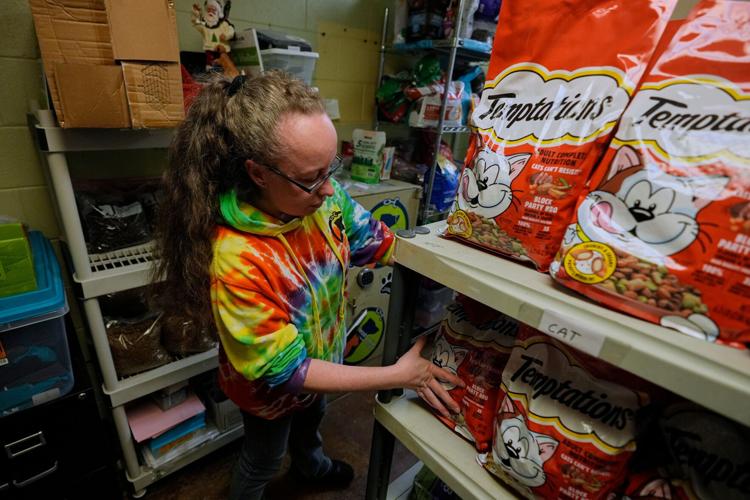
Though SNAP can't be used for pet food, the food assistance program helps low-income families free up money to purchase kibble. It's also common for owners to supplement or entirely feed their animals human food purchased using SNAP, said Stephanie Hicks, executive director for Care for Pets, the Rockford, Illinois, nonprofit that helped Lungwitz and others. Some volunteers walked the grocery aisles with struggling pet owners.

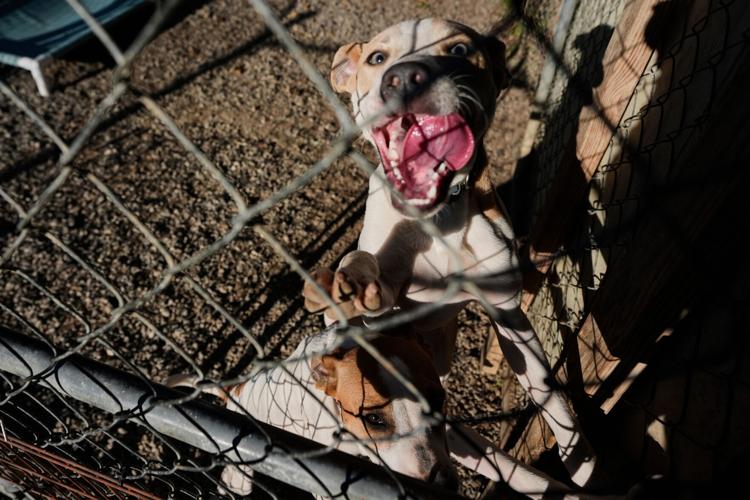
Dogs are seen Thursday at the New Leash On Life animal shelter in Lebanon, Tenn.
The Humane World for Animals, formerly the Humane Society of the United States, estimates that more than 20 million pets live in poverty with families.
Economic strain is one of the leading reasons animals are surrendered to shelters, spokesperson Kirsten Peek said.
While it is still too early to tell whether that is happening, groups are collecting pet food as shelters worry about a possible surge as the shutdown also leaves hundreds of thousands of furloughed workers without paychecks.
"An increase in surrenders is always a concern when an influx of people fall on hard times," Peek said.

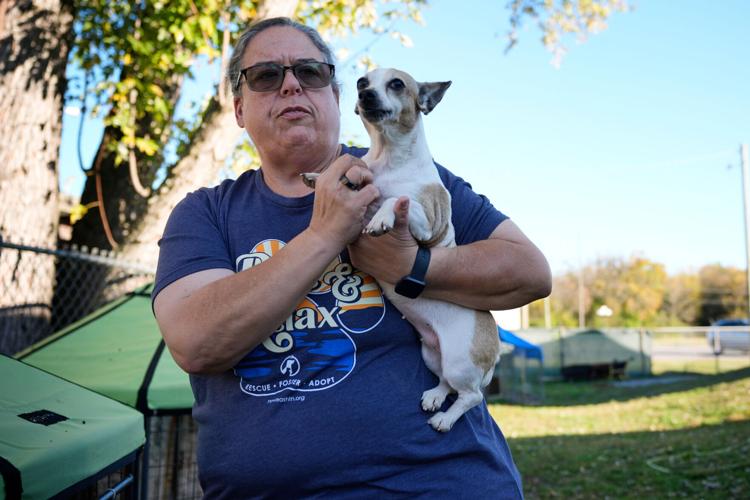
Angela Chapman, director of New Leash On Life animal shelter, holds an owner-surrendered dog Thursday at the facility in Lebanon, Tenn.
Finding ways to make pet food last longer
The concerns have one Louisiana shelter considering diverting money away from veterinary care so it can buy pet food. The SNAP delays come at a particularly bad time for the Companion Animal Alliance in Baton Rouge: The shelter recently lost a donor, forcing it to halt a program that distributed pet food to about 200 families each month.
"People are exceptionally panicking. I don't know what a better word would be," said Paula Shaw, the shelter's director of access to care, noting it was so common for SNAP recipients to give their own food to their pets that the shelter provided information about human foods owners could add to pet food to make it last longer
Offers of pet food and Venmo donations were immediate after Charley's Angles Pet Initiative in Massachusetts put out a plea on Facebook. "We're expecting, at least in the short term, that there's going to be a surge" in demand, said Kandi Finch, a groomer who named her nonprofit after a beloved pet.

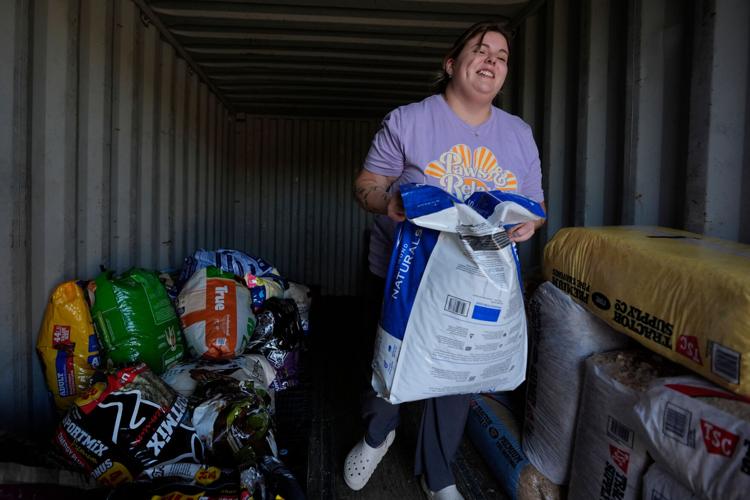
Danica Anderson restocks a pet food pantry for families needing help to provide for their dogs and cats Thursday at New Leash On Life animal shelter in Lebanon, Tenn.
A rise in families using pet food pantries
That's exactly what has happened at New Leash on Life, a shelter in Lebanon, Tennessee, outside of Nashville. The number of families using its pet food pantry jumped to 125 in October, up from 75 to 100 in a typical month, said executive director Angela Chapman.
"We'd rather help them with their food than have to surrender a pet," she said.
In New Orleans, Zeus' Rescues gave out a ton of pet food in October, double the normal amount, said founder Michelle Cheramie, who said this is the highest demand she's seen in 20 years.

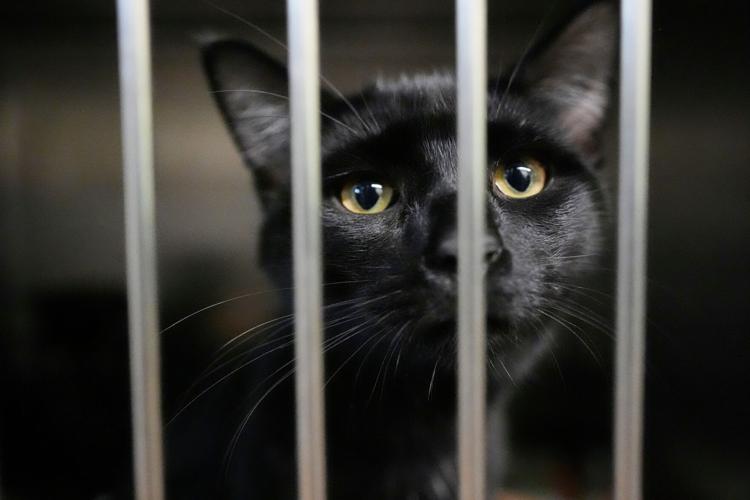
An owner-surrendered cat is seen Thursday at the New Leash On Life animal shelter in Lebanon, Tenn.
"It's heartbreaking," she said, noting some people are so desperate, they dumped animals in the shelter's yard.
Among those seeking help there Thursday was Katie Saari, who is unemployed because of health issues and struggling to set up interviews to get SNAP benefits amid the shutdown. Out of money, she needed food for her two dogs.
"They're more important to me than I am, so I want to make sure they're fed first," she said. "They're my babies."

Jordan Robinson restocks a pet food pantry Thursday at New Leash On Life animal shelter in Lebanon, Tenn.
Aware of the problem, many food pantries also stock their shelves with pet food, said Kim Buckman, with Feeding Missouri, a coalition of food banks in the state.
"We do know a lot of people will feed their pets before themselves," she said. "In some cases, that is their emotional support animal."
Such is the case for Lungwitz, who said she has post-traumatic stress disorder and severe depression. A psychiatrist told her to get a dog because they need walks. That's how she wound up with her Chihuahua. Her American Bulldog — 80 pounds of "pure muscle" — made the domestic violence survivor feel safe. She says it worked, allowing her to venture out into the community and land a job.
But money is so tight, she sometimes seeks help at food banks, including getting doughnuts from one for her 17-year-old daughter's birthday. "I'm struggling," she said.
Monthlong government shutdown in photos: Disruptions, delays and divisions

Volunteer Betty McNeely, right, helps a man bag food items Oct. 28 at Project Feed, an emergency food pantry in Portland, Maine. With no endgame in sight, the U.S. government shutdown is expected to roll on for the unforeseeable future, injecting more uncertainty into an already precarious economy.

Brock Brooks, a disable Marine Corps veteran, cries Oct. 30 while describing the impending SNAP shutdowns while waiting in line to enter the food pantry service at Calvary Episcopal Church in Louisville, Ky. Funding for the Supplemental Nutrition Assistance Program, or SNAP, lapsed Saturday.

Volunteers prepare emergency food packages Oct. 28 at the Tarrant Area Food Bank in Fort Worth, Texas.

Tammy Norton, a furloughed federal employee of 16 years who currently works for the Internal Revenue Service, reacts with emotion Oct. 28 as she talks about running through her limited savings to support her family during the government shutdown, at a food distribution center for federal employees affected by the government shutdown in Dania Beach, Fla. The monthlong government shutdown halted routine federal operations, furloughed about 750,000 federal employees and left others working without pay.

Volunteer Joel Hernandez helps load a vehicle Oct. 27 during a food distribution targeting federal employee households affected by the federal shutdown as well as SNAP recipients in San Antonio.

A food and supplies bank is set up Oct. 17 at Harry Reid International Airport in Las Vegas, Nv.

House Minority Leader Hakeem Jeffries, D-N.Y., disputes a reporter's question Oct. 24 as he enters his office at the Capitol in Washington on day 24 of the government shutdown.

The Capitol is seen at nightfall Oct. 22, day 22 of a government shutdown, in Washington.

Sen. John Barrasso, R-Wyo., the Senate GOP whip, left, and Speaker of the House Mike Johnson, R-La., arrive for a news conference with top Republicans on the government shutdown Oct. 1 at the Capitol in Washington.

Air Traffic Controllers stand Oct. 28 outside Detroit Metropolitan Wayne County Airport in Romulus, Mich., distributing leaflets explaining how the federal government shutdown is affecting air travel. Airports have been scrambling with flight disruptions.

Travelers sit together and wait Oct. 2 at the Baltimore/Washington International Thurgood Marshall Airport in Baltimore.

TSA agent Sashene McLean, holding her 1-year-old daughter, comes from work to collect a donation of produce, meat and yogurt Oct. 28 at a food distribution center in Dania Beach, Fla., organized to assist federal employees missing paychecks during the government shutdown.

Senate Majority Leader John Thune, R-S.D., speaks to reporters Sept. 30 at the U.S. Capitol in Washington as the U.S. government was on the brink of the first federal government shutdown in almost seven years.

Speaker of the House Mike Johnson, R-La., and GOP leaders, from left, Rep. Lisa McClain, R-Mich., and Majority Whip Tom Emmer, R-Minn., blame the government shutdown on Democrats during an Oct. 2 news conference at the Capitol in Washington. Americans, meanwhile, are divided on who’s to blame.

Senate Minority Leader Chuck Schumer, D-N.Y., attends a Sept. 30 news conference about the government shutdown on Capitol Hill in Washington. Democrats seek an extension of expiring tax credits that helped millions of people afford health insurance, while Republicans say they won’t negotiate until the government is reopened.