LONDON — As chances rise of a Joe Biden-Donald Trump rematch in the U.S. presidential election, America’s allies are bracing for a bumpy ride.
Many worry that a second term for Trump would be an earthquake, but tremors already abound — and concerns are rising that the U.S. could grow less dependable regardless of who wins. With a divided electorate and gridlock in Congress, the next American president could easily become consumed by manifold challenges at home — before even beginning to address flashpoints around the world, from Ukraine to the Middle East.
French President Emmanuel Macron’s recent verdict was blunt: America’s “first priority is itself.”

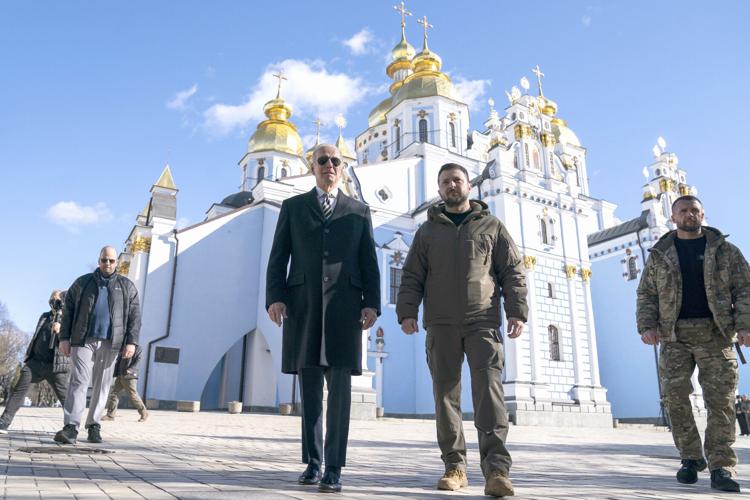
President Joe Biden walks with Ukrainian President Volodymyr Zelenskyy on Feb. 20, 2023, in Kyiv, Ukraine. Concern is rising among America’s allies that the U.S. could grow less dependable regardless of who wins the presidency in November.
The first Trump administration stress-tested the bonds between the U.S. and its allies, particularly in Europe. Trump derided the leaders of some friendly nations, including Germany’s Angela Merkel and Britain’s Theresa May, while praising authoritarians such as Turkish President Recep Tayyip Erdogan and Russian leader Vladimir Putin. He has called China’s Xi Jinping “brilliant” and Hungary’s Viktor Orbán “a great leader.”
People are also reading…
In campaign speeches, Trump remains skeptical of organizations such as NATO, often lamenting the billions the U.S. spends on the military alliance whose support has been critical to Ukraine’s fight against Russia's invasion.
He said at a rally on Saturday that, as president, he'd warned NATO allies he would encourage Russia “to do whatever the hell they want” to countries that didn't pay their way in the alliance. Trump also wrote on his social media network that in future the U.S. should end all foreign aid donations and replace them with loans.

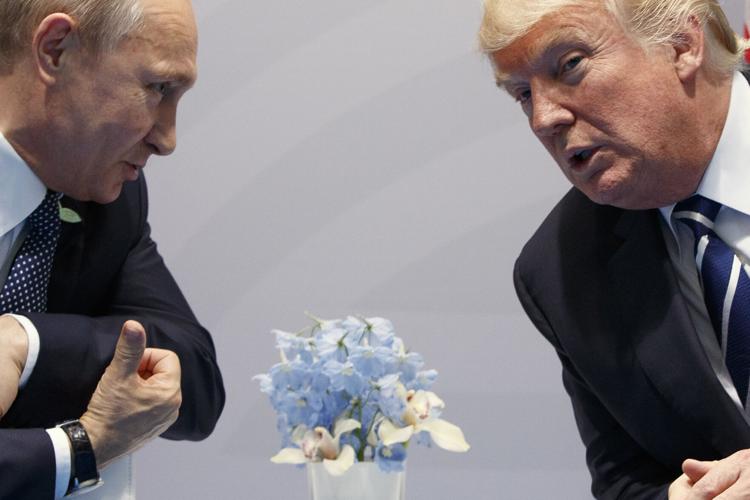
Then-U.S. President Donald Trump, right, meets with Russian President Vladimir Putin on July 7, 2017, at the G20 Summit in Hamburg, Germany.
NATO Secretary-General Jens Stoltenberg warned that Trump risked endangering U.S. troops and their allies. “Any suggestion that allies will not defend each other undermines all of our security, including that of the U.S., and puts American and European soldiers at increased risk,” he said in a statement Sunday.
Biden, meanwhile, has made support for Ukraine a key priority and moral imperative. But Biden’s assertion after his election in 2020 that “America is back” on the global stage has not been entirely borne out. Congressional Republicans have stalled more military aid for Ukraine, while America's influence has been unable to contain conflict in the Middle East
Thomas Gift, director of the Centre on U.S. Politics at University College London, said that whoever wins the presidential race, the direction of travel will be the same – toward a multipolar planet in which the United States is no longer “the indisputable world superpower.”
Most allied leaders refrain from commenting directly on the U.S. election, sticking to the line that it’s for Americans to pick their leader.

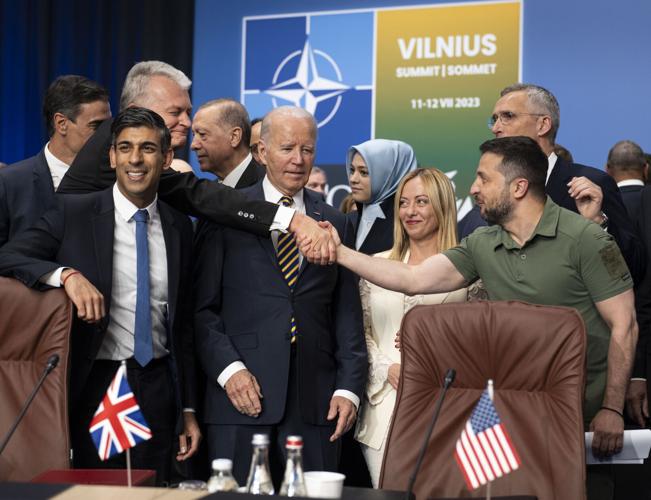
Ukrainian President Volodymyr Zelenskyy, right, reaches past President Joe Biden to shake hands with Lithuanian President Gitanas Nauseda on July 12 as they stand with other NATO members, including British Prime Minister Rishi Sunak, left, during a meeting of the NATO-Ukraine Council in Vilnius, Lithuania.
They are conscious that they will have to work with the eventual winner, whoever it is — and behind the scenes, governments will be doing the “backroom work” of quietly establishing links with the contenders’ political teams, said Richard Dalton, a former senior British diplomat.
But many of America's European NATO allies are worried that with or without Trump, the U.S. is becoming less reliable. Some have started to talk openly about the need for members to ramp up military spending, and to plan for an alliance without the United States.
German Chancellor Olaf Scholz said he was “currently on the phone a lot with my colleagues and asking them to do more” to support Ukraine. Germany is the second-largest donor of military aid to Kyiv, behind the U.S., but Scholz recently told German weekly Die Zeit that the country couldn’t fill any gap on its own if “the U.S.A. ceased to be a supporter.”
Trump's comments on Saturday about NATO rang alarm bells in Poland, which shares a border with Ukraine. “We have a hot war at our border,” Polish Prime Minister Donald Tusk said Sunday.

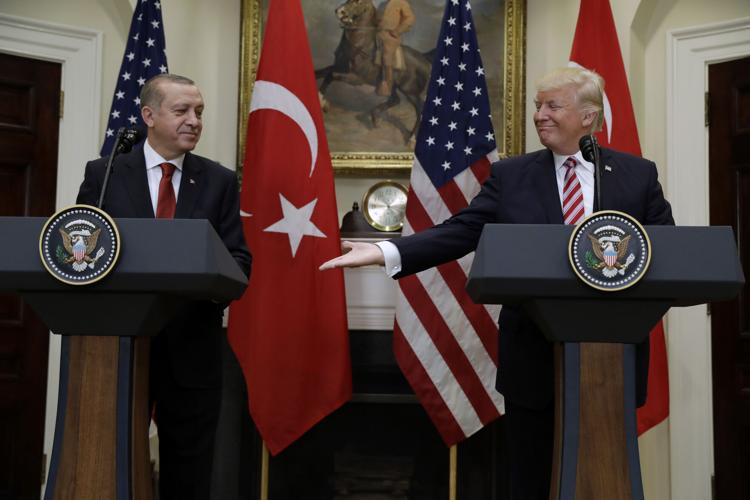
Then-U.S. President Donald Trump reaches out a hand to Turkish President Recep Tayyip Erdogan on May 16, 2017, at the White House.
He warned: “We must realize that the EU cannot be an economic and civilizational giant and a dwarf when it comes to defense, because the world has changed.”
Russia, meanwhile, is busy bolstering ties with China, Iran and North Korea and trying to chip away at Ukraine’s international support.
Macron also suggested American attention was focused far from Europe. If Washington's top priority is the U.S., he said its second is China.
“This is also why I want a stronger Europe, that knows how to protect itself and isn’t dependent on others,” Macron said at a January news conference.
Trump does have supporters in Europe, notably pro-Russia populists such as Hungary's Orbán. But former British Prime Minister Boris Johnson raised some eyebrows when he argued recently that “a Trump presidency could be just what the world needs.”
Johnson is a strong supporter of Ukraine in its struggle against Russian invasion, whereas Trump has frequently praised Putin and said he’d end the war within 24 hours. However, Johnson said in a Daily Mail column that he didn’t believe Trump would “ditch the Ukrainians,” but instead would help Ukraine win the war, leaving the West stronger “and the world more stable.”
Tips to help beat the winter blues, and more videos to improve your life
These tips can help beat SAD and tackle the winter blues, how to financially recover from an expensive vacation, and more videos to improve your life.