NAIROBI, Kenya — King Charles III expressed “greatest sorrow and the deepest regret” for the “abhorrent and unjustifiable acts of violence” committed against Kenyans as they sought independence, during a speech on his first day of a four-day visit. But he didn’t explicitly apologize for Britain’s actions in its former colony, as many Kenyans wanted.
Charles at the state banquet hosted by Kenyan President William Ruto said there “can be no excuse” for the “wrongdoings of the past.” He said addressing them with honesty and openness could “continue to build an ever closer bond in the years ahead.”

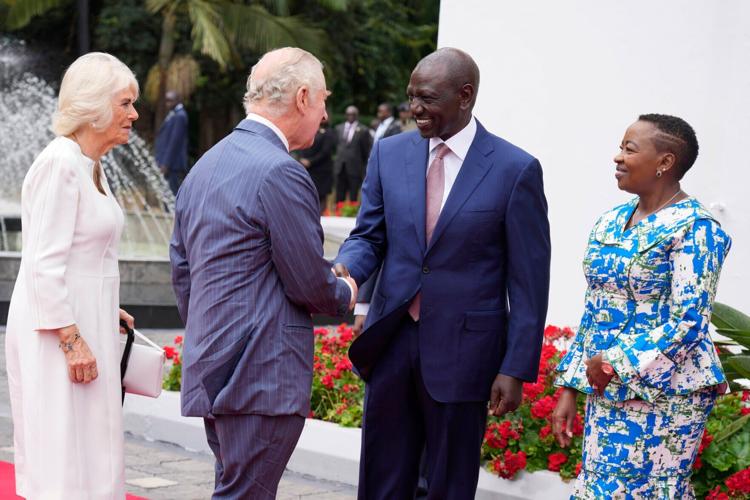
Kenya’s President William Ruto and first lady Rachal Ruto, right, welcome Britain’s King Charles III and Queen Camilla on Tuesday at the State House in Nairobi, Kenya.
Kenya is celebrating the 60th anniversary of its independence this year. It and Britain have had a close but at times challenging relationship after the prolonged struggle against colonial rule, sometimes known as the Mau Mau Rebellion, in which thousands of Kenyans were killed.
People are also reading…
Ruto told the banquet that Britain’s response to Kenya’s quest for self-rule was “monstrous in its cruelty.” Colonial authorities resorted to executions and detention without trial as they tried to put down the insurrection, and thousands of Kenyans said they were beaten and sexually assaulted by agents of the administration.
“While there have been efforts to atone for the death, injury and suffering inflicted on Kenyan Africans by the colonial government, much remains to be done in order to achieve full reparations,” Ruto said.

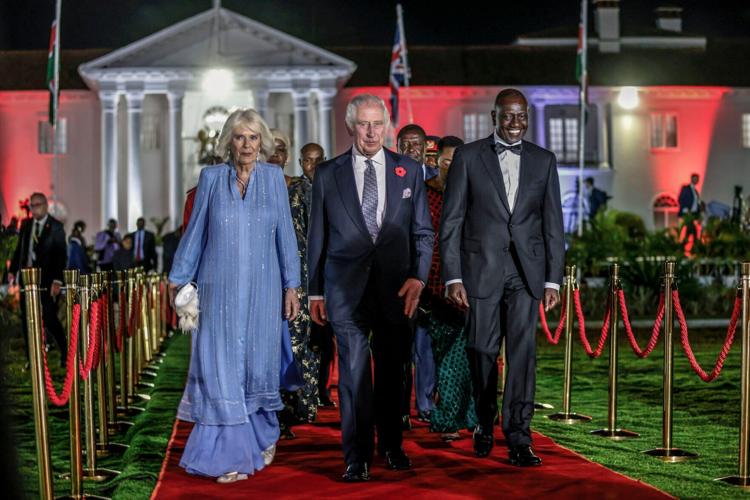
From left, Britain's Queen Camilla and King Charles III and Kenyan President William Ruto arrive Tuesday for a banquet at the State House in Nairobi, Kenya.
This is the king’s first state visit to a Commonwealth country as monarch. Buckingham Palace said he would acknowledge the “painful aspects” of Britain and Kenya’s shared history while underscoring his commitment to an organization that’s been central to the U.K.’s global power since World War II.
The visit is full of symbolism. Charles’ mother, the late Queen Elizabeth II, learned she had become the U.K. monarch while visiting the East African nation — at the time a British colony — in 1952.
The king and Queen Camilla touched down in the capital, Nairobi, late Monday. The king and Ruto on Tuesday visited a museum that showcased the events preceding Kenya’s independence and walked through the Tunnel of Martyrs, which memorializes Kenyans who lost their lives in conflict.
Politician and human rights activist Koigi Wamwere said the king ought to apologize and offer full reparations for the two countries to move forward, saying “Britain must undo as much as they can.”
Salim David Nganga, speaking at the capital’s Jevanjee Gardens, where colonial statues were brought down in 2020, said, “the king should never have been allowed to step in this country, considering the dark history of British colonialists.”

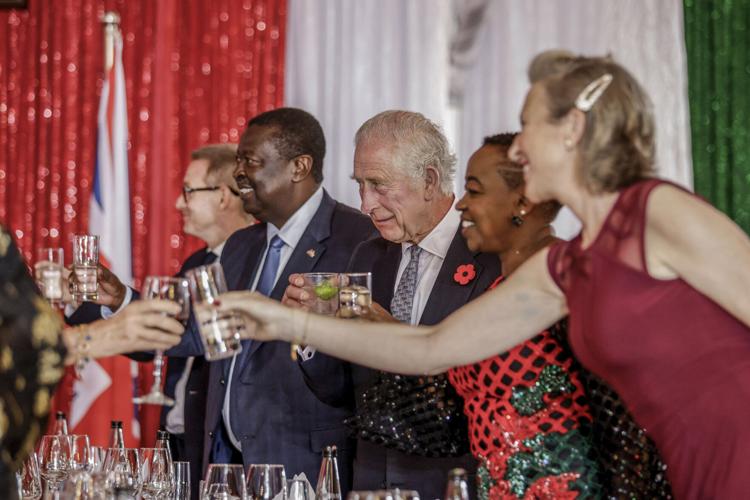
Britain's King Charles III, third from right, interacts with guests Tuesday during the state banquet hosted by Kenyan President William Ruto at the State House in Nairobi, Kenya.
The king’s visit also reignited tensions over land in parts of Kenya.
Joel Kimutai Kimetto, 74, said his grandfather and father were kicked out of their ancestral home by the British.
“What is most painful is that years after the brutalities and the stealing of our land, British companies are still in possession of our ancestral homes, earning millions from their comfortable headquarters in the U.K., while our people remain squatters,” he said in a phone interview. “We ask President William Ruto and our leaders to use this golden opportunity to address our plight with the king.”

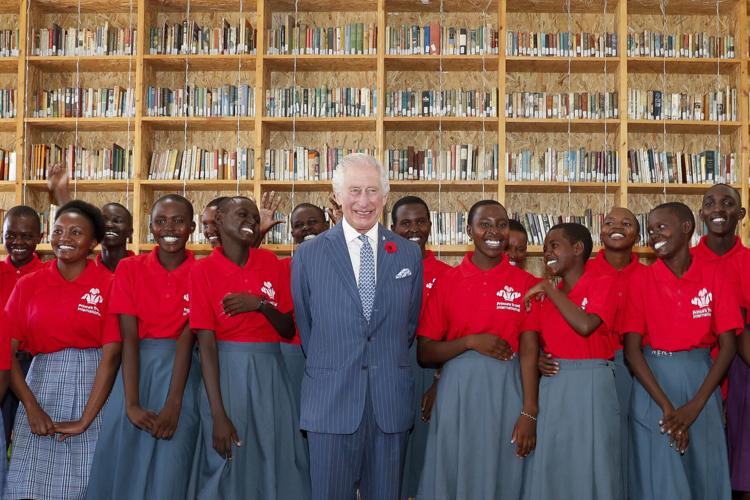
Britain's King Charles III poses for a photograph Tuesday with secondary school students during his visit to the Eastlands Library in the Makadara district of Nairobi, Kenya.
Elsewhere, police canceled a planned protest and news conference by victims of a fire at a conservancy in central Kenya that allegedly was started by British soldiers in training was canceled ahead of the king’s visit.
Protesters briefly chanted anti-British songs and threw roses at the foot of a monument to Mau Mau veteran Dedan Kimathi in Nairobi’s central business district Tuesday. Uniformed and plain-clothed police officers dispersed the group.
Charles also planned to visit Nairobi National Park and meet with environmental activist Wanjira Mathai, daughter of late Nobel laureate Wangari Maathai, as he emphasizes his commitment to environmental protection.
During his visit, Britain announced $5.5 million in new funding to support education reforms in Kenya.