

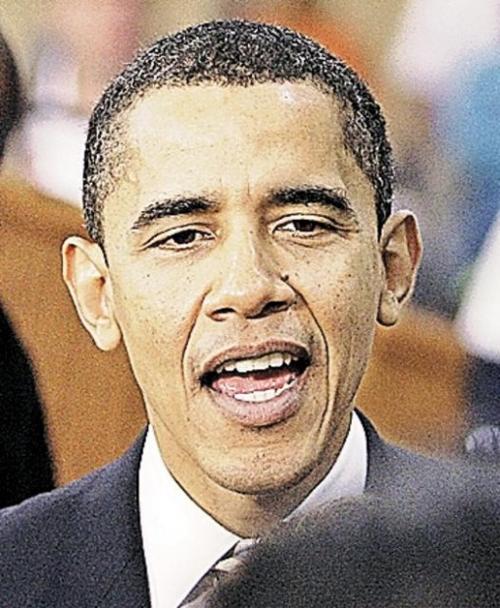
In 1981, at the small, mostly white college he was attending in Los Angeles, 19-year-old Barack Obama tried something that shaped the course of his life.
He gave a speech.
Like many students of that era, the sophomore was drawn to the South African divestiture movement, which demanded that college trustees drop institutional investments that supported the racial segregation system known as apartheid.
Obama's role at the Occidental College rally that winter day was to grab the crowd's attention, then be whisked off by students in paramilitary costumes.
"He was so composed in his arguments that I think after that speech a lot of people wondered, 'Who is that guy and why haven't we heard more from him?' " recalled Rebecca Rivera, a classmate.
That debut speech was a turning point; it set a template for revealing a rare talent.
People are also reading…
Nearly a quarter-century later, another Obama speech, this one at the 2004 Democratic National Convention, transformed him into an American political phenomenon. It launched him from being an obscure state lawmaker into a celebrity U.S. senator from Illinois, and it gave him a springboard to become a challenger for his party's 2008 presidential nomination.
While Democratic and Republican rivals campaign on their military heroism, governing résumés, private-sector successes or White House ties, what sets the 46-year-old Obama apart most is how he engages audiences, physically and emotionally. His presence helps him politically transcend his biracial background.
He seems to hug and shake a crowd at once. On the campaign trail, he has a crisp, resonant voice combined with an easy, self-effacing manner. Tall, slim, with exceptionally long fingers, he juxtaposes a physical sense of calm with disarmingly emotional strings of words. His presence lets him lift a vague stump speech about hope into something that seems much weightier, at least in the moment.
Organizing struggling blacks
Hearing his own voice that day at Occidental seemed to spark Obama's political awakening and set him on his career path.
He transferred within months to Columbia University.
Obama spent a few years as a community organizer in Chicago, mobilizing black residents of the struggling South Side to agitate for themselves, whether it was lobbying for a job-training center or removing asbestos from a housing project.
There, he discovered that sharing life stories with people "gave me the sense of place and purpose I'd been looking for," he later wrote in a memoir.
He went on to Harvard Law School, stepping into an incubator for America's elite — future Supreme Court justices, Fortune 500 leaders, U.S. senators and presidents.
"He walks between worlds," said Obama's half-sister, Maya Soetoro-Ng. "That's what he's done his entire life."
Former Harvard classmates and professors remember Obama as an intellect with mature judgment, a conciliator who could see both sides of an issue.
"You wanted to hear him thinking. There was something special about him," law professor Charles Ogletree said.
Obama had two pivotal moments at Harvard. One came at a summer job at a Chicago corporate law firm where he met another Harvard law graduate, Michelle Robinson, who would become his wife and the mother of their two daughters, Malia and Sasha. The other was a professional triumph: Obama made headlines when he was elected the first black president of the Harvard Law Review.
With graduation, Obama became a hot commodity. High-powered job offers flooded in, but he chose another direction.
Returning to Chicago, he joined a small civil-rights firm, ran a voter registration drive and lectured on constitutional law at a university.
Election to the Illinois Senate followed, then a failed bid for the U.S. House of Representatives and a shoot-the-moon campaign for an open U.S. Senate seat. He won, helped greatly by his opponents' flameouts.
Finally came the invitation to give "the speech" in 2004, after Democratic presidential nominee John Kerry decided Obama projected the right image.
None of this was predestined for a man with Obama's odd upbringing.
Dad left when Barack was 2
Barack ("blessed" in Arabic) was born in Hawaii on Aug. 4, 1961. He was named for his black father, a former goat herder from Kenya who had won a scholarship to the University of Hawaii. His white mother, Ann Dunham, had grown up in Kansas but later moved to Hawaii with her parents. The couple met in college, but their marriage was short-lived.
His father left his family to study at Harvard when Obama was 2, returning just once.
Obama wrote poignantly about that visit in his memoir — remembering the basketball his father gave him, the African records they danced to, the Dave Brubeck concert they attended. Obama, then 10, never saw his father again.
By then, Obama's mother had remarried, to Lolo Soetoro, another university student. They moved to his native Indonesia, plunging the 6-year-old Obama into a land of delicacies such as snake meat and grasshopper; a pet monkey, Tata; and the harsh realities of Third World poverty and disease.
After four years, Obama returned to Hawaii, where he attended an elite private academy on a scholarship.
He knew his father mostly as a mythical figure in Kenya, yet he still identified himself as black. And as one of the few blacks at his Honolulu school, "I probably questioned my identity a bit harder than most," he wrote in a 1999 article for the school's bulletin.
"As a kid from a broken home and family of relatively modest means, I nursed more resentments than my circumstances justified, and I didn't always channel those resentments in particularly constructive ways."
In his memoir, "Dreams From My Father," Obama wrote about using drugs in his youth — including marijuana and cocaine — to "push questions of who I was out of my mind."
Embracing social justice
In college, after the campus divestiture campaign, social justice — especially for blacks — became Obama's cause and guided his life choices.
Judson Miner, who heads the liberal Chicago civil-rights firm that hired Obama after Harvard, said that the first time he had lunch with his recruit, he was so struck that "I told my wife I just had lunch with one of the most extraordinary people I'd met."
"This was a guy who was interested in having an impact with things," Miner said. "I think he was really wrestling with: How can you be most effective? As a lawyer? In some other role?"
Miner enthusiastically supports Obama's presidential bid.
"If he had a fault, which I guess sometimes manifests itself on the campaign trail, he instinctively appreciates all the nuances of things," Miner said. "He's decisive, but that processing involves wrestling with these things a little bit. And sometimes that's not a good trait for a politician."
Obama's critics see bigger flaws in his judgment, which they chalk up to a combination of inexperience and sanctimony.
One such incident involves a 2005 land deal first reported by the Chicago Tribune. Obama and the wife of Tony Rezko, a politically connected Chicago developer who since has been indicted in connection with paying kickbacks, bought adjacent plots of land on the same day. Months later, Obama bought back part of the Rezko parcel to expand his $1.65 million home's lot.
The revelation stunned government watchdogs, because in the Illinois Senate and on Capitol Hill, Obama flaunted his reputation as a clean-government champion. He has urged tighter fundraising and disclosure rules, and railed against getting too cozy with lobbyists.
Obama, who had known Rezko since the early 1990s, later said it was "boneheaded" of him not to anticipate how the sale would look; he returned Rezko's contributions. Critics have found no evidence that he did legislative favors for Rezko.
But Cindi Canary, the executive director of the Illinois Campaign for Political Reform, said the deal still gives her pause.
"More than anything else, there was a sense that Senator Obama should have known better," she said. "One is judged by the company one keeps. Tony Rezko was a very well-known wheeler and dealer in Illinois politics, someone who for a number of years had a swirl of trouble around him and allegations before the final indictment came down."
Rival calls him "naive"
Rival Democrats have painted Obama as too green on foreign policy to serve as a wartime president.
Sen. Hillary Rodham Clinton, D-N.Y., called him "irresponsible" and "naive" when he said he would be willing to meet with the leaders of nations that the United States considers hostile, such as Iran and North Korea.
Sen. Joseph Biden, D-Del., criticized Obama for a speech in which he said he would invade U.S. ally Pakistan if necessary to get high-level terrorists. Biden's issue wasn't Obama's willingness to invade so much as his broadcasting it. That, Biden said, could undermine Pakistan's president and damage U.S. interests.
Obama raises the experience question in his own campaign speeches, painting his rivals as cynics and arguing that his mix of youth, background diversity and civic engagement would better serve the nation.
Voters often ask Obama which president he admires most. He usually says Abraham Lincoln, who ended slavery, managed the country through civil war — and delivered one of history's most famous speeches, the Gettysburg Address.
But Obama sometimes betrays a yearning to be viewed like John F. Kennedy, to set a style of leadership that re- invigorates public faith in government.
"One of my jobs as president is to make government cool again," Obama told an engaged college crowd in New Hampshire last fall.
Because of Kennedy, Obama said, "thousands of young people were inspired to say, 'I want to give something back; I want to serve.' Now we're losing that. And we've got to restore it."
For a closer look at Barack Obama and his campaign, go online to go.azstarnet.com/videos and view his profile video.
coming up: more profiles
This is part of a series of profiles of major presidential candidates, as Arizonans get ready to vote on Feb. 5.
• Last week: The Republicans.
• This week: The Democrats.


