

PALO ALTO, Calif. - On an early May morning 43 years ago, fire swept through Stanford University's Navy ROTC building, destroying a structure that had been damaged in another suspicious blaze just two months earlier.
No arrests were ever made in the two arson fires, but they came at a time of angry, sometimes violent demonstrations against the Vietnam War on college campuses nationwide. Those protests often targeted the closest symbol of the U.S. military, the Reserve Officers Training Corps - with more than 200 campus ROTC units reporting vandalism during that war.
Flash forward to a much different time.
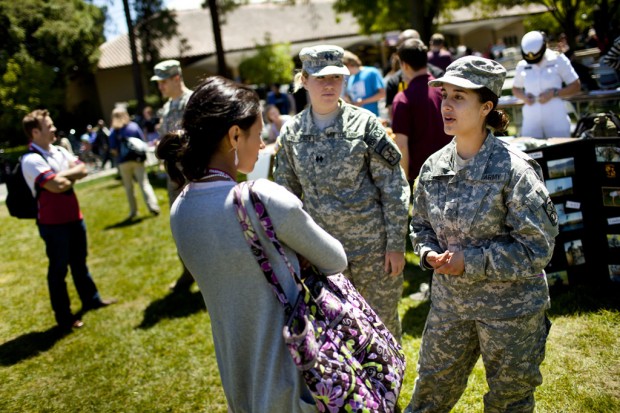
On a recent afternoon, Stanford senior Ann Thompson wore her Army ROTC uniform with pride as she helped staff a recruiting table for the military training program at a campus activities fair. She chatted with visitors about the ROTC's scholarships as a few dozen students marched nearby to protest the program's likely expansion at Stanford.
People are also reading…
"There definitely are people not supportive of ROTC, but we still have respectful conversations," said Thompson, 22, of Paso Robles, Calif. "I can't fathom anyone burning a building down."
Helped by the recession, more active recruiting and a sea change in student perceptions of the military, enrollment in ROTC programs on college campuses is booming.
Even with ongoing U.S. involvement in conflicts in Afghanistan, Iraq and now Libya, participation in the program has surged 27 percent over the last four years - to 56,757 men and women, according to the Defense Department. The military boosted the number of ROTC scholarships to help expand the wartime officer corps, and the recession made the offers attractive to students.
Today's college students, who never faced a military draft and whose childhood memories include the terrorist attacks of Sept. 11, 2001, are more receptive than their parents' generation to seeing fellow students in uniform. Returning veterans who served in Iraq and Afghanistan and are now enrolled in college also create a more sympathetic, and familiar, image of the military.
In another sign of the changing times, the congressional rescinding last year of the "don't ask, don't tell" ban on gays serving openly in the military has recently led Stanford, Harvard, Yale and several other elite universities to take steps to welcome the ROTC back to their campuses for the first time in 40 years.
Jimmy Ruck, a 21-year-old Stanford senior and Army ROTC cadet from Millbrae, Calif., will join a military intelligence unit as a second lieutenant after he graduates in the coming weeks.
In the Vietnam era, hostility toward the ROTC soared as the war's casualties increased and reached a height when U.S. troops were sent into Cambodia in 1970.
Student protesters occupied ROTC centers at many colleges, and fires and explosions damaged the program's buildings at the University of Michigan, Kent State University and the University of Colorado.
From 1968 to 1974, the ROTC closed 88 units.


