

Every three years, two full moons will occur within the same month. This is because the lunar cycle and calendar year are not perfectly synchronized.
Spooky season is upon us — and Halloween night will be even a little bit spookier.
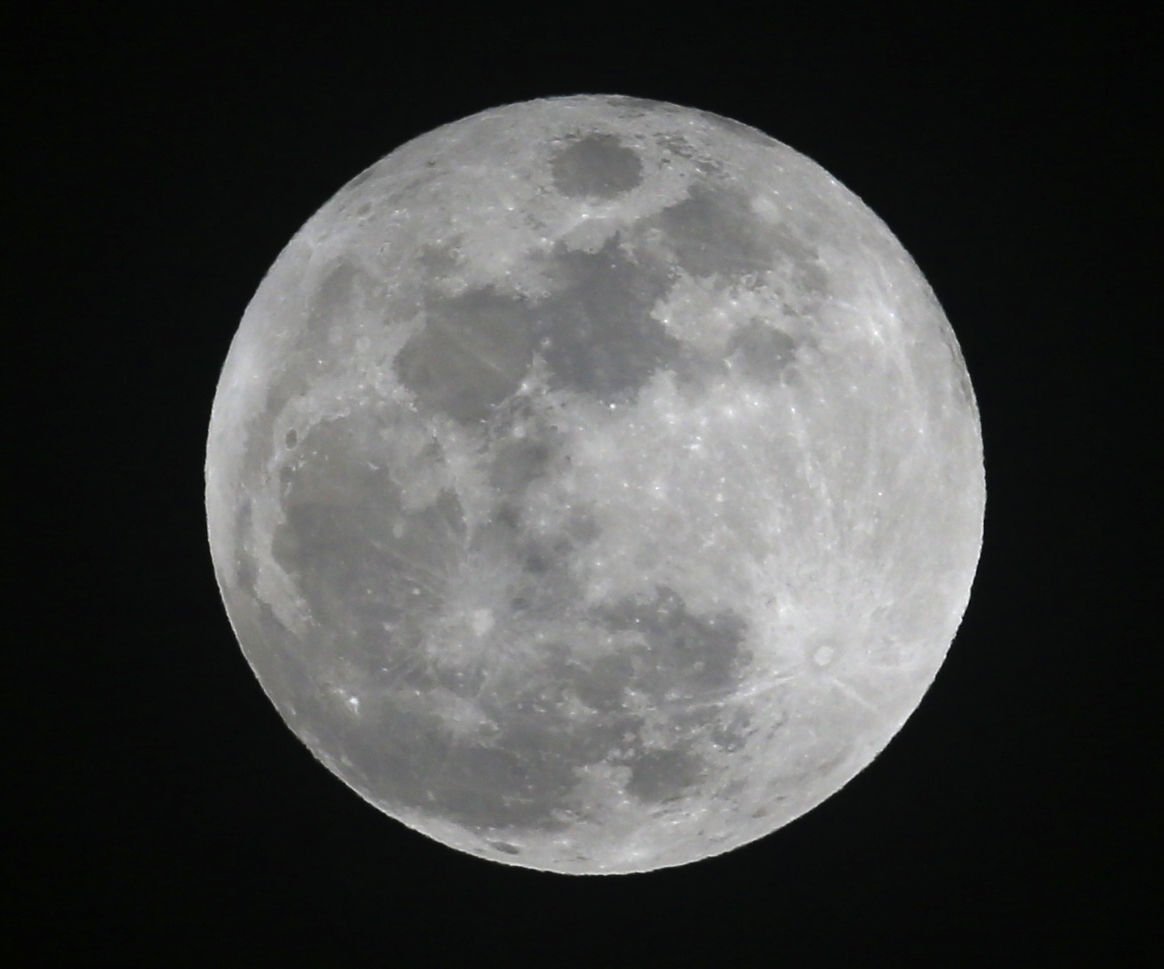
The night sky will be illuminated by a blue moon, the second full moon in a month. And with mostly clear skies expected tonight in much of the U.S., you'll have a good chance to see the blue moon. Clouds are expected mainly in some parts of the north and east, according to the National Weather Service.
It's also the first time a Halloween full moon has appeared for all time zones since 1944, according to Farmers' Almanac.
Every month has a full moon, but because the lunar cycle and the calendar year aren't perfectly synched, about every three years we wind up with two in the same calendar month.
October's first full moon, also known as the harvest moon, appeared Oct. 1. Tonight is the first instance of a blue moon in the Americas since March 2018.
People are also reading…
The "once in a blue moon" phenomenon does not necessarily mean the moon will look blue on Halloween. While the dark blue tone of an evening sky can affect the coloring we see, Earth's satellite will most likely not appear blue at all.
Typically, when a moon does take on a bluish hue, it is because of smoke or dust particles in the atmosphere, such as during a major volcanic eruption.
When the phrase "once in a blue moon" was coined, it meant something so rare you'd be lucky (or unlucky) to see in your lifetime, according to NASA.
What is the Harvest Moon? A guide to full moon nicknames
What is the Flower Moon? A guide to full moon nicknames
January: Wolf Moon
The names for full moons, especially the most common ones adopted by the Old Farmer's Almanac, generally come from a combination of Native American and Colonial American terminology that have been passed down through generations.
According to the Old Farmer's Almanac, January's full moon was named the Wolf Moon because wolves tend to howl more during this time period.
Other names: Moon After Yule, Old Moon, Ice Moon, and Snow Moon.

An airplane passes the full moon, known in the Farmers' Almanac as the "Wolf Moon," on its final approach to Los Angeles International Airport over Whittier, Calif. on Wednesday, Jan. 15, 2014. (AP Photo/Nick Ut)
February: Snow Moon
February is generally the snowiest month of the year in North America, so its full moon was appropriately nicknamed the Snow Moon, according to the Old Farmer's Almanac.
Other names: Hunger Moon, Storm Moon and Chaste Moon.
The full Snow Moon lights up the night sky over Lawrence, Kan., Friday, Feb. 10, 2017. February's full moon is so-named from Native American traditions because usually the heaviest snows fall in month. (AP Photo/Orlin Wagner)
March: Worm Moon
March marks the end of winter, which is the first time earthworms start coming out of the ground. The Worm Moon in March is usually the last full moon before the spring equinox.
Other names: Crow Moon, Crust Moon, Sap Moon, Sugar Moon, and Chaste Moon.
According to TimeandDate.com, the Old English or Anglo-Saxon name is the Lenten Moon.

The full moon rises above the Lincoln Memorial, the Washington Monument and the U.S. Capitol in Washington on Saturday, March 19, 2011. The moon appeared larger as it made its closest approach to Earth in 18 years. (AP Photo/Jose Luis Magana)
April: Pink Moon
April's Pink Moon doesn't actually appear pink in the sky. It's named instead after the pink flowers – Wild Ground Phlox or Moss Phlox– that start showing up in early spring, according to TimeandDate.com.
April's full moon is also called the Paschal Full Moon in the Christian calendar. The Paschal Full Moon is the first full moon after the Vernal Equinox and is used to determine the date for Easter.
Other names: Sprouting Grass Moon, Fish Moon, Hare Moon, and Egg Moon

A view of the full pink moon, in Lakatamia a suburb of capital Nicosia, Cyprus, Friday, April 19, 2019. (AP Photo/Petros Karadjias)
May: Flower Moon
May's full moon is simply named the Flower Moon due to the flowers that bloom during the month.
Other names: Corn Planting Moon and Milk Moon.

A full moon rises behind the Temple of Poseidon in Cape Sounion, south east of Athens, Greece, while tourists watch, on Saturday, May 5, 2012. Saturday's event is a "supermoon," the closest and therefore the biggest and brightest full moon of the year. (AP Photo/Dimitri Messinis)
June: Strawberry Moon
In North America, the name comes from Algonquin tribes of Native Americans. This full moon was their sign to harvest wild strawberries, according to The Old Farmer's Almanac.
Other names: Honey Moon, Mead Moon, Full Rose Moon, Oak Moon, Cold Moon or Long Night Moon, according to EarthSky.org.

The nearly full moon rises in the background as a horse eat grass in a field in Bloomsburg, Pa., after the sunset Monday, June 16, 2008, following a thunder storm which moved across the region. (AP Photo/Bloomsburg Press Enterprise, Jimmy May)
July: Buck Moon
Antlers generally start showing up on male deer during July, giving the month's full moon the name Buck Moon.
Other names: Thunder Moon, Wort Moon, and Hay Moon.

Fireworks light up the sky against a full moon during a Fourth of July celebration in Kansas City, Kan., Tuesday, July 3, 2012. (AP Photo/Charlie Riedel)
August: Sturgeon Moon
Many Native American tribes would fish for sturgeon during August, thus giving the month's full moon the name Sturgeon Moon.
The fish were once found in much of the U.S. and Canada, but the population has been significantly depleted due to overfishing.
Other names: Grain Moon, Green Corn Moon, Fruit Moon, and Barley Moon.

The super moon rises over the Chinese calligraphy on a sign that reads "Beijing" in Beijing, China, Sunday, August 10, 2014. The phenomenon, which scientists call a perigee moon, occurs when the moon is near the horizon and appears larger and brighter than other full moons. (AP Photo/Andy Wong)
September: Harvest Moon/Corn Moon
The September full moon is usually the Harvest Moon, which is the full moon closest to the autumnal equinox. However, that sometimes happens in early October instead.
The name Corn Moon is used nearly as often.
Other names: Barley Moon.

The harvest moon rises over the Colorado prairie framed by the engines of a Royal Air Force cargo plane parked at a general aviation terminal at Denver International Airport in east Denver on Thursday, Sept. 27, 2007. (AP Photo/David Zalubowski)
October: Hunter's Moon
As previously mentioned, October's full moon is sometimes referred to as the Harvest Moon if it's the closest full moon to the autumnal equinox. However, it's more commonly referred to as the Hunter's Moon. This is because October was when people in the Northern Hemisphere would begin preparing for winter by hunting, slaughtering and preserving meat.
Other names: Blood Moon, Sanguine Moon, Travel Moon and Dying Grass Moon.

A pedestrian crosses over the John A. Roebling Suspension Bridge as the full moon rises, Thursday, Oct. 5, 2017, in Cincinnati. The moon, better known as the Harvest Moon because it's the first full moon during the fall season, had not risen in its full stage during the month of October since 2009. (AP Photo/John Minchillo)
November: Beaver Moon
Colonists and Native Americans used beaver furs to keep warm during winter. They'd set traps in November before swamps froze over to make sure they had enough fur for the cold months ahead. Beavers also became more active during November, making it that much easier to trap them, thus the name Beaver Moon.
Due to hunting, the beaver population in North America has dwindled to about 12 million, where it used to be about 60 million, according to TimeandDate.com.
Other names: Frost Moon, Trading Moon, Snow Moon and Mourning Moon.

The full moon rises behind holiday lights on Thanksgiving in Lawrence, Kan., Thursday, Nov. 22, 2018. (AP Photo/Orlin Wagner)
December: Cold Moon
The naming of December's full moon is pretty straightforward — it's cold in December in most parts of the Northern Hemisphere. More specifically, it's usually the first month in many areas where it gets really cold and stays that way.
Other names: Long Nights Moon, Moon Before Yule, Oak Moon and Wolf Moon.

The Full Cold Moon seen through the star of a Christmas tree in Beirut, Lebanon, Thursday, Dec. 24, 2015. The full moon, which is the last of the year, is called the Full Cold Moon because it occurs at the start of winter. The last time there was a full moon on 25 December was 1977, and there won't be another one until 2034. (AP Photo/Hassan Ammar)
Blue Moons
The Blue Moon has nothing to do with color. Most commonly, a Blue Moon occurs when there are two full moons in the same month. The first would get the traditional name, while the second moon is called the Blue Moon.
An alternative definition considers a Blue Moon the third full moon in an astronomical season with four full moons, according to TimeandDate.com. A typical season has three full moons.

A blue moon rises behind the Statue of Liberty seen from Liberty State Park in Jersey City, N.J., Friday, July 31, 2015. The blue moon happens when the moon rises in its full stage twice during the same month. (AP Photo/Julio Cortez)
More moon fun facts: No. 1, it's not made of cheese
It's not made of cheese, and 12 other fun moon facts
Cheese myth origin

Though the idea that the moon is made of cheese has been around for millennia, it’s doubtful that anyone truly believed it, Mental Floss notes. Perhaps the earliest record of this notion comes from a medieval story about a ravenous wolf chasing a fox, hoping to score an easy meal. The fox convinces his pursuer that the moon’s reflection on a pond is a block of cheese floating on the surface and that the wolf must drink all the water to nab the tasty treat. The wolf drinks too much and bursts.
Moon shot speech

On May 25, 1961, President John F. Kennedy gave a historic speech before a joint session of Congress that set the United States on the path to the moon. “First," he said, "I believe that this nation should commit itself to achieving the goal, before this decade is out, of landing a man on the moon and returning him safely to the Earth.”
To the moon

Apollo 11 launched from the Kennedy Space Center in Florida on July 16, 1969, carrying Commander Neil Armstrong, command module pilot Michael Collins and lunar module pilot Edwin "Buzz" Aldrin. An estimated 530 million people watched Armstrong's televised image and heard him describe "one small step for a man, one giant leap for mankind" on July 20, 1969.
Plan to make money

The astronauts got creative about how to support their families if they did not return from space: autographs. According to NPR, during quarantine (about a month before Apollo 11 launched), the astronauts signed hundreds of envelopes and gave them to a friend to save in case the worst happened.
Anything to declare?

In 2015, Buzz Aldrin revealed that the Apollo 11 astronauts were required to sign customs forms after they returned to Earth and declared they were carrying "moon rock and moon dust samples.”
It's been a long time

In 1972, Apollo 17 was the last Apollo mission to place people on the moon. It carried the only trained geologist to walk on the lunar surface, lunar module pilot Harrison Schmitt. Eugene Cernan, commander of Apollo 17, still holds the distinction of being the last person to walk on the moon.
Moon superstitions

Superstitions concerning the moon have been around for centuries. People long have been intrigued by the notion that a full moon drives people to madness and crime. The myth is embedded in popular culture and folklore about werewolves and Creedence Clearwater Revival's "Bad Moon Rising." The word "lunacy" has its roots in the Latin word for moon. The ancient Mesopotamians saw lunar eclipses as an assault on the moon by seven demons. In Togo and Benin, there is a myth that the sun and the moon are fighting during an eclipse and that people must come together to encourage them to stop, National Geographic reports.
Blood moon

The full moon will pass through Earth’s shadow on the night of July 27 and emerge as the blood moon, a lunar eclipse. The sun, Earth and moon are closely aligned at this time. The moon will take on a deep red to orange hue, creating a great opportunity for astronomers and photographers to capture the spectacle. A super blood moon, such as the one pictured last year, is a total lunar eclipse and occurs when the moon is at its closest to Earth.
Total solar eclipse

Total solar eclipses occur when the new moon comes between the sun and Earth and casts the darkest part of its shadow, the umbra, on Earth. A full solar eclipse was observed in the U.S. last August (pictured), plunging a swath of the land into darkness for a few minutes in the path of totality.
The tides

While both the moon and the sun influence the ocean tides, the moon plays the biggest role because it is closer to Earth than the sun. The tidal effect of the moon on Earth is more than twice as strong as that of the sun, even though the sun's gravitational pull on Earth is about 178 times stronger than that of the moon, Timeanddate.com reports.
Moon phases

The moon is rotating at the same rate that it revolves around the Earth (called synchronous rotation), so the same hemisphere faces Earth at all times. The phases of the moon depend on its position in relation to the sun and Earth. As the moon makes its way around the Earth, we see the bright parts of the moon's surface at different angles. During a full moon, the hemisphere of the moon we can see from Earth is fully illuminated by the sun.
Lunar meteorites

Lunar meteorites are rocks found on Earth that were ejected from the moon by the impact of an asteroid or possibly a comet. Scientists have discovered traces of moganite in a lunar meteorite that was discovered 13 years ago in Africa. This mineral requires water to form, so its discovery is possible confirmation that frozen water exists beneath the moon’s dusty surface. Pictured are a few meteorites in the collection of Dave Radosevich of Garden Grove, Calif.
Lunar samples

Six Apollo missions brought back more than 800 pounds of lunar material, NASA says, and a 2011 agency report found hundreds of samples missing. The lunar bag Neil Armstrong used to bring back moon dust samples in 1969 sold at auction for $1.8 million last year after a legal battle between NASA and a previous owner. Moon rocks at Johnson Space Center in Houston are pictured.


