Despite the pandemic, 2020 was a landmark year for the commercial space industry. SpaceX became the first company ever to send humans to space aboard a privately owned spacecraft. The U.S. government continued to work closely with startups and space businesses to put humans back on the Moon. And, helped by governments declaring them "essential businesses" amid the pandemic, a pack of young space companies kept working to create new rockets or satellite services.
But 2021 is expected to be even bigger for the burgeoning industry as reigning giants such as SpaceX continue to pursue futuristic technologies — from Mars rockets to space-based internet service and extraterrestrial tourism.
Here's a look at what the private sector has planned in space next year.

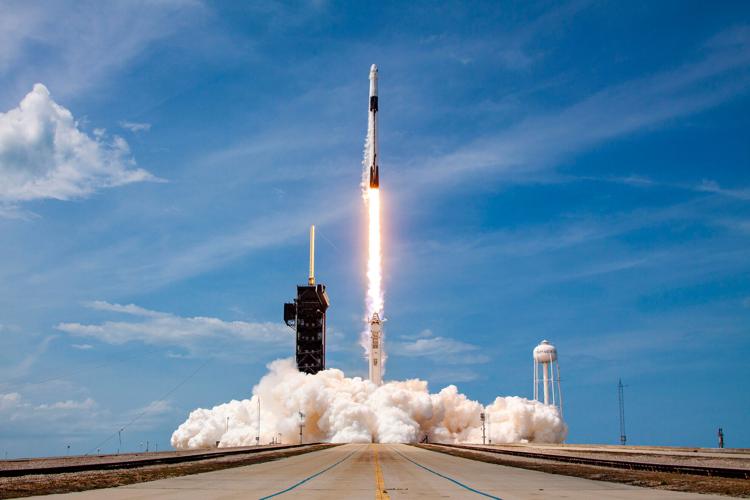
MAY 30: In this SpaceX handout image, a Falcon 9 rocket carrying the company's Crew Dragon spacecraft launches on the Demo-2 mission to the International Space Station with NASA astronauts Robert Behnken and Douglas Hurley onboard at Launch Complex 39A May 30, 2020, at the Kennedy Space Center, Cape Canaveral, Florida. The Demo-2 mission is the first launch of a manned SpaceX Crew Dragon spacecraft. It was the first launch of an American crew from U.S. soil since the conclusion of the Space Shuttle program in 2011.
Astronauts fly commercial
People are also reading…
SpaceX made history when its Crew Dragon spacecraft proved it can ferry NASA astronauts to the International Space Station, marking the first time in SpaceX's 18-year history that the company put humans in space. It was also the climax of a decade-long partnership with NASA to return human spaceflight capabilities to the United States.
SpaceX is expected to make those trips routine. Another group of astronauts is expected to take flight aboard a Crew Dragon in Spring 2021, and yet another Crew Dragon flight could launch next Fall.
The ability to fly its own astronauts after spending nearly a decade relying on Russian spacecraft to put US astronauts in space is a huge deal for NASA. The space agency says it'll now be able to keep the space station fully staffed, allowing a dramatic boost in the amount of research that astronauts are able to conduct aboard the ISS.
Next year, Boeing could also add another vehicle to the United States' arsenal of human-worthy spacecraft. The company is planning to conduct the first crewed flight of its Starliner vehicle, which is being developed under the same NASA program as SpaceX's Crew Dragon.
Boeing's Starliner, which looks similar to SpaceX's Crew Dragon, will first need to re-do a botched flight test that the company tried to carry out one year ago. Boeing says it's targeting March 29 for a second attempt, and — if all goes well — Starliner's first crewed launch could kick off a few months later.
Orbital tourism
Both Boeing and SpaceX's spacecraft are privately owned, per the terms of the development deal they signed with NASA, which means both companies will have the option to sell seats aboard their spacecraft to anyone who can afford the roughly $50 million per-seat price tag.
SpaceX has already signed a deal with Axiom, a startup founded by former NASA Administrator Michael Suffredini, to take a group of "private astronauts" to the ISS aboard a Crew Dragon in the second half of 2021.
Axiom has confirmed two of the crew members that will be on that flight: Michael Lopez-Alegria, a former NASA astronaut and veteran of three Space Shuttle missions who will fly as a private citizen, and Eytan Stibbe, a former Israeli fighter pilot and wealthy investor who is reportedly funding his own trip.

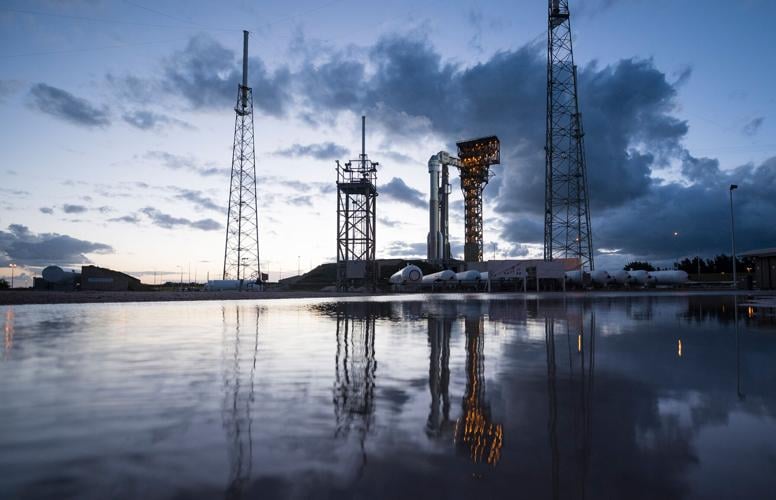
A United Launch Alliance Atlas V rocket with Boeing's CST-100 Starliner spacecraft onboard is seen on the launch pad at Space Launch Complex 41 ahead of the Orbital Flight Test mission in December 2019.
Suborbital joy rides
Two billionaire-backed ventures — Richard Branson's Virgin Galactic and Jeff Bezos's Blue Origin — are developing small rocket-powered vehicles with the goal of sending wealthy thrill-seekers on brief trips into the upper atmosphere.
Virgin Galactic, which went public via a reversed merger in 2019, has moved into its luxurious new spaceport in New Mexico and is preparing to open for business as soon as next year. Branson is planning to be among the first passengers on board the supersonic space plane that the company has spent the past two decades building and testing. A recent test flight of that vehicle was cut short due to an engine issue, but Virgin Galactic is still hoping to finish its final tests within the next few months.
Blue Origin, which developed a fully autonomous rocket and capsule that takes off vertically from a launch pad, could also open for business next year. The company has tested its technology at a remote site in West Texas 13 times and spent years showing off the spacecraft's large windows and spacious cabin.
Blue Origin, however, has not yet announced the price of tickets or when it plans to start selling them.
Virgin Galactic, on the other hand, has sold more than 600 tickets priced between $200,000 and $250,000. And the company plans to reopen ticket sales soon, though executives have warned that prices will go up.
ULA goes to the Moon, Bezos's orbital rocket takes flight
In the rocket launch business, SpaceX may be facing stiffer competition than ever next year. Two companies — United Launch Alliance, a joint Lockheed Martin-Boeing venture, and Blue Origin — are planning to introduce two massive new launch vehicles that aim to compete with SpaceX's Falcon rockets on launch power and price.
Blue Origin's towering New Glenn rocket — which is roughly five times taller than the company's space tourism rocket — is expected to conduct its inaugural launch next year after years of development.
ULA's rocket, called the Vulcan Centaur, is expected to kick off with a bang: It's first-ever mission will be to deliver a lunar lander to the moon sometime next year. That rover, built by a startup called Astrobotic, will deliver research cargo to the lunar surface on behalf of NASA.
Blue Origin's, ULA's and SpaceX's hulking rockets are expected to battle it out for lucrative government launch contracts for years to come. The United States military, for example, recently selected SpaceX and ULA for nearly a billion dollars with of contracts. Blue Origin lost out on that round, but it's expected to continue vying for future missions.

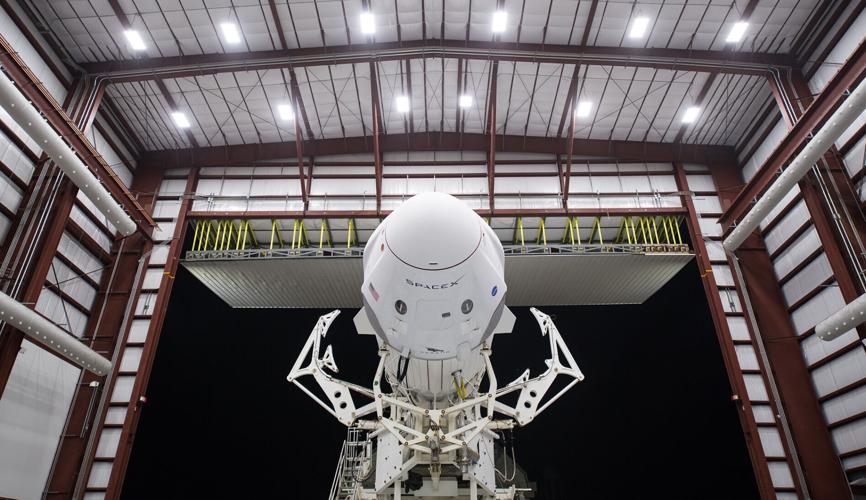
A SpaceX Falcon 9 rocket with the company's Crew Dragon spacecraft onboard is seen as it is rolled out of the horizontal integration facility at Launch Complex 39A as preparations continue for the November Crew-1 mission.
Small rockets
For years, a group of young companies have hoped to develop small rockets — a fraction of the size of SpaceX's Falcon rockets — that can cheaply launch new satellites into space on a regular bases. This could open up new business opportunities, according to entrepreneurs and Silicon Valley investors.
Rocket Lab is the only one of those companies to actually put a rocket in space so far, and it has launched more than a dozen successful missions in the past couple of years.
But 2021 may be the year that new players finally enter the scene.
Astra, based in Alameda, California, has already conducted two test launches and is aiming to put its first rocket into orbit next year. Los Angeles-based Relativity, which is working to 3D print its rockets, is aiming for its inaugural launch next Fall. And Texas-based Firefly may attempt to put its 95-foot-tall Alpha rocket on a launch pad within the next few months.
Funding the future
It's not clear how many small rocket launch vehicles the business sector actually needs. But more than 100 startups are vying to join the ranks of Rocket Lab — and that is definitely too many, Ann Kim, the managing director of frontier technology at Silicon Valley Bank, told CNN Business.
2021 could be a year that many of those companies begin to merge or go out of business.
That doesn't mean, however, that venture capital investors are no longer interested in backing space-focused startups, Kim said. Investors have so far poured more than $166 billion into 1,128 different space startups involved in key aspects of the industry, from launching rockets to crunching data collected by satellites, according to data collected by Space Capital, the analysis arm of the investment group Space Angels.
Venture capital funds have tens of billions more to deploy in 2021, according to Kim.
But investors will likely be putting their cash into more data and software-focused companies, rather than into ventures hoping to break into the costly and risky hardware business. At this point, the industry has picked its frontrunners for who investors believe will have viable rocket and satellite businesses, Kim said.
SpaceX: Starship and Starlink
SpaceX, the poster child of the commercial space era, has two major projects that are likely to see plenty of action in 2021: Starship — a massive rocket that CEO Elon Musk hopes will put humans on Mars — and Starlink, a swarm of satellites in low-Earth orbit that SpaceX plans to use to beam the internet into homes from space.
SpaceX has already deployed about 1,000 satellites to get its Starlink network running, and the company will continue to add more as it finishes a beta testing program. It could become commercially available early next year.
Starship, the Mars rocket, is still in its very early stages of development. But SpaceX has managed to garner plenty of public interest in the development process. The company has constructed several large, steel rocket bodies and has been putting them on a launch pad to conduct increasingly higher test flights.
Musk, who founded SpaceX with the goal of colonizing Mars, promises to keep that action going well into 2021.
Shoot for the stars: 11 things you didn’t know about applying to be a NASA astronaut
Shoot for the stars: 11 things you didn’t know about applying to be a NASA astronaut
Help wanted

Currently, NASA has 48 astronauts in its corps and is seeking more applicants.
Sign of the times

According to WHTR, the application closed on March 31 and included, for the first time, an online assessment portion.
Stem's the word

One of the basic application requirements to be an astronaut in the next class of Artemis Generation is a master’s degree in a STEM-related field. According to the NASA website, “The requirement for the master’s degree can also be met by: Two years (36 semester hours or 54 quarter hours) of work toward a Ph.D. program in a related science, technology, engineering or math field; A completed doctor of medicine or doctor of osteopathic medicine degree; Completion (or current enrollment that will result in completion by June 2021) of a nationally recognized test pilot school program.
Learning to fly

Being an astronaut for NASA requires a bit of flight experience, specifically, “at least 1,000 hours of pilot-in-command time in jet aircraft,” according to NASA’s website. They can also have at least two years of professional experience related to their degree which can include jobs like teaching kindergarten.
Extras

Space.com notes that astronaut candidates (known by the acronym ASCAN) can help themselves in the application process by having other skills like scuba diving, wilderness experience and fluency in a foreign language (Space.com notes that all astronauts are required to speak Russian).
Height requirement

ASCANs should be between 62 and 75 in. (5’2” to 6’3” in.) to meet NASA’s “anthropomorphic requirements,” Science Direct notes. According to the NASA website, these contemporary requirements are much more flexible. During the first flight in 1959, astronauts had to be shorter than 5 feet 11 inches to fit in the Mercury spacecraft.
Get your sea legs before space

According to Science Direct, ASCANs have to also pass a swim test, become SCUBA certified and pass a military water survival test. CBS notes that the swim test includes swimming three lengths of a pool and treading water for 10 minutes in a flight suit and tennis shoes.
If at first you don't succeed

Many astronauts don’t get accepted on the first try, Space.com says. In fact, Clay Anderson applied 15 times and waited two more years before becoming an astronaut and serving as a member of the Expedition 15 crew aboard the International Space Station in 1998.
I can see clearly now

Perfect vision is crucial for ASCANS—even if they need a little help to achieve it. Part of the physical requirements to be an astronaut are 20/20 vision either with or without glasses or contacts.
A shrinking application pool

The NASA application, according to Wired, drew in more than 18,000 applicants. Of those applicants, Wired reports that around 14,000 will meet the basic requirements. A review panel of experienced astronauts then whittles down the applicant pool to 500. After reference checks and a first round of interviews, the pool goes from 500 to 100 to around 50 or 60 who go on to the second round of interviews. After the intense space-flight physical, between eight and 14 applicants will become astronauts and begin training
Age ain't nothing but a number

Astronauts have been a wide range of ages according to CBS. Most fall between the ages of 26 and 46, with the average being about 34 years.
The-CNN-Wire™ & © 2020 Cable News Network, Inc., a WarnerMedia Company. All rights reserved.