

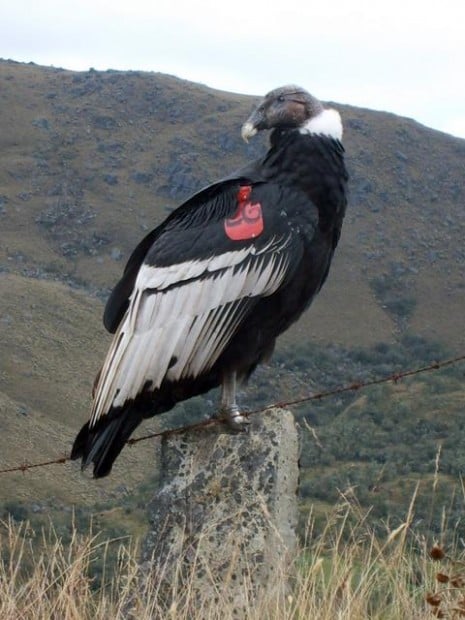
SOGAMOSO, Colombia — In ancient times, they were revered as messengers of the gods. Later, they proudly soared on the Colombian coat of arms. But at this moment, two young condors just wanted their dinner.
So local "condor keepers" placed a cow fetus on a desolate rain-swept cliff here in the Colombian Andes Mountains, the weekly ration for Iraka and Ogonta, two females released earlier in 2009 in a repopulation program sponsored by Southern California's San Diego Zoo.
Donated by a local slaughterhouse, animal carcasses are the ideal diet for the monumental birds — "good-quality rotting food," as the zoo's Alan Lieberman described it. The Andean condors are the latest of 70 birds released in Colombia since 1989 after being hatched and raised in 20 U.S. zoos, most often at the San Diego Zoo.
The reintroduction program has helped push Colombia's condor population to about 150 birds, said Orlando Feliciano, a Bogota veterinarian who has worked with the San Diego Zoo on the project since its inception. In the mid-1980s, condors in Colombia numbered no more than 15, he said.
People are also reading…
For centuries, condors were killed by people who either thought, mistakenly, that the carrion-eating birds attacked livestock or that their feathers or bones had magical or medicinal powers.
"They were virtually extinct, as they are today in Venezuela," Feliciano said.
The condors have an impressive survival rate here: About 70 percent are thought to live through the yearlong reintroduction into the wild before being forced to "make a living on their own," Lieberman said.
That success reflects the environmental consciousness of towns such as Sogamoso, not to mention the residents' realization that the birds can attract tourists.
Located about 110 miles northeast of Bogota, Sogamoso is on the edge of the 100,000-acre Siscunsi Regional Nature Park that the state of Boyaca established for the condors.
Earlier in August, when Iraka flew to a town 30 miles from here and perched, disoriented, looking for food, locals knew to call authorities to capture the bird and take it back to Siscunsi park.
Eleven local farmers, including Victor Rios, have been named "condor keepers." Outfitted with uniforms, binoculars and hand-held antennas that detect signals emitted from radio transmitters attached to the condors' wings, they monitor the birds' movements as best they can.
"They are such majestic animals you can't help but be fascinated," said Rios, who also is paid a small monthly stipend.
The condors imported to Colombia were all hatched by pairs of Andean condors in zoos in San Diego, Los Angeles, Cincinnati, Pittsburgh, Denver and elsewhere.
Once the birds are 3 to 4 years old, they are turned over to the San Diego Zoo, which outfits them with radio transmitters and ships them to Colombia, where biologists in five Andean regions called "repopulation nuclei" take over.
The apparent success of the costly program — which parallels a similar program for the California condor — bespeaks the financial and personnel commitment of the U.S. zoos, particularly San Diego's, that underwrite most of the costs.
The raising, transportation and outfitting of each condor with an implanted radio costs "thousands of dollars" per bird, said Michael Mace, the San Diego Zoo's curator of birds.
"We do it because we can, as stewards of the planet and mindful of our responsibility to take care of the ecosystem and the wildlife within it," said Lieberman, who directs the San Diego Zoo's field programs.
The two condors released in February brought to 11 the total set free in Boyaca state since 2004. Two have died — one killed by a hunter, another electrocuted on a high power line.
The state environment office, Corpoboyaca, and a local nongovernmental organization known as Fundetropico, educate local schoolchildren and farmers that, contrary to common belief, condors do not kill livestock or threaten humans, but eat only carrion, the decaying flesh of dead animals.
For centuries, such misconceptions caused relentless hunting of the birds.The education programs tout the condors' role in cleaning the environment and their cultural significance.
"Condors are the emblem of Colombia, a symbol for all South America," Feliciano said.
"We teach the mythic value of the condor, how pre-Columbians saw them as a medium of the gods," said Olga Lucia Nuñez, a biologist with Fundetropico. "Condors stand for peace and respect. They are messengers from the sun."


