

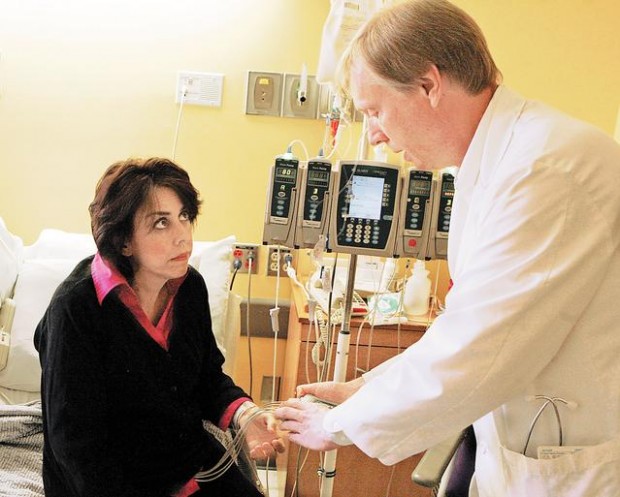
Until she took a few bites of mashed potatoes this week, Leslie Terán-Richter had not eaten since October.
Though she'd been receiving nutrients through an intravenous line, it certainly wasn't as satisfying as eating solid food. She found herself having detailed fantasies about pasta and bean-and-cheese burritos. Watching television only fueled her obsession.
She even started singing a jingle from a particularly torturous advertisement about Jack in the Box mini- sirloin burgers.
The Rio Rico woman, 44, is the first person in Arizona to have a small-bowel transplant, with a donation that came courtesy of her older sister, Michelle Terán. Prior to her April 30 surgery at University Medical Center, she had faced a lifetime of receiving sustenance via IV.
In addition to impeding their quality of life, receiving nutrition intravenously — called total parenteral nutrition — puts patients at a higher risk of developing liver failure and infections.
People are also reading…
Intestine transplants are rare and available at only a handful of U.S. medical centers. Until this year, Tucson patients who needed such transplants had to go out of state. Since the chairman of the University of Arizona's Department of Surgery, who came to Tucson from Minnesota in 2007, is nationally noted for his work in intestinal transplants, the surgery for the first time is available here, too.
Dr. Rainer Gruessner standardized the technique of living-donor intestinal transplants during the 1990s while he was vice chairman of the surgery department at the University of Minnesota. He's performed other live intestinal transplants, but until Terán-Richter's nine-hour surgery he hadn't done one in Arizona.
Doctors say the surgery also marked the first living-donor intestinal transplant — as opposed to using a deceased donor — in the entire Southwest. Only 40 to 50 have been performed worldwide, Gruessner said. Not only is the surgery risky, but there's also a lack of awareness about it, he said.
Terán-Richter, a records manager for the town of Sahuarita, fell ill last October with little warning. She'd completed chemotherapy for breast cancer last May and was otherwise enjoying good health. She even enjoyed a cruise to the Caribbean in September. But she began having stomach pains that grew so severe Oct. 1 that she and her husband, Eric, went to the emergency room at Holy Cross Hospital in Nogales, Ariz.
She was sent home the next morning, thinking she had gastroenteritis — a common inflammation of the gastrointestinal tract, she said. But that day, Terán-Richter passed out while brushing her teeth, her husband recalled.
She ended up being airlifted to Tucson Medical Center, where doctors discovered she had developed a rare condition — sometimes called "short gut syndrome" — in which her small bowel had twisted, completely blocking the blood flow. All but 5 inches of her small intestine, which is typically 25 to 27 feet long, had died. Terán-Richter's prognosis was grim.
Eric Richter, 46, who had been told to prepare for the worst, immediately sought out Gruessner.
"She was on a path that would have eventually led to disaster," Gruessner said.
"It was a freaky, one-in-a-million thing," Terán-Richter said this week during an interview in her room at University Medical Center. "Cancer was a cakewalk compared to this."
Both of Terán-Richter's older sisters offered to donate portions of their small bowels, which eliminated a need for her to go on a waiting list. Still, it was another six months before the transplant occurred. Among other things, the Richters had to persuade their insurance company to cover the transplant.
Terán-Richter went back to work in December, along with her IV and a bag her husband disguised as a purse to collect her fluids. Eric also drove her to and from work every day. Terán-Richter kept working until the date of her operation.
Though it was risky, she was relieved to go to University Medical Center for the April 30 surgery. Michelle Terán, a San Diego Realtor who flew in for the procedure, donated 6 feet of her small intestine at the same time. Two weeks later Terán, 56, is working again and, other than some pain and an 8-inch scar, is doing fine. She's expected to recover fully and has the same expectation for her little sister.
"She's fought breast cancer and now this. She's pretty amazing, as far as being resilient to the cards not exactly being laid in her direction," Terán said. "I'm just trying to spread the word now. I think a lot of people don't know this can be done — people with malfunctions of the small intestines."
Terán-Richter, who hopes to go home from the hospital this Saturday, is looking forward to getting her life back, spending time with her family and her rescue dog, Pepito, and to moving a little more. She'd like to start yoga and Pilates.
She's also looking forward to eating a real meal. Though she'd been looking forward to eating for so long, so far she's been unable to take more than a few bites.
She'll have to continue getting biopsies of her small intestine twice per week for the next few months, but doctors are hopeful Terán-Richter will otherwise lead a normal life. The biggest risk continues to be rejection, since small-bowel transplants have a high rejection rate. She'll be on anti-rejection drugs for the rest of her life.
Eric Richter is a construction worker and custom-home builder who has not been working since last year. Though Terán-Richter has health insurance, co-payments and related expenses from both her breast cancer and current condition have added up. The couple say their house will be foreclosed on June 30. But they already have a rental lined up in Green Valley and say they are counting their blessings because Terán-Richter is alive.
The couple, who have been married for nearly 15 years, first dated as teenagers before splitting up and getting back together several years later.
"Things happen for a reason," Eric Richter said. "There's a lot of negativity out there, but we shut that out. I have all the confidence that she'll recover."
Find more health information at www.tucson.com/health


