

PHOENIX — Biologists from the Arizona Game and Fish Department are trying to educate the public about bald eagles in hopes of gaining public support for programs aimed at protecting the birds.
The state's highest concentration of bald eagles can be found on the Verde River, from Granite Reef Dam on the south, near the confluence with the Salt River, up to the northern reaches of Bartlett Lake, about 40 miles north.
At least two nesting pairs have been found around the lake, a reservoir along the Verde.
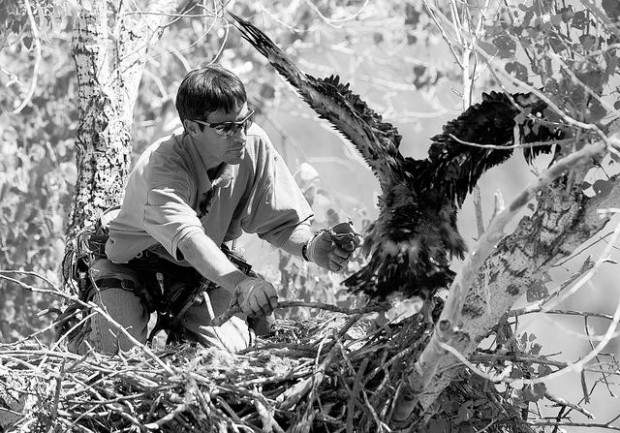
Game and Fish biologists try to identify every bald-eagle nestling they can reach and place bands on their legs.
With the banding, "we can model eagle health throughout the state," biologist Kenneth Jacobson said. "We can gauge their estimated mortality, how long it takes until breeding, whether breeding is successful and the number of areas they inhabit."
People are also reading…
While adult bald eagles stay put around their nesting sites in Arizona, juveniles have been tracked via satellite as far north as Swan Lake in Manitoba, Canada, and as far south as northern Mexico. Round trip is more than 2,200 miles.
It will be at least five years before the bird mates. It will take the same length of time to get the distinctive "bald" coloration, a pure white feathered head and white tail feathers.
Jacobson said the Game and Fish Department has located 52 nesting sites in Arizona so far this year, compared with 48 last year.
Biologists watch the birds closely because eagle populations were threatened throughout most of the United States by the use of the pesticide DDT. Only recently have numbers recovered to the point that the birds are being removed from the endangered list.
Without endangered-species protections, eagles will retain safeguards under the Migratory Bird Act, the Bald and Golden Eagle Protection Act and other state and federal policies.
Environmental groups, including the Center for Biological Diversity and the Maricopa Audubon Society, hope the final determination has a special place for Arizona eagles.
The organizations contend that the desert eagles need continued protection because they are isolated behaviorally, biologically and ecologically from other bald eagles. They breed earlier in the season and do not interbreed with bald eagles that nest elsewhere.
Jacobson said eagles are "doing very well" in Arizona. The Game and Fish Department supports taking the eagles off the endangered-species list, but it plans to continue its nest-watch program and other steps to protect the birds.


