PHOENIX — State fire officials unveiled a new network of cameras using artificial intelligence in hopes of spotting wildfires before they get too big.
That network, at least as far as the Department of Forestry and Fire Management itself is concerned, is not very big. It currently amounts to just seven cameras, mostly in Mohave County and southeast Arizona.
But it is designed to mesh with cameras already operated in forest areas by Arizona Public Service and Tucson Electric Power to look out for wildfires, said Russ Shumate, the forestry department's deputy director of operations. All totaled, according to fire officials, that makes close to 50 cameras.
"We put them in areas where they weren't, or were never going to be,'' Schumate said. So, for example, he said the decision to put cameras in Mohave County is directly related to the fact that APS does not serve the area.
People are also reading…
Data from all the cameras — run by both the state and the utilities — is fed into his agency's dispatch center.
While this technology avoids the need for full-time spotters living in fire towers traditionally placed on hilltops, it doesn't replace the human factor.
As Shumate explains, the cameras are programmed to look for any unusual smoke.

In this June 2020 photo, the Bighorn Fire burns into a small canyon behind a stand of saguaros in the Santa Catalina Mountains. John Truett, the state's fire management officer, warned Friday that 2026 could be a bad year for wildfires.
"It's deciding whether what it sees is a fire or not,'' he said. "What it does at that point is flags us and we start looking."
But not everything the cameras spot, and that the artificial intelligence flags, is the beginning of a forest fire.
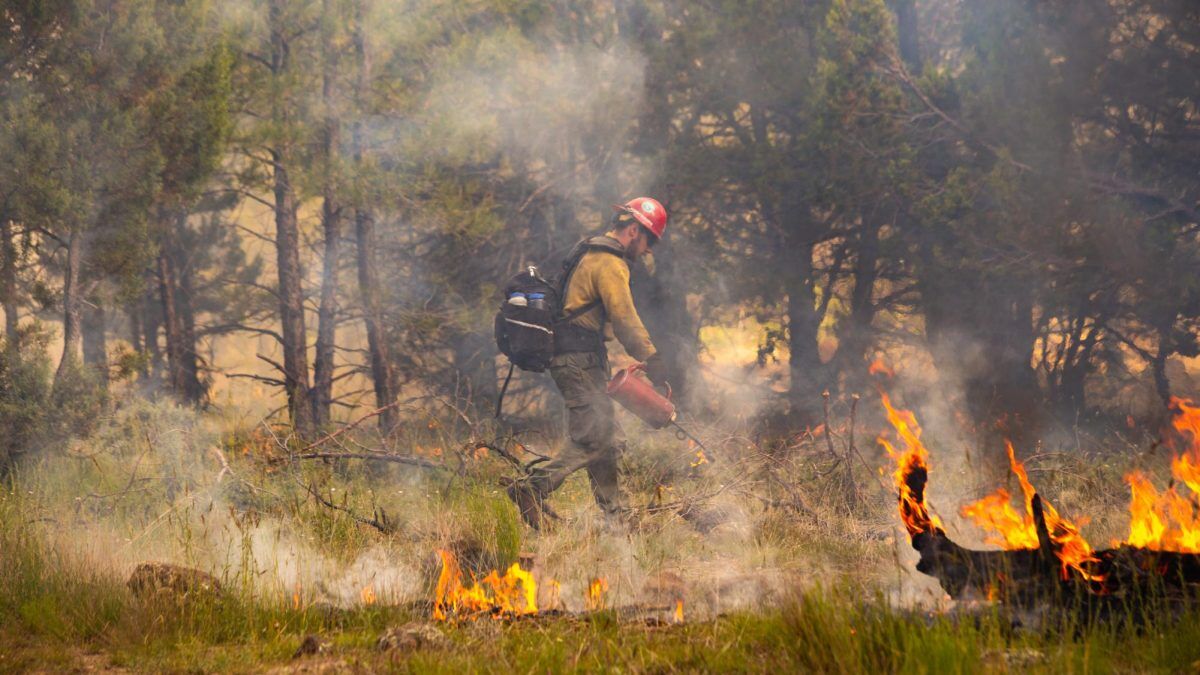
"It might be a prescribed fire,'' or might even be just dust or a vehicle going down a hill, Shumate explained. "The decision-making comes in after it gets flagged.''
Could be a bad year for fires
All this comes as John Truett, the state's fire management officer, warned Friday that this could be a particularly bad year for fires.
"This year we expect the season to ramp up quickly in the southern and southeast areas of Arizona due to long-term dryness and the fine fuel loading,'' he said.
"The abundant moisture that we had in the fall has led to an abundant grass crop,'' Truett said. "And those grass crops are already 'curing out' and ready to go.''
And in the rest of the state, by May, the problems will move north toward the Mogollon Rim "and up into the pine types at our higher elevations," he said. He also said there is a "very heavy grass crop'' in the Prescott and Chino Valley area.
Complicating matters is "tree mortality,'' with dry conditions making trees — especially the Ponderosa pines — particularly at risk of infestation from beetles.
"We have thousands of acres of dead pine trees out there that are just waiting to explode,'' Truett said.
Something else that's different this year: "Normally, the Southwest will be the first thing to start burning in the West. But this year, if you look at the maps, all the West is ready to burn," he said.
That's important because Arizona, like other states, depends on help from others, including the U.S. Bureau of Land Management for federal lands.
"So, we're going to be in a very stiff competition here in the next few weeks for resources,'' Truett said.
As to those cameras keeping an eye out for wildfires, Shumate said they have their limitations.
"Human towers can see farther out than AI towers,'' he said, with about a 10-mile limit on the cameras' ability to reliably spot smoke.
Also, Shumate said the fire towers have traditionally been placed at mountain peaks, providing the broadest view. But the cameras tend to be at the same level as the surrounding forest because of how they work in detecting smoke.
Howard Fischer is a veteran journalist who has been reporting since 1970 and covering state politics and the Legislature since 1982. Follow him on X, Bluesky and Threads at @azcapmedia or email azcapmedia@gmail.com.