

PITTSBURGH
Willie Tuitama was prepared for the biggest game of his life. All he had to do was click a mouse.
The UA's quarterback sat at a cramped computer desk inside a hospital last December, his career hanging in the balance.
First came a memory test, where words flashed every 750 milliseconds: Fork. Knife. Half. Stadium.
Zig-zagging lines flashed across the screen, followed by X's and O's. Tuitama finished a match-the-shapes drill, a color quiz and a final word exam. Each is designed to test a different part of the brain.
Tuitama glared at the monitor like it was an opposing defense, left-clicking and right-clicking with each brain-bending question. He finished the six-section test in 20 minutes.
"I thought I nailed it," he said.
People are also reading…
Tuitama, 20, knew what was at stake: His health. His football career. The immediate future of Arizona's program.
All because of a concussion, a closed-head injury that occurs when the brain rattles against the skull following sudden impact.
"To the individual who suffers the blow, it's like running downhill, head down, into a wall," said Dr. Emanuel Kanal, a neurological radiologist at the University of Pittsburgh Medical Center.
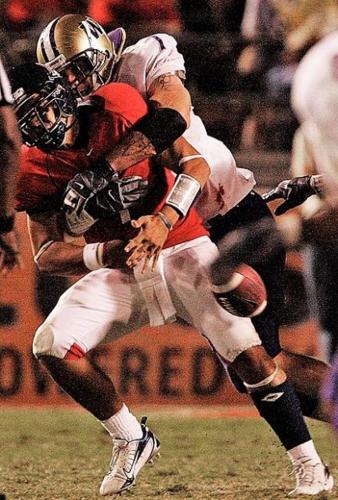
Tuitama was two weeks removed from his fourth episode in three months. The ordeal began Sept. 9, when he suffered a concussion during the first play of Arizona's 45-3 loss to Louisiana State University.
"With each of those hits, he got drilled," said Micky Collins, a neuropsychologist and Tuitama's doctor at UPMC.
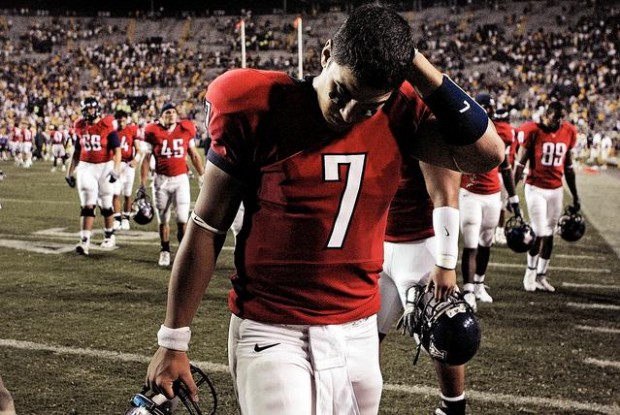
Arizona's star — who had never before his sophomore year had a concussion — spent the rest of the season battling both the side-effects and the stigma that he was injury-prone.
The quarterback traveled with assistant athletic director for medical services Randy Cohen and coach Mike Stoops to UPMC's renowned sports medicine clinic following the season to take the computerized ImPACT postconcussive analysis test and undergo an MRI. The university paid about $2,000 to send all three, according to public records obtained by the Star.
Positive results would clear him to play again. Any inconsistencies would put his promising career on hold.
The big hit
Tuitama couldn't stop screaming.
Arizona's quarterback lay on the Rose Bowl's 25-yard line last October, feeling as if someone was beating him in the back of his head.
He squeezed his eyes shut, like a child making a Christmas wish. The pain did not go away.
The Southern California sun, so post-card perfect just seconds earlier, now seared his brain like a white-hot poker. The UCLA marching band — so peppy when it played "Sons of Westwood" earlier — now ripped through his ears.
Tuitama howled loud enough that his teammates feared the quarterback had broken his leg in half, blown out a knee or separated a shoulder.
"But it was my head," Tuitama said. "I was yelling because it was so painful."
Concussion symptoms vary from the severe — permanent brain injury — to mild headache and nausea, depending on the location and severity of the hit.
Tuitama was particularly sensitive to light and sound on that Oct. 7 day, symptoms consistent with an injury to the back of the head.
Arizona's training staff took him to the sidelines and gave him earplugs to drown out some of the noise. They hung a white towel over his head to block out the sun.
Within a few minutes, the decision was made to take him to a nearby hospital for an MRI.
Lui Tuitama said his son was conscious the whole time, but in great pain.
"Willie knew where he was. He kept asking for the score … but he kept saying, 'Dad, my ears. Everything's loud.' "
The Tuitamas knew the drill by the time they arrived in the emergency room. Willie had suffered his first head injury over a month earlier against LSU. He stayed in the game for a few drives before nausea and short-term amnesia revealed the injury to Arizona coaches.
Tuitama was clearly symptomatic as the LSU game wore on. He tried to call an old Pop Warner play in the huddle. He rolled left on a pass attempt only to inexplicably hold onto the ball as he took another sack.
"I don't know what I was thinking," Tuitama said. "I was kind of outta whack."
Doctors determined that Tuitama never fully recovered from the LSU hit.
Tuitama missed all or parts of seven games. He was on the sidelines, seething, when Arizona's season ended with a Nov. 25 loss to Arizona State.
The training staff hid his helmet.
"They had to do what they had to do," Tuitama said. "Not playing was just something I had to deal with."
Wants to play
Initially, Lui Tuitama couldn't see what the fuss was about. He said he had suffered five concussions during his playing career in high school and college.
The elder Tuitama was hospitalized following his first concussion, which occurred during the California Interscholastic Federation playoffs his freshman year of high school. With the others, he was sent back into play almost immediately.
"It was always, 'How many fingers am I holding up?'," Lui said. "You'd get that right, and you can go back in and play."
For generations, most doctors and athletic trainers treated concussions as temporary inconveniences. Most followed Quigley's Rule, a general edict saying three strikes and you're out. Others believed in forcing a player to take a week off before returning to action.
That logic has changed with the advent of advanced neuropsychological testing.
In 2000, Dr. Mark Lovell of UPMC introduced the Immediate Postconcussion Assessment and Cognitive Testing (ImPACT) system to gauge short-term memory loss and delayed response time in affected athletes.
With ImPACT, athletes first take a baseline test under healthy circumstances at the beginning of their freshman season. They then take the test again following a concussion.
If the results correspond within a certain level of acceptable consistency, athletes may be cleared to play. If not, they wait a period of weeks — sometimes longer — before retaking the test.
Lovell had previously used a similar, noncomputerized test to gauge the postconcussive effects of the NFL's Pittsburgh Steelers. He found the computerized test allowed him to compare each athlete's injury in a controlled environment. Each test result is followed by pages of charts and analysis.
Schools and professional teams can buy the ImPACT system starting at $500 a year. The package includes a training session, test-taking software and 24-hour-a-day support from Pittsburgh.
The UA and Arizona State athletic departments both subscribe to the ImPACT system, as well as eight Arizona high schools. None are in the Tucson area.
"It's a tool," Lovell said. "It levels the playing field. It gets everyone working on the same terms."
The ImPACT system has helped make UPMC the nation's premier center for sports concussion management.
More than 2,000 people visit the Center's 60-acre complex along the Monongahela River every year for diagnosis, treatment and rehabilitation work.
Most are high school athletes who have suffered head injuries, though victims of car accidents and household mishaps are frequent visitors. The Steelers and the University of Pittsburgh football team have offices adjacent to the complex for easy access.
Once inside, patients are greeted by autographed pictures of Lance Armstrong, Mario Lemieux, Bill Russell, Pelé and hundreds of other athletes.
Tuitama walked past those framed photos and into a nondescript examination room. There, under a framed jersey belonging to former NFL running back Merril Hoge, he began the tests that would shape his future.
"I wasn't really nervous," he said.
The results
In December, Tuitama's latest ImPACT test results were not good. They were exceptional.
He scored in the 99th percentile in visual memory and in the 93rd percentile in verbal memory in his final ImPACT test. Tuitama's motor speed reactions were in the 97th percentile.
His reaction time — in the 65th percentile following the UCLA hit — was up to 92 percent.
"Look at those numbers," said Collins, Tuitama's doctor. "You can't make that stuff up … unless Willie took 60 credits in the neuroscience program at the University of Arizona.
"This isn't an IQ test, but you guys should feel in pretty good hands with this guy as your quarterback."
Collins had more good news: By restricting Tuitama's play after the first concussion, the UA medical staff prevented further, long-term damage, even though his initial ImPACT tests were encouraging enough to get him back on the field.
Tuitama arrived at UPMC symptom-free in part because the medical staff was conservative with each incident.
That was also validation for Tuitama's parents, who insisted their son was dazed — but not concussed — even as he was being pulled from games.
Tuitama's clean bill of health has allowed him to pursue his passion.
The quarterback has spent most of the spring semester schooling himself on Arizona's "Air Raid" offense in anticipation of the fall season.
Tuitama stays late after each spring workout to throw passes to his wide receivers. He has shed 20 pounds since November, and is close to his freshman weight of 230 pounds.
On the field, Tuitama is showing few ill effects from his 2006 season. He completed 22 of 31 passes for 155 yards and a touchdown in Arizona's first spring scrimmage last weekend, and will start under center when the Wildcats hold their spring game on Saturday.
"Now," Stoops said, "we just have to do a good job of keeping people off him."
Still, Tuitama is not cured.
The brain is the body's most complex organ, and his doctors warn that another concussion could put Tuitama's career — and health — in further jeopardy.
"Can we guarantee Willie's not going to have another concussion? No. This is the brain we're dealing with," Collins said. "We've used every tool known to man, and he has been cleared to play."
● Contact Star reporter Ryan Finley at 573-4312 or rfinley@azstarnet.com.
COMING MONDAY: concussion series day 2
We peek inside Willie Tuitama's brain and examine athlete concussion prevention, technology in the field and treatment of the injury.


