
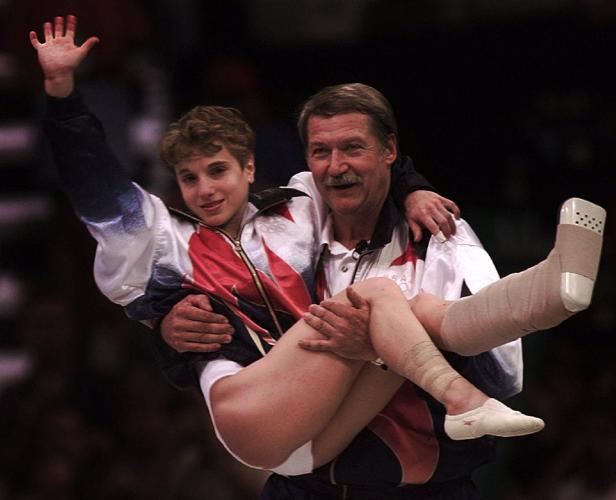
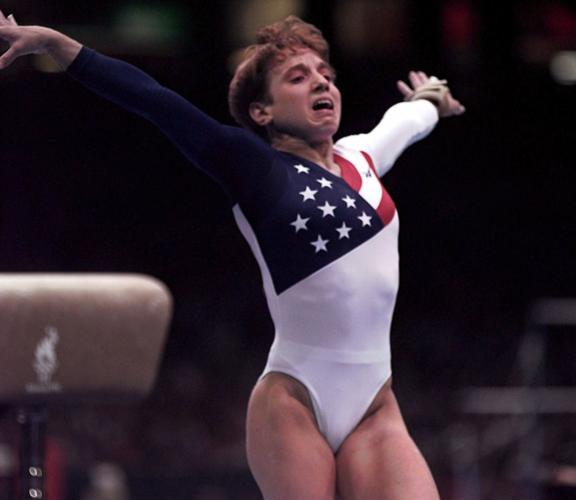

July 23, 1996: Strug’s dramatic vault wins Olympic gold medal
Over the last 20 years, Kerri Strug has become a wife, mother, marathon runner and schoolteacher. She earned a master’s degree from Stanford, wrote two books, worked for the Justice Department and for a U.S. senator.
It would take a third book to list all that she has done since that transcendent Tuesday afternoon at the Georgia Dome on July 23, 1996.
Remember?
More than 26 million Americans watched as the 4-foot-8-inch, 90-pound Tucson gymnast vaulted into sports history, an indelible moment kindred to Dodgers slugger Kirk Gibson, limping to the plate in the bottom of the ninth inning, hitting a winning home run in the World Series.
By now, more than 260 million Americans have surely seen the video of Strug’s unforgettable vault, watched her dab away tears — and wipe away their own tears — as USA Olympic coach Bela Karolyi carried his injured champion to the gold medal ceremony.
People are also reading…
It was part fairy tale and part Hollywood. And all of it was true.
“It’s pretty amazing to think that, in a couple of seconds, my life changed, and I made an impact on so many people,” she told me when I spent a day at her second- grade class at the Matsumoto Elementary School in San Jose, California, in 2002. “To me, it was my job to make that vault. No matter what the circumstances were, I was supposed to do it.”
I first heard the name Kerri Strug in 1989. UA gymnastics coach Jim Gault, who was Kerri’s teacher for six formative years, had flown with the 11-year-old gymnast to a summer competition in Europe. He phoned the sports desk from an airport in New York.
“I’ve got a story for you,” he said. By the end of our conversation Gault said “I think she will be in the Olympics some day.”
I asked him how to spell Kerri.
Strug won a team bronze medal at the 1992 Barcelona Olympics but the greater story was that she was burned out by Karolyi’s manipulative nature and his immoderate demands. She left Karolyi, left his Texas gym, and enrolled at Tucson’s Green Fields Country Day School for the 1994-95 school year.
In the fall of ’94, former USA Olympic coach Yoichi Tomita told me that Strug had begun working out at his Gymnastics World facility on Fort Lowell Road.
“We’re not going to yell at her and lock her out of the gym,” he said, a veiled reference to Karolyi’s coaching tactics. I was so naïve about international-level gymnastics that I thought Tomita and his partner, Jerry Hinkle, could successfully coach Strug to the 1996 Atlanta Olympics while simultaneously coaching 200 other local gymnasts.
When I walked into Gymnastics World a few days later, I was introduced to former Russian national champion Artur Akopian, who had been sent to Tucson by USA Gymnastics to captain Strug’s preparation for the ’96 Olympics.
“I usually spend a week here with Kerri,” Akopian said. “When I leave, USA Gymnastics sends Geza Pozsar to work with her.”
Geza Pozsar?
“He’s a former Romanian national gymnastics champion who worked for Karolyi. We alternate working with Kerri.”
That’s when I fully understood what it takes to build and become and Olympic champion, and how far Kerri Strug had come since her days with UA coach Jim Gault.
Eighteen months later, the day before Team USA began competition at the Atlanta Olympics, Strug and Karolyi had reconciled. She was in her prime, a relative unknown to more famous teammates Dominique Moceanu, Amanda Borden and others from the “Magnificent Seven.”
In a media session in a steamy tent outside the Georgia Dome, I asked Karolyi about Strug’s chances to win a gold medal.
“You’ll never see Kerri on a Wheaties box,” he said. “You’ll never see her in a commercial. She competes because she wants to compete and that’s why it is so special to coach her.
“She thinks different about her athletic career than 99 percent of the others. ”
Ten days later Strug was on the cover of a Wheaties box.
Where is she now: Strug is married to Tucson attorney Robert Fischer. They have two children, Tyler, 4, and Alayna, 2.
How she did it: Strug’s father, retired Tucson heart surgery Burt Strug, was a tennis player at Brandeis University. Her mother, Melanie, was a ballerina. They moved to Tucson from Houston in 1977 when Melanie was pregnant with Kerri.
“Ever since she was little she was upside down rather than right-side up,” Melanie told the Star in 1992. “Kerri used to watch the movie ‘Nadia Comaneci,’ about the famous Romanian gymnast, over and over. She’d watch it so frequently that if you turned the sound down she knew the words.”