



Sunnyside High School wrestling coach Bobby DeBerry, overseer of the state's leading wrestling dynasty, wants spectators to observe the nuances of the sport — the moves behind the moves.
"When people aren't as familiar with wrestling, they sometimes look at it like it's just two guys grabbing each other, pushing each other, in any way they can," said DeBerry, whose Blue Devils have won 10 straight team state titles.
"But there are so many aspects to it that people don't realize when they are watching bouts. There is a reason behind every move made."
To use football as an analogy, there is an offense, defense, and even a brand of special teams (for example, the moves made from the starting position, akin to a kickoff).
Coaches have unique systems and a set of moves they drill into their athletes. And the wrestlers' abilities to pull off the moves vary depending on body type, experience, quickness, strength and opponent's skill.
People are also reading…
As wrestling regional competition starts later this week, the Star caught up with the Sunnyside wrestling squad to explain five of the more than 500 possible maneuvers — some common, some special.
THE MOVES:
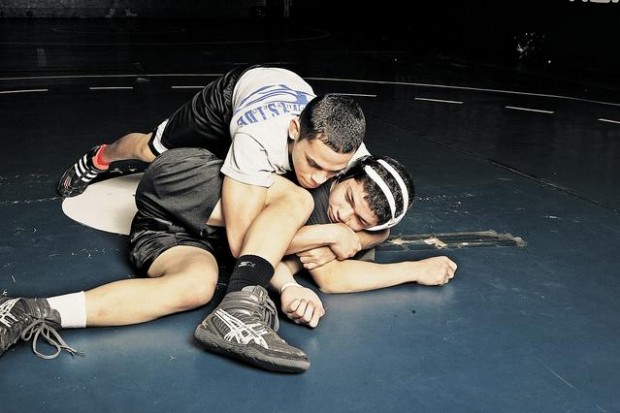
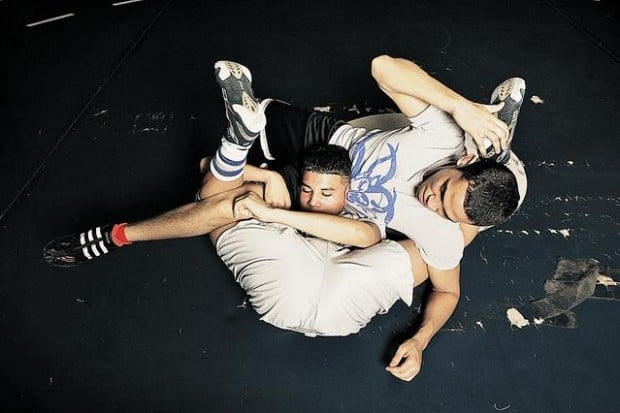
Cradle
This pin combination is difficult to escape from without being counted out. The wrestler on top hooks one elbow behind an opponent’s head, one elbow behind and under the opponent’s knee, and then locks his hands to fold the opposition in half, resembling a baby being cradled.
Blast Double-Leg Takedown
It’s simple, but very effective. The wrestler gets within arm’s reach of the opponent, and quickly goes for the shot, burying his head into the opponent’s chest to knock him off balance. Simultaneously, the wrestler rips the lower legs out from under his opponent and drives him to the mat. Two points are awarded for the takedown.
Spladle
This move looks like a groin injury in waiting and caused a ruckus in Sunnyside’s wrestling room. It was difficult to find a wrestler willing to be contorted by this odd move.
“There’s no way I’m letting myself get spladled in the newspaper,” joked Sunnyside state champion Raymond Piña. “Not gonna happen.”
Although highly uncommon, the spladle involves a wrestler cradling an opponent before splaying his legs spread eagle, and pulling his head in the opposite direction. If completed, it is equivalent to a legally painful knockout punch. Absolute control of an opponent’s head and legs is necessary to pulling it off.
“Once you’re in the spladle, there is no getting up,” DeBerry said. “It’s over.”
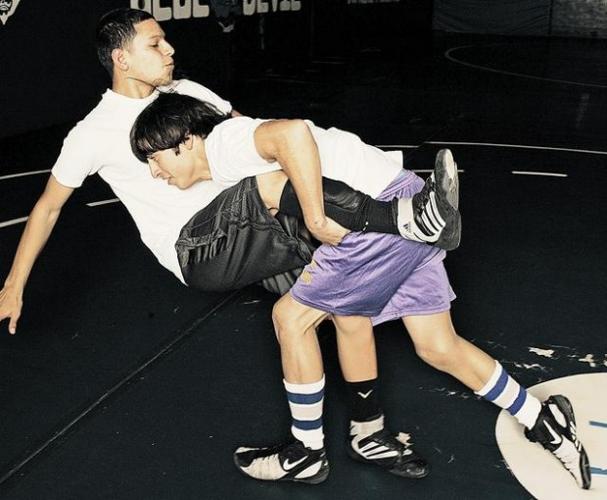
Headlock
The old-fashioned headlock is a staple move for the big boys.
“With the heavier weights, you don’t want them to wrestle from their knees on the mat, because they’re going to have trouble moving around down there and trying to get up,” DeBerry said.
The headlock from the standing position is one of the most common moves seen among the higher weight classes. Just ask Sunnyside heavyweight Anthony Pike, a master of the headlock and throw.
“Get his neck up under your elbow, and your other elbow under the far arm, and lock your hands together,” he said. “Get him off balance, and just throw him off your hip.”
Double Chicken Wing
With the foe flat on his chest, the top wrestler straddles him and hooks his arms under and through, controlling the arms behind the opponent’s back similar to a police officer trying to put on cuffs. With the opponent’s hands rendered useless, the wrestler on top moves toward his opponent’s head, using a leg drive to turn him onto his back for the pin.
Click the images to see what the moves look like*
A grip by any other name
• Cultural variations within each wrestling program affect how a wrestler goes about his/her business on the mat.
Cienega coach Marty Niblo, who grew up in the wrestling haven of Iowa, highlighted a move known around his hometown as The Farmer. In Arizona, it's referred to as The Handshake. In other parts of the country, he's heard it called Thread the Needle.
Wherever you go, the names change for the moves. That's something that can throw people off," Niblo said during the Flowing Wells Invitational earlier this month. "When you're in the middle of a match, and you hear a term you've never heard before coming from the other coach, you have to adjust and try to learn the language they use."
DeBerry takes it a step further.
When the Sunnyside coaches need to relay information to a wrestler during the match, they'll speak Spanish. It's the equivalent of a baseball coach reconfiguring his signals to throw off the other team.
"It's all part of the sport," DeBerry said. "You change things up to gain an advantage."


