

Behind the scenes of the Pittsburgh Penguins back-to-back Stanley Cups in 2016 and 2017, then-General Manager Jim Rutherford and his staff used analytics to pinpoint which players to add to a roster led by elite centermen Sidney Crosby and Evgeni Malkin.
The man in charge of the Penguins’ foray into the data revolution: Sam Ventura, co-founder of the now-defunct hockey analytics website War-On-Ice.com. Ventura, who grew up in the Pittsburgh area, joined the Penguins in 2015 as a consultant and, in 2017, was elevated to a full-time role as director of analytics and hockey research.
Ventura, now 33, owns a bachelor’s degree in computational finance and statistics from Carnegie Mellon University, as well as a master's of science and Ph.D. in statistics. When the Penguins won their second straight championship, he received a half day with the Cup.
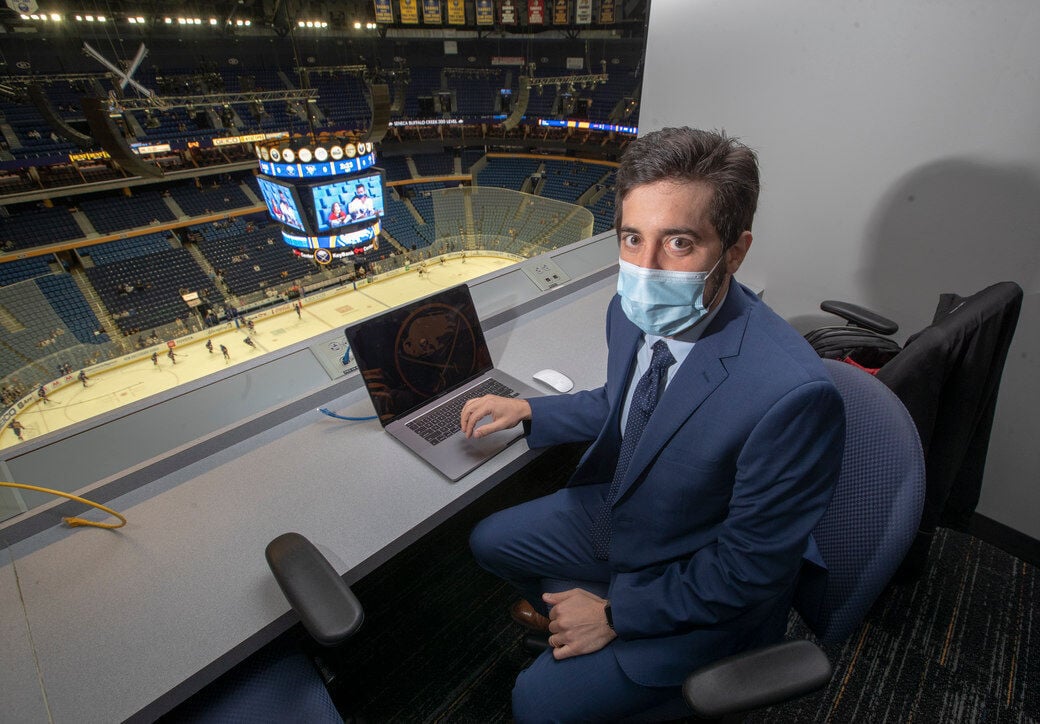
Ventura was promoted by the Penguins to director of hockey operations and hockey research in 2020, but he did not hold the position for long. His contract expired this summer and he was promptly hired by the Buffalo Sabres to lead General Manager Kevyn Adams’ analytics department. Ventura's title is vice president of hockey strategy and research.
People are also reading…
Ventura was first hired in Pittsburgh by current Sabres assistant general manager Jason Karmanos, who joined Adams in Buffalo last April. Ventura has been with the club since early July, and he is in the process of hiring a data scientist and data engineer.
Together, Ventura and his staff will provide Adams with information to help with personnel decisions as well as amateur and pro scouting. To better understand what lies ahead, and how the Sabres plan to use the NHL’s player and puck tracking data, The Buffalo News spoke to Ventura about his new role:
Buffalo News: Why did you decide to come to Buffalo?
Sam Ventura: Certainly, working with Jason Karmanos again was a big part of it. You know, he and I have established a really good working relationship over the last six years. I was excited to work with him, and with Kevyn as well, who I had heard nothing but really good things about. In addition to all of that, you know, I saw it as a really unique opportunity to try to help be part of the positive change going on in this franchise. The goal is to bring it from where we finished last season, all the way up to the top. It won't be easy and won't be quick necessarily, but that's our plan. And, you know, it's a unique opportunity in the league as far as opportunities go.
BN: How is this opportunity unique?
SV: The biggest one is having many more draft picks than what we had in Pittsburgh. The state of the team there was that we were trying to win the Cup every year and, as a result, you know, you end up trading a lot of draft picks when you're trying to do that. So, it was really exciting this offseason, in particular, with the number one overall pick, and then, I think, nine or 10 more by the end of it. That's probably more picks than I had been a part of during my entire career in Pittsburgh. Not quite, but I think that's the biggest part, is the draft and being able to have played a role in bringing in a lot of young talent into the organization.
BN: How has the job of an analyst evolved in recent years?
SV: When I joined the Penguins in 2016, I think back then, there was a mindset around the league that you just needed one person to kind of do all the work that goes into hockey analytics. You know, collecting all the information, building out the databases, doing all the analysis, communicating the results and everything in between. Whereas I think now, teams are starting to realize that that's probably too much work for one person to do and so you need a bigger team to help accomplish all the goals that we have as hockey organizations and as hockey analytics groups within those organizations.
BN: How will the new hires help?
SV: The biggest thing is going to be just helping build out all of the information that we'll need to get into the hands of all the decision-makers in our organization. So we're going to be not just providing information for the draft, but for free agency and for Kevyn, and Jason and (assistant general manager Mark Jakubowski) to use in all the decisions that are made in hockey operations on the management side, and then also there's going to be information that will be flowing into the hands of our coaching staff, the staff in Rochester, our scouts. So, the two hires that we're hoping to make here pretty soon will really be focusing on helping create all that information from all the raw data sources that we have access to via the NHL and third-party agreements.
BN: Did it help that you entered the league with a different perspective than someone who has worked in hockey?
SV: I think I probably have learned a lot more from people who have worked in hockey than people have learned from me, to be honest. One thing for me, you know, coming from the public sphere to working for the Penguins is you don't really know what to expect from the people that are already there. And one thing I learned pretty quickly is that there are some really, really smart people working in the National Hockey League and they have a lot to teach you. And so I really look back on my time with the Penguins as a fantastic learning experience. There's so many things about the league that you just don't know when you're going in. I feel like I learned more than I dished out.
BN: What will you gain with puck and player tracking technology?
SV: Hockey analytics is an interesting field and that when it first came to be, you know, it was really just using the information that the league provided to try to help explain what was going on. When did a shot happen? Who was on the ice for that shot? And that's like the basis of all hockey analytics, essentially. But there's a lot of context in there that when you're watching the game that isn't accounted for in that type of analysis. What puck and player tracking is going to do is it's going to allow us to help hone in on the context and figure out why players are making certain decisions or how involved they were on a particular play. And so it really gives us an entire new level of detail with which to analyze player and team performance.
BN: What misconceptions, if any, are created by the hockey analytics available to the public?
SV: I'm certainly not the first person to make this observation, but essentially, the data that a lot of analysis is based off of essentially gives you a snapshot once every handful of seconds. So imagine watching a hockey game where I tell you that you have to keep your eyes closed the whole time and then I'll tell you to open your eyes for a second every once in a while, and you can see what's happening. And then I say to you, 'Now tell me who the good players are.' You might do a decent job, but it's certainly going to be a lot easier when you can keep your eyes open the whole time. So that's essentially what it's like going from the event-level data to the tracking data. So, you know, that should give you a good idea of the increase in our ability to analyze player and team performance now that we have more detailed data.
BN: Do you monitor trends around the league as far as how successful teams are building a roster through analytics?
SV: I think you have to be a little careful looking at the results of the playoffs, and then looking at the construction of those teams and trying to say, "Oh, we need this type of player." We try to look at it more from a big-picture point of view and identify other skill sets and strategies that lead to long-term success, and then target acquiring players, and using strategies that will meet those principles.
BN: What's the next step for puck and player tracking?
SV: In hockey, we're just at the beginning, but I think the nice thing about where the state of sports analytics is that we've been able to study what's happened in other sports, the NBA, or the NFL, or soccer, baseball. Those sports have all had tracking data in one form or another for anywhere from a couple of years to over a decade. We've been able to see what the best research strategies are in those other sports, and it sort of gives us a little bit of a head start when we think about how we're going to tackle this big problem in hockey.
For me, in particular, I have some affiliations with Carnegie Mellon University, and I've been part of a group that has been studying NFL tracking data for the last three or four years and trying to figure it out what the best ways to analyze player and key performance are with that data. So, you know, we'll probably start by just applying some of the same knowledge that we've gained from other sports and trying to see how it works.
BN: Will you work with the coaching staff to use data when putting together a lineup throughout the season?
SV: The most important thing is that we're going to be providing them with whatever information they will need to make decisions and then from there, it'll be a two-way street in terms of the conversation surrounding all of that information, and how it would affect any on-ice decision that they need to make.
BN: What gave you confidence that your work would be used by the organization?
SV: I wouldn’t have taken this position if I thought I would be spinning my wheels or something like that. I think there's a commitment in the organization to integrate this type of information into the decision-making process. I'm excited to work with Kevyn and Jason and Mark and (director of pro scouting Jeremiah Crowe) and the whole staff to make that happen.


