University of Arizona-led asteroid mission achieves dramatic, flawless finish
DUGWAY PROVING GROUND, Utah — A cupful of rubble from the construction of the solar system is now in the eager arms of scientists.
A capsule filled with rocks and dust from the asteroid Bennu dropped into Utah’s western desert at 7:52 a.m. Tucson time on Sunday, as the University of Arizona-led, $1.1 billion OSIRIS-REx space mission reached a dramatic but flawless conclusion.
A recovery team, including OSIRIS-REx principal investigator and UA Regents’ Professor Dante Lauretta, rushed to the landing site on the Utah Test and Training Range in helicopters to secure the capsule and bring it back to a sterile clean room set up for the occasion at this secure military installation west of Salt Lake City.
“I cried like a baby in the helicopter when I heard that the parachute opened and we were coming in for a soft landing,” said Lauretta after landing to applause back at the staging area. “It was just an overwhelming moment for me.”
Inside the capsule is a science canister filled with material that could offer clues about the origins of the solar system and life on Earth.
Researchers aren’t expecting anything alive in the samples, but they do hope to find pristine, 4.5 billion-year-old material containing amino acids and other organic molecules — so-called “seeds of life” that scientists theorize were delivered to the young Earth by meteorites.
A helicopter delivers the space capsule carrying NASA's first asteroid samples to a temporary clean room at a Utah military facility Sunday. The OSIRIS-REx spacecraft released the capsule after a seven-year journey to asteroid Bennu and back.
Rick Bowmer, Associated Press
Though just enough to fill an 8-ounce coffee cup, the OSIRIS-REx payload represents the largest amount of material brought back from space since Apollo 17 returned from the moon in 1972.
The Japan Aerospace Exploration Agency has conducted the only other successful asteroid-sampling missions so far. Its Hayabusa spacecraft collected less than a milligram of dust grains from asteroid Itokawa in 2010, and Hayabusa2 returned with just over 5 grams of dirt from asteroid Ryugu in 2020.
At about 250 grams, the OSIRIS-REx sample is believed to be about 50 times larger.
A recovery team member examines a capsule containing NASA’s first asteroid samples before it is taken to a temporary clean room at Dugway Proving Ground in Utah on Sunday.
Rick Bowmer, Associated Press
The capsule won’t be opened until it is flown to Houston Monday on a military cargo plane and delivered to a special curation facility at NASA’s Johnson Space Center in Houston, where the science canister inside will be painstakingly emptied and its contents cataloged. That’s when scientists will find out exactly how much of Bennu they brought back.
Recovery team members carry a capsule containing NASA's first asteroid samples to a temporary clean room at Dugway Proving Ground in Utah. "Your package has been delivered," NASA tweeted.
Rick Bowmer, Associated Press
Mission requirements called for the spacecraft to come home with at least 60 grams of asteroid regolith. A NASA official in Utah said they probably won’t know the exact size of the sample until later this week.
To keep the material safe from earthly contamination until then, it will be pumped full of nitrogen gas, forming a dry, protective atmospheric “purge” that will be maintained throughout its processing and storage.
The prize arrives a bit early
Lauretta didn’t get much sleep before Sunday’s landing. He said he tossed and turned for a while, then “got up and graded student essays” to pass the time.
Sunday’s priceless delivery from space actually arrived a few minutes early.
From left, Francis McCubbin and Scott Sandford, both of NASA, and the University of Arizona’s Dante Lauretta collect data next to the OSIRIS-REx sample return capsule after it landed in Utah on Sept. 24.
Keegan Barber NASA via AP
At 7:42 a.m. Tucson time, the capsule, about the size of a truck tire, hit the atmosphere above the California coast at about 27,000 mph and quickly heated up to about 5,000 degrees Fahrenheit.
The main parachute deployed a few minutes later, prompting a cheer from the crowd of officials gathered in Utah to watch the landing.
The prize from NASA’s first asteroid sampling mission landed intact about 10 minutes after entering the atmosphere, three minutes sooner than expected.
The drama unfolded at the Utah Test and Training Range, a secure U.S. Air Force reserve covering 2,675 square miles on both sides of Interstate 80 west of the Great Salt Lake.
Nearby Dugway Proving Ground, once a secret site for chemical and biological weapons testing, served as a staging area for the recovery operation. The helicopters and temporary clean room were housed at Michael Army Airfield, inside the proving ground.
Tucson-born mission
The successful recovery capped an effort that began in Tucson about 20 years ago, back when Bennu was known only as asteroid 1999 RQ36.
A UA team led by Regents Professor Michael Drake, director of the Lunar and Planetary Laboratory, initially applied for funding through NASA’s Discovery program in 2004, but the proposal failed to make the cut three years later.
Drake and company tried again under the New Frontiers program, and NASA selected the mission in May 2011.
At the time, Drake called it the largest research project the university had ever seen, and he described OSIRIS-REx as an exploration of humanity’s origin and its destiny.
“The origin is, ‘Where did the organics come from that led to us?’ The destiny is, ‘Will we go the way of the dinosaurs?’” he said.
Brother Robert Macke smiles as he watches the OSIRIS-REx capsule begin its Utah landing during a watch party Sunday at the University of Arizona's Michael J. Drake Building, 1415 N. Sixth Ave. in Tucson. Macke said he's an operator of a picometer for measuring density osmosis for the asteroid mission.
Grace Trejo, Arizona Daily Star
Drake died on Sept. 21, 2011, after a long illness, leaving Lauretta to assume command of the mission from his long-time mentor and friend.
The robotic spacecraft was launched in September 2016 and arrived at Bennu in December 2018.
On Oct. 20, 2020, OSIRIS-REx swooped in to touch the asteroid’s surface for about six seconds — just long enough to scoop up a cloud of pebbles and dust.
It left Bennu for good in May 2021, after also collecting enough data about the asteroid's composition and orbit to precisely predict its odds of hitting the Earth some day. (Scientists now give the cosmic rock pile roughly the size of Pusch Ridge in the Catalina Mountains a 1 in 2,700 chance of impacting our planet on Sept. 24, 2182.)
The spacecraft has now traveled almost 4 billion miles to Bennu and back on a circuitous route around the sun between the orbits of Earth and Mars.
‘We’re finally here for real’
Anjani Polit was the only other member of the UA’s mission team who traveled to Utah for the landing.
“It’s hard to believe we’re finally here for real,” she said as she watched the recovery helicopters lift off to head out to the 250-square-mile landing zone.
Polit has worked on OSIRIS-REx for the past seven years. As mission implementation systems engineer, her job now inovles helping to coordinate the analysis team of about 200 researchers around the world who will spend the next two years performing the first in-depth science work on the samples.
The University of Arizona's Dante Lauretta, the principal investigator for OSIRIS-REx, talks to reporters after the successful recovery in Utah of the space capsule containing asteroid samples. "I cried like a baby," a relieved Lauretta said.
She said the team should begin receiving bits of Bennu in a month or two.
Both Polit and Lauretta are scheduled to fly with the canister to Houston on a C-17 transport plane on Monday morning.
World-class lab at UA
Meanwhile at the UA, a suite of electron microscopes and other sophisticated instruments waits at the Kuiper Space Sciences Building to start examining the asteroid grains down to the atomic level. Researchers have spent the past decade or so assembling a world-class laboratory complex in the building’s basement, expressly to support OSIRIS-REx.
The Kuiper Materials Imaging and Characterization Facility can take a single speck of dust, one fifth the width of a human hair, and carve it into hundreds of slices for individual study.
The director of the facility, UA professor Thomas Zega, is part of NASA’s “quick-look team” assigned to conduct the first science on the material brought back from Bennu.
He and the rest of the team, which includes UA assistant professor Pierre Haenecour, will work out of the sterile curation facility at Johnson Space Center.
The quick-look team will perform an initial characterization of the material using dust that stuck to the outside of the spacecraft’s sampling device when it touched down on the asteroid.
This illustration depicts the OSIRIS-REx spacecraft at the asteroid Bennu.
Conceptual Image Lab, Goddard Space Flight Center, NASA via AP
Zega and Haenecour plan to bring some of that early sample back to Tucson with them once their work in Houston is done.
Eventually, those first bits of Bennu will be joined at the Kuiper building someday by a much larger share of the precious payload.
Scientists near and far
Over the next two years, about one-quarter of the material recovered Sunday will be doled out for study by scientists around the world, and a sizable amount is expected to land at the UA.
The remaining three-quarters of the haul from NASA’s first asteroid sampling mission will be set aside by the space agency for future research, much the way moon rocks collected during the Apollo missions are still being analyzed today.
“Future scientists who might be in elementary school right now could be studying these samples some day,” Polit said.
The OSIRIS-REx spacecraft released the sample-return capsule at 3:42 a.m. Tucson time, sending it on a solo journey toward the atmosphere that lasted four hours.
The probe, the size of a passenger van, was then steered away from Earth to begin its next adventure: a rendezvous with the asteroid Apophis in 2029.
The spacecraft touches the surface of asteroid Bennu on Oct. 20, 2020.
NASA TV video via AP, 2020
That mission, called OSIRIS-APEX, is being led by UA assistant professor Dani DellaGiustina, who headed up the OSIRIS-REx imaging team and then served as its deputy principal investigator.
DellaGiustina observed the end of one mission and the beginning of the next from the flight operations center at Lockheed Martin Space outside of Denver, where the spacecraft was built.
Mission team members not directly involved in the recovery operation watched NASA’s live broadcast from the UA’s Drake Building, which is named after the man who gave OSIRIS-REx its start.
Members of the University of Arizona-led OSIRIS-REx mission team watched Sunday morning's events from the Michael J. Drake Building as samples taken from an asteroid landed in Utah following a seven-year journey.
Interest in Sunday’s event extended far beyond the scientific community. NASA officials said 60 different media outlets were on site to cover the landing, including journalists from Japan, Britain and Canada.The space agency broadcast the landing live in English and Spanish on its TV channel and across social media.
Sir Brian May, the world-famous Queen guitarist and Ph.D. astrophysicist, celebrated the capsule return in a video he recorded for the broadcast. In it, he shouted out his “dear friend Dante” Lauretta, with whom he co-authored a 3D atlas of Bennu that was published in July.
On Friday, the U.S. Postal Service held a first-day-of-issue ceremony in Salt Lake City for the new “OSIRIS-REx Return to Earth” postage stamp, which depicts the sample-return capsule descending under a parachute over the Utah desert.
On Tuesday, the Pima County Board of Supervisors and the Tucson City Council declared Sept. 24 as “OSIRIS-REx Sample Return Mission Day” with a proclamation recognizing the UA’s achievement and its out-sized role in space exploration and the community.
A number of UA officials traveled to Utah to witness the historic landing, including university President Robert Robbins.
Even a former UA administrator made the trip, albeit from a shorter distance.
Elizabeth “Betsy” Cantwell spent four years as senior vice president for research and innovation at Arizona before leaving in May to become president of Utah State University in Logan, about 160 miles northeast of Dugway Proving Ground.
She said Utah State designed an instrument for OSIRIS-REx, but a “space engineer by training” like her wasn’t going to miss the landing regardless, especially after watching the mission’s earlier achievements from Tucson.
“The coolest thing isn’t where we are now, it’s when the science comes out,” Cantwell said from the tarmac at Michael Army Airfield, as the helicopters began to return from the landing zone. “That science — and I think we’ll see the papers start to come out pretty quickly — is going to be amazing, just amazing.”
Scientists hope for soft landing as UA-led space mission returns to Earth
The Tucson-born space mission to collect samples from an asteroid will come to an end in the Utah desert on Sunday morning, and you can watch the drama unfold starting at 7 a.m. Tucson time.
NASA will be broadcasting live as the sample-return capsule from the OSIRIS-REx spacecraft streaks through the sky and makes what scientists hope will be a gentle parachute landing at the Department of Defense’s Utah Test and Training Range, west of Salt Lake City.
The capsule carrying rocks and dust from the asteroid Bennu will be traveling at about 27,650 mph when it hits the atmosphere just off the coast of California at 7:42 a.m. Tucson time on Sunday. Its fiery reentry and path to the ground will be tracked with infrared instruments and optical cameras.
After about two minutes, a drogue parachute is expected to deploy to slow the capsule below the speed of sound. Then comes the main parachute, which should unfurl six minutes later and about a mile above the desert to carry the capsule on its five-minute descent to a secure, 300-square-mile landing zone within the military range.
A recovery team member examines a replica of the OSIRIS-REx sample-return capsule duirng a rehearsal in the Utah desert on Aug. 29. The real capsule, packed with rocks and dust from the asteroid Bennu, is set to land at about 7:55 a.m. Tucson time on Sunday.
NASA, Keegan Barber
The mission team is closely watching the weather at and around the landing site. Though the capsule was designed to withstand lightning, ice and anything else it might reasonably encounter in Utah’s west desert in late September, wind remains a concern as the truck-tire-sized reentry package floats down from the sky beneath its parachute.
Wet conditions could also pose a problem, turning the range’s silty soil into cement-like mud that could prevent off-road vehicles from aiding in a search and recovery operation on the ground, should prove to be necessary.
As it stands now, the recovery team, including scientists from the University of Arizona, plans to rush to the landing site in four helicopters to retrieve the prize as quickly as possible to avoid earthly contamination.
A graphic shows the expected sequence of events as the OSIRIS-REx spacecraft releases its sample-return capsule to reenter the Earth’s atmosphere and land in the Utah desert. The capsule carrying material from the asteroid Bennu is expected to make its initial entry into the atmosphere at 7:42 a.m. Tucson time on Sunday.
Courtesy Lockheed Martin
The capsule will be placed in a harness and attached to a 100-foot-long tether beneath one of the helicopters to be flown back to a staging area at nearby Michael Army Airfield, part of the military’s Dugway Proving Ground.
Once there, the capsule will be whisked into a temporary clean room, where the science canister inside will be prepared and packaged for its flight to its final destination at Johnson Space Center in Houston on Monday morning.
The U.S. Postal Service introduced a new OSIRIS-REx postage stamp during a ceremony Friday at Clark Planetarium in Salt Lake City.
U.S. Postal Service
The space agency’s live broadcast will be carried on NASA TV, the NASA app and online at www.nasa.gov/nasalive. Coverage in Spanish will stream through NASA’s social media accounts on X, Facebook and YouTube. The broadcast will end after the capsule arrives at the clean room.
No public watch parties are planned at UArizona, but mission team members not participating in Sunday’s landing will gather to watch it at the Drake Building on Drachman Street and 6th Avenue. The building, which used to serve as headquarters for the OSIRIS-REx science team, is named after UA professor Michael Drake, who led the mission until his death in 2011.
The $1.1 billion journey was launched in September 2016 and arrived at Bennu in 2018.
On Oct. 20, 2020, the robotic spacecraft touched the surface of the asteroid and scooped up about 8.8 ounces of debris that could be as much as 4.5 billion years old and contain secrets about the origins of the solar system and life on Earth.
OSIRIS-REx departed Bennu and began its 1.4 billion mile trip home the following May. As the spacecraft approached Earth, mission engineers adjusted its trajectory with a pair of maneuvers over the past two weeks to line it up for Sunday’s release of the sample-return capsule, which is scheduled to happen at about 3:40 a.m. Tucson time.
The final course adjustment was made on Sept. 17, while OSIRIS-REx was still about 1.8 million miles away.
About 20 minutes after the spacecraft releases the sample-return capsule early Sunday morning, it will fire its thrusters and head back out into space on its next adventure.
U of A chef designs OSIRIS-REx watch party dishes
Do you want to throw the perfect OSIRIS-REx watch party, but you don’t know what snacks to serve?
University of Arizona executive chef Michael Omo has you covered with a full menu of “O-Rex-cipes,” perfect for eating and drinking your way through NASA’s live broadcast of Sunday’s historic space landing.
Omo and his team have come up with 11 drinks and dishes to boost your early mission brunch (the returning space capsule filled with asteroid samples hits the atmosphere at 7:42 a.m. Tucson time) and the after party.
Savory dishes include Asteroid and Meat-eorites (baked meatballs), Orbit Discs Reflector (foil-wrapped chilaquiles) and Egg Bennu-dict, named for the asteroid OSIRIS-REx landed on in 2020. Those can be paired with the Cruciferous Capsule Salad or the Chocolate-Coated Asteroid Belt with Space Dust Molecules, basically chocolate-covered bacon sprinkled with peanut butter dust that reconstitutes in your mouth.
For dessert, Omo and company have baked up Cosmic Cake, Rocket Pops and miniature almond and pistachio cakes called Sample Returns that can be packaged and attached to little parachutes so your party guests can literally launch them and watch them land.
And you can wash all of that down with a Mission Control Siphon Coffee (dry ice makes it smoke), a signature cocktail called an Always Sunny in Tucson or a Zero Gravity Mocktail, which is a lavender lemonade made with something called butterfly water.
Omo oversees all aspects of the cooking and dining experience at the UA as the university’s director of culinary excellence and quality assurance.
Q&A: OSIRIS-REx chief opens book on NASA's asteroid mission as last test looms
When OSIRIS-REx swings past Earth next week to drop off its priceless samples from asteroid Bennu, no one will be more relieved than Dante Lauretta.
The University of Arizona professor has been working on the NASA mission since 2004 and leading it as principal investigator since the death of his mentor and former boss, Michael Drake, in 2011.
Lauretta will be at the Department of Defense's Utah Test and Training Range, west of Salt Lake City, on Sept. 24 to help secure the newly arrived space capsule containing rocks and dust snatched from the surface of Bennu on Oct. 20, 2020.
The pristine asteroid samples are thought to contain clues about the origins of the solar system and maybe life on Earth. Their successful recovery will mark the end of a $1 billion, multi-billion-mile space voyage for which Lauretta has played a central role for almost 20 years.
Not bad for a kid who grew up without a television — or indoor plumbing, really — on a patch of desert north of Phoenix.
Lauretta was born on Oct. 19, 1970, in Montreal, with the dual citizenship to prove it, but he spent his formative years in a single-wide trailer at the end of a dirt road in New River, Arizona.
He went on to study math, physics and Japanese at the UA, where he now serves as a Regents' Professor at the prestigious Lunar and Planetary Laboratory.
The 52-year-old scientist is also a married father of two, who likes to unwind by playing guitar, doing yoga, designing award-winning board games and writing books. In July, he published a 3D atlas of Bennu with Brian May, a Ph.D. astrophysicist who also happens to be the lead guitarist for the rock band Queen.
Lauretta's next side project is a memoir of sorts, though he insists the coming book also serves as a biography for Drake, the spacecraft and its mission. “The Asteroid Hunter” is set for release on March 19, 2024, but it’s still missing one crucial chapter.
Lauretta plans to write the epilogue, titled “Homecoming,” in October, after OSIRIS-REx delivers its precious cargo.
He recently sat down with the Arizona Daily Star at his office at the UA for a wide-ranging chat about the long journey to Bennu and back, his background and how he's feeling as the mission’s last big test approaches.
(This conversation has been edited for length and clarity.)
Star: Describe what you and your team will be doing on Sept. 24.
Lauretta: I'm on the field recovery team, by choice. I really wanted to be out there. I've got to welcome this sample to Earth, right? I'm on the welcoming committee.
Star: So you’ll be standing by as the sample-return capsule comes down, and then you'll fly out to the landing site in a helicopter. How close will you land to the thing?
Lauretta: 250 feet. You don't want to have the helicopter blowing dust onto the capsule and all that stuff. Then it's (attached to) a 100-foot-long line in a harness when we remove it from the field, so the helicopter will never be within 100 feet of the capsule. It will fly the capsule in that harness back to the receiving area (where) other members of the team will physically pick it up and carry it inside of a portable cleanroom. Then we're going to start to disassemble it. The treasure box is what's called the science canister. It's like this aluminum housing that's got the sample head and the sample inside of it. All we care about is that canister that will get sealed up and flown to Houston the very next morning.
Star: Are you getting on the airplane with it?
Lauretta: Yeah, Monday morning (Sept. 25). That's the green-light schedule, everything going according to plan.
The thrilling finale of OSIRIS-REx, the University of Arizona-led NASA space mission, is set for Sept. 24, when a capsule containing rocks and dust from the asteroid Bennu is set to land at the Utah Test and Training Range, west of Salt Lake City.
NASA’s Goddard Space Flight Center
Star: This will be on a military cargo plane, right? Have you flown on one of those before?
Lauretta: Yeah. When we shipped the spacecraft from Denver to Kennedy Space Center, we also used C-17. And then I was on an Antarctic Expedition way back 20 years ago, and we took a C-17 out of Antarctica.
Star: I wanted to ask you about that. I noticed you have an award on your wall from your work down there.
Lauretta: That's my medal. You get that medal from Congress if you spend more than 30 days in Antarctica in service to the United States. We were in the field for 42. The Antarctic Search for Meteorites.
Star: Why there?
Lauretta: Well, it's a big desert, so it's very dry. And meteorites, if they're exposed to water, they tend to rust and break down. And it's a natural conveyor belt. You've got these giant glaciers that cover most of the land out there. These meteorites from outer space land on the glacier, and the glacier kind of moves like a conveyor belt towards the ocean. But if it hits the mountains, the glacier tries to go over the mountains and the wind cuts it away, and you get this big concentration of meteorites right there. It's been collecting meteorites for a hundred thousand years for hundreds of miles up river of the glacier, and the glacier brings them all to you and drops them right at the base of the mountain. All you have to do then is drive around on the glacier looking for black rocks, and you'll find meteorites.
Star: So you were roaming around Antarctica in 2003, and then you joined the asteroid sampling mission?
Lauretta: That's right. About a year after I got back is when Mike (Drake) called me. He was my boss, he hired me. I was an assistant professor here, and he was the lab director. And we got along really well, you know, we kind of hit it off. We had similar research interests. We went to the same conferences. He was my mentor, even before OSIRIS-REx.
Star: Why do you think he picked you as his deputy P.I. for the mission?
Lauretta: Well, I don’t like to get inside other people's heads. But I was doing a lot of astrobiology work, origin of life work, and getting some really exciting results in the lab. Mike studied planet differentiation (and) core formation. But he knew for this mission we needed to go (with the) origin of life, that's what was going to sell it to the agency. So he brought me on as that scientist to really talk to him about that.
He came on board because of his management experience, leading a big lab and being involved in these other missions. He was seen as a leader. It made sense for him to lead a program. He was 25 years older than me, so he was in his late 50s, which is normally when you take on one of these jobs.
Arrival anxiety
Star: Is there a part of this last stage of the mission that worries you the most?
Lauretta: Yes, the final performance of the sample-return capsule. Because it's been quiet, and the batteries have been off since we launched (in 2016), so we haven't talked to any of that. And I know it's all been tested, and it's all going to work. But there are batteries that we're not going to hear from until a couple hours before we hit the top of the atmosphere, and those release the parachute.
A training model of the OSIRIS-REx sample-return capsule is seen during a drop test on Aug. 30 at the Department of Defense's Utah Test and Training Range. The real capsule is due to land in Utah on Sept. 24.
NASA/Keegan Barber
We've been through countless reviews and exercises and tests about what's going to happen in the days leading up to the SRC release. We've just talked about it so much. And we've reviewed the footage from the Genesis capsule: the 2004 Lockheed Martin-built sample-return capsule that crashed because the parachute didn't deploy. I close my eyes, and I see that capsule crashing into the Utah mud.
I just want our sample safe on the ground on Earth, right? That moment, I'm carrying so much anxiety about it. It just feels like that's going to be a watershed moment in my life.
Star: And all that starts with the parachute?
Lauretta: Yes, I think if I see the chute open, we're good. We're good.
Star: It's going to land somewhere.
Lauretta: It’s going to land somewhere, that’s right. And we’ve got the Air Force watching it. They're gonna know exactly where it is.
Star: So what happens before all that?
Lauretta: We have to make a go, no go decision. It's possible we will not release the capsule. That's part of our decision matrix.
For example, if something goes wrong with the spacecraft and the capsule is coming (down) right in the middle of Salt Lake City, we can't release it, obviously, because people might be at risk of injury or fatality. Safety is number one. It would take a lot of things to go wrong for us to drift. But, you know, we're coming in from outer space, and you're talking like 80 miles (between the designated landing zone and Salt Lake City), so it could happen. If we're off course, we’ll just zip by the Earth and that sample leaves.
So the go, no go poll, that's at 2 a.m. on Sept. 24. That's critical, because then it's like, “OK, we're good.”
Then the spacecraft has to receive the command from the control center in Denver to release the capsule, and then those batteries get turned on and we see if they're alive. We'll know at that point if we're coming in with a live capsule or a dead capsule.
We'll release (even) if those batteries are dead and just get ready for this Genesis level event, as we call it — just get ready for a hard landing and to go out there and see what we can find.
Star: What happened when the Genesis capsule crashed? Did it just disintegrate?
Lauretta: It was a solar wind collection mission, so it had these really big plates of high purity material — silicone like a computer chip would be built on or gold — and those fragmented and shattered. They were still able to find pieces of them and actually recover the science, but it was a heartbreaking and painful process. We don't know what our science would be like, because we have a very different kind of sample. We have this probably powdery asteroid regolith.
Origin story
Star: You probably get asked to explain this mission all the time. What's your response when someone says, tell me about OSIRIS-REx?
Lauretta: Well, we built a robot to go to an asteroid to get dirt and rocks and bring it back to Earth. And the question is, why would you go do something like that? The reason we're interested in our specific asteroid named Bennu is really two-fold. The first is what I'm really interested in: the origins investigation. I'm interested in the origin of life, the origin of the solar system and the origin of Earth, specifically as a habitable planet. Bennu is an ancient remnant from the beginning of the solar system. It's four and a half billion years old. It formed before the Earth did, and it records the earliest chemistry of carbon and water and the kinds of things that were delivered to the Earth by objects like Bennu in our ancient past. So it gets to that question we all ask ourselves: Where did we come from?
The second reason is Bennu is a near-Earth asteroid that's considered potentially hazardous. It might impact the Earth about 160 years from now in the year 2182. So the OSIRIS-REx mission gives humanity the information it needs in the event that this asteroid, or really any asteroid in the future, is going to come and impact the Earth. All of the technology, going out to the asteroid and characterizing its orbit, its chemistry, its geology, its rotation — that will help you with a future mission where you might need to prevent the asteroid from hitting the Earth.
Star: So you're learning what you need to know to launch a planetary defense mission one day?
Lauretta: Exactly. And you’re also really refining the odds of whether this particular asteroid is going to hit the Earth or not.
Star: You’ve got a pretty solid sense of that at this point, right?
Lauretta: It's a .05% chance in the next 200 years, which is low. I like to say you’d cross the street with those odds.
Star: Help us visualize the amount of asteroid material you think the spacecraft is bringing back.
Lauretta, grabbing a plastic foam coffee cup from his desk: Like eight ounces, right? So it should be like a coffee cup full. This is probably an eight-ounce cup. And it depends on the density. If it's really low density, it'll be over-filling the cup. If it's high density, it will pack down in there.
Star: And that doesn't count any bits that might be clinging to the container inside the return-capsule.
Dante Lauretta, left, poses with his mentor and OSIRIS-REx predecessor, University of Arizona professor Michael Drake, in 2007. Drake died in 2011, six months after NASA awarded the asteroid sampling mission to his UA team.
Mamta Popat / Arizona Daily Star
Lauretta: That's right. I think there'll be dust covering everything inside the canister.
Star: That’s one of the few problems you've run into with the mission so far, right? You ended up stirring up so much asteroid debris that it was leaking from your sampling device.
Lauretta: That's right, and we lost (some) sample (material) because of that.
Star: And that happened because Bennu didn’t behave the way you expected it to?
Lauretta: Yeah. Every time we've tried to interact with a planetary surface for the first time, we've been surprised. We knew something would happen. We were ready to be surprised, which is kind of the best you can hope for in those situations.
Formative years
Star: Tell us about your childhood.
Lauretta: I moved to the States pretty quickly after being born in Canada, then moved around quite a bit and landed in Arizona in 1975. New River was like fourth grade through freshman year of high school, so kind of the formative years.
Star: That's when you were living in the mobile home?
Lauretta: In the middle of nowhere. I went to Deer Valley Middle School and Deer Valley High School. It was like an hour each way. We were out at Carefree Highway and 16th Street, and there was nothing out there. We didn't have plumbing. We had to go haul our water. We had this big 500-gallon tank that we had to drive to a filling station whenever it ran out, get 500 more gallons and bring it back.
Star: Wow.
Lauretta: It's crazy to think about. We didn't have a TV. Books and school was kind of it for outside information. I had a job starting at 11 years old. I was a stable boy basically, cleaning out horse stables at a local Arabian show-horse ranch. I got a job there, and I saved $60, and I bought a 13-inch black-and-white cathode-ray-tube TV so I could see what was going on in the world.
Star: Did you ever get yourself in trouble out there?
Lauretta: Lots. Yes. Sure. I can't imagine my kids doing the stuff I was doing at age 11, 12, 13. We would go miles out into the desert, me and one other buddy. We would explore mines, we would go jump off cliffs into swimming holes. We were stupid kids.
Star: So how do you go from stable boy to astrophysicist?
Lauretta: Well, I did well in school, and I got a scholarship to go to the University of Arizona. I came here as a math major, theoretical math, partly because I had no clue what it meant to pick a major. I was the first person to go to college in my family, and I was like, “Well, I'm pretty good at math. Let's do that.” And I also figured that if you learn your math, you can do a lot of different things with it, so I expanded into physics.
Then in my last year in college, I got a Space Grant from NASA to work as an undergraduate researcher, and that really opened my eyes to this whole field of planetary science. That is kind of where I got the spark and decided, all right, I want to get in on this.
And it was an interesting time. It was the early 1990s, and NASA's planetary science program had kind of been in the toilet for most of the ‘80s. It was all (space) shuttle, and there were no new missions being funded. But in the early ‘90s, the Mars exploration started to come back online, and I thought I was gonna get involved in that.
Star: It didn't quite work out that way, though.
Lauretta: Yeah. I started on the Mars Observer spacecraft. That's what I went to graduate school to work on. And that spacecraft was lost within months of my arrival (in 1993). The spacecraft disappeared, the mission was over, no data was returned. I'd been working a full two months on the program, so I was like, “Well, now I gotta go figure out something else.” But my professors and mentors had been working (on it) for decades.
Star: So I guess that's another thing that you carry with you, right? You've seen what happens …
Lauretta: when these missions fail. That's right. Careers can be over.
Star: And right at the goal line.
Lauretta: Just like we’re facing (now).
Star: So it all started with that NASA Space Grant. Is that the one you learned about from an ad in the Daily Wildcat (student newspaper)?
Lauretta: Yeah. I just casually reading it, and it kind of showed up there. I just got off my shift as a breakfast cook (at Mike’s Place). I had lots of jobs back then. I was in college, so I was paying the bills with whatever would do that. I worked at the loading dock at a department store. That was kind of fun. I worked at a game store, because I always loved board games. Lots of restaurants, lots of tutoring jobs around campus. I worked for athletics and tutored the student-athletes. I did math, physics and philosophy for the student-athletes, which was fun. I was really into philosophy, almost majored in philosophy, but I figured that's the kind of thing you can do while studying math.
I still am interested in philosophical issues. The search for life in the universe, the origin of life and all these things that we're going after — you start poking at the boundaries where science breaks down, which is where the really, really fun stuff is.
Star: How do you mean?
Lauretta: There's certain things we can't explain in the scientific paradigm right now, consciousness being a big one. We can't explain why we are conscious, where our mind comes from, the origin of mind. I kind of break it up into four fundamental questions, and science is doing OK on maybe two of them, one better than the other: The origin of the universe; the origin of the solar system, including our planet; the origin of life and the origin of mind.
The origin of the universe, we really don't know what's going on there. Once you get past the cosmic microwave background radiation and you get to the Big Bang, science kind of loses it, right? We can't explain how that happened. We just say it looks like it did happen.
The origin of the solar system we’ve made a ton of progress on. That's kind of where I grew up, my field, and I think we've got a pretty good sense that physics and chemistry is really taking us almost all the way there, if not all the way there.
The origin of life is still a huge mystery. We don't really know how you go from inanimate matter to living material. What is the key distinction there, and how could the origin of life have taken place? Physics and chemistry has done a lot to help us understand biology and biochemistry for sure.
And then the origin of mind? Wide open. No idea why. Science just doesn't explain it. There's nothing in physics and chemistry — or I’d say very little, and none of it’s widely accepted — about where the conscious experience comes from. We’re working on it.
"You're the guy"
Star: What has been the most stressful part of the OSIRIS-REx mission for you?
Lauretta: Honestly, the most nerve-wracking time period was very early in the mission, when we were still in the proposal phase. Mike Drake, who was my mentor and the P.I. (principal investigator), was really sick, and I had to step up and lead. Then Mike would come back and be healthy for a while, and I would step aside. So I was really worried about him, and everything was on the line. Like if you don't win that phase, you're done. You don't fly.
So it was really those early days. First of all, just being there with Mike, somebody I cared about who was dying, was very stressful. And also because without Mike, I was the one that had to do it, right? I was pretty young; I was in my 30s. I was like, “I don't know if I'm ready for this job.”
Star: There must have been some people, maybe even involved with the mission, who were thinking the same thing.
Lauretta: Exactly. There was a lot of doubt about my ability to come in and lead the charge. And there was part of me that was like, “Well, maybe I should listen to them.” But the other part of me was like, “You can do it.” And Mike, you know, we had this moment at the end, where he really passed the torch. He was in the hospital, right before his last procedure, and he said, “You’ve got to take it. You’ve got to go. You're the guy.”
Star: So how do you decompress from a high-stakes job like yours? What do you do to relax — or at least look relaxed?
Lauretta: I think side projects. You know, we’ve got the Bennu book (with Brian May), and I have another book that's coming out. I try to be creative. I'm a board game designer, so I've designed games. And I love playing board games, especially with my kids and other family members.
In the mornings, the first thing I do when I wake up is usually a workout — yoga or strength training or maybe a hike. And I play my guitar. Not well, but, you know, that’s not what it's there for. It's there for stress and to go on my back patio and howl with the coyotes or whatever.
Star: And now you’ve written a memoir. Except the final chapter of OSIRIS-REx is not in the book.
Lauretta: It's to come. The epilogue is not written. Right now it ends in May of 2021, when we depart Bennu. That's the last paragraph. So the agreement was we would get this into production and get everything copy-edited and typeset, and then I would deliver the final chapter a month after the capsule is on the ground.
Star: You’ve certainly got a good story to tell.
Lauretta: It's not just about me. That's the fun part. “The Asteroid Hunter” is actually OSIRIS-REx. I didn't know that when I started writing it, but as the book unfolded, its OSIRIS REx that turns out to be the hunter.
Star: So it’s OSIRIS-REx’s memoir.
Lauretta: Basically, yeah, and I'm involved. But OSIRIS-REx, obviously, is a big part of my life.
Star: Nearly 20 years. That’s almost a career. It’s close to a generation.
Lauretta: Exactly. And I'm in my early 50s, so I still have some runway ahead of me, hopefully.
Star: Now the real work begins.
Lauretta: That's right. The whole mission was about the laboratory science, which is why I signed up for it in the first place. That was the deal.
Star: Speaking of books, tell us more about your recent collaboration with Brian May.
Lauretta, pulling out a copy of the new atlas: So this is “Bennu 3-D: Anatomy of an Asteroid,” which we just published as a joint venture between the University of Arizona Press and the London Stereoscopic Company. And the London Stereoscopic Company is owned by Dr. Brian May — or Sir Brian May, I should say — who is a science team member, actually. He's been working with us really since 2018, and he became an integral part of the team because of what he does.
University of Arizona professor Dante Lauretta, right, poses with Brian May, lead guitarist for the rock band Queen, in 2019. Lauretta teamed up with May, who holds a doctorate in astrophysics, on a new book about the asteroid Bennu.
Courtesy of Dante Lauretta
He calls it Victorian-era science. He has these stereoscopes, like this one here, and he finds two images that make a perfect stereo pair. Then when you look at them through the stereoscope, the scene pops up in beautiful 3D.
He started doing this with just the images we were putting out publicly on the internet, and he sent them to me kind of out of the blue. I thought I was being punked, like there's no way this is really Brian May emailing me. But sure enough, it was him. And when I saw the product, I was like, “We could really use these for site selection. Can you make more of these?”
He was thrilled to be part of the team and to be contributing in a productive way to our sample site selection. He and his partner, Claudia Manzoni, who does a lot of the early recon work to find the data, did like 50 different regions of the asteroid surface for us as we were hunting for our sample site, and they produced some amazing and beautiful products. At the end, we kind of looked at the body of work, and we were like, “We should just put all this in a book.”
Star: The book even comes with a stereoscope.
Lauretta: Yeah, that's right in the back. You can just wander around Bennu forever and look at the amazing 3D shots of it. That wow moment, Brian loves that. And of course, Brian was a hero. I loved his music as a kid growing up. It was just super cool to be working with one of your heroes. And he's a really nice guy. He loves the science and the mission, and he knows his stuff. He's got a PhD. So we had a ton of fun.
Star: Did you get to jam with him at all?
Lauretta: A little bit, just talking about a song that I was working on that he thought was interesting. He gave me some things to go do, which I need to go do. We'll see if we move it forward or not. It could just be a lark.
Star: Wow.
Lauretta: Yeah.
Star: You and Sir Brian have something else in common. You both have asteroids named after you. Do you guys ever compare notes?
Lauretta: We do. You always do. In the asteroid-named community, the lower the number, the more prestigious it is. So mine is 5819. I forget what his is, but mine is lower.
Star: That's great. You’ve got something on Brian May.
Lauretta: We're actually pretty good admirers of each other's work, I think. And we share an attention to detail. That's a trait that we came across with the book. Every little thing was scrutinized at a very high level. His work, especially his music, is known for very high production quality, very fine attention to detail, and that's how we approach our science.
Star: And as it turned out, you needed his 3D imagery.
Lauretta: That's right. We needed it for our site selection process. Brian sent a whole case of these (stereoscopes) to the sample site selection board. It works with your phone, so we could just keep swiping — site one, site two, site three — and get a real good sense of the challenge that was facing us.
Dante Lauretta, left, a UA professor and leader of NASA’s OSIRIS-REx asteroid sample return mission, reacts after the spacecraft touched down on Bennu on Oct. 20, 2020.
NASA Goddard YouTube Channel
Lauretta: Exactly. It was very rough and rugged and much more rocky than we had anticipated. We had to improve our guidance accuracy enormously.
Bottomless cup
Star: How many people are on the OSIRIS-REx team these days?
Lauretta: So direct employees here at the University of Arizona, we're at about 35. Then we have our partners at NASA, and we have our partners at Lockheed Martin. There's about 250 people full time on the mission right now. And when I look at my extended sample analysis team, there's another couple hundred (at) laboratories around the world that are getting ready to receive samples.
Star: Is anybody else going to have a lab as nice as the one you’ve built here?
Lauretta: (Laughs) No, we're going to have the best. There's lots of really great laboratories on the team. I don't want to sell my collaborators short. But we have an amazing facility here. We're going to do cutting edge research.
Star: And for a long time to come, right?
Lauretta: The rest of our lives and our students’ lives. The great thing about sample return is that it just keeps on giving. We're reasonably smart, we've got these great new instruments, we're going to tackle all these big questions. But the people in the future, they're going to be even smarter, they're going to have even better instruments, they're going to know everything we know, and they can design whole new experiments.
I think I'll be involved in Bennu sample science for the rest of my life. And I'm training a bunch of students, and they'll continue to study this.
Star: That coffee cup full of material is going to go a long way.
Lauretta: It's an infinite supply for us. We work at the atomic scale. So when you start counting atoms, there are a lot of atoms in this material.
Star: So what's going through your mind right now as the mission approaches the finish line?
Lauretta: This is a pivot point for me in life in many different ways. But not being responsible for a spacecraft and a NASA mission, especially the flight part of it, that to me is going to be a huge relief. I can just feel this weight getting heavier every day, and I know it’s going to be lifted. I'm really looking forward to that change, that transition point where I can go back to being a professor and teaching and working with my students and working in the lab and enjoying the results of these missions without the burden of the leadership.
Star: How does that burden manifest itself?
Lauretta: My job is to be the one that's looking across all the elements of the project and making sure everybody who needs to be communicating is communicating. I'm always planning the next phase, right? My team implements what's happening today on the spacecraft. I'm the one that looks forward.
This is your life: Dealing with the budget, what happens when Congress shuts down the government, all these crazy things you need to be aware of as P.I. but you don't think about as a scientist. The P.I. shields the team from all of the nonsense as much as possible — just deals with it and says, “I don't want this falling on my team's head. I'm gonna make sure it stays up and out.”
Star: That’s right, you’ve had to live through a couple of government shutdowns. What does that mean for a mission like this?
Lauretta: Well, it means your civil servants don't get to go to work. In development, it's really hard. You're trying to build hardware and make a launch date, and you have a third of your workforce say, “Literally it is illegal for me to answer this email.” It's like, what is the use of this? There's no problem that's fixed with what you guys (in Congress) are doing there.
You just spend your way out of it. It costs you a lot of money. For every dollar you defer, it costs you $3 to make it up. There's nothing more annoying than when a politician exclaims with glee how much money they're saving by shutting down the government, because they're actually spending three times what you normally would have spent if you kept the government up and running. All of that work still has to get done.
Star: Do you remember your first shutdown?
Lauretta: 2013. That was during development, before launch, building our instruments. One of our instruments was at (NASA’s) Goddard (Space Center), and that was the team that really got hit the hardest.
Star: How about your second shutdown?
Lauretta: The second one was 2018, I think. We were in operations, and that was a little easier to deal with. We got an exception for our people operating the spacecraft, because it was considered a national asset that needed to be protected. You’ve got to keep flying the spacecraft.
Then the other thing is, a lot of us are (government) contractors, so we make sure our contracts are funded so the contractors can keep working. It's just the civil servants that get shutdown, so you plan for it. We're even planning for it now. We think there might be a government shutdown in October, so we’ve got to get the (asteroid) sample out of Houston before Sept. 30 or else, you know, our team in Houston could be out of work and we won't get access to our return sample until they're back.
Star: So the looking-ahead part involves things most researchers never have to worry about.
Lauretta: That’s right. I follow Politico.com and The Hill and all those stupid websites that tell you what the politics are. I was always looking at the president's budget, because that gives you the five-year outlook. Congress funds one year at a time, but the president submits a five-year plan. Whether that is going to get implemented into law you have no idea, but it's the only document you have that shows you what the next five years might look like.
I have a whole lecture on that when I teach a class on how you lead a spacecraft mission. There's a whole lecture on the federal budget process and how you get your project into the federal budget.
Star: Yet another reason to look forward to the return of the asteroid samples and the end of the mission: No more bureaucracy to deal with.
Lauretta: I can be a scientist again.
Arizona, Tucson economies forecast to stay on track
The Arizona economy hummed along through the first half of 2023 and is expected to post solid gains this year and next if the U.S. economy avoids a recession as expected, University of Arizona economists say.
But although Tucson has regained all of the jobs it lost during the height of COVID-19, the Old Pueblo is still off its pre-pandemic job growth trend, according to the latest economic outlook from the UA’s Economic and Business Research Center.
And while Arizona’s employment is back to pre-pandemic levels and inflation is easing, housing affordability remains a big concern, said George Hammond, UA research professor and director of the economic research center.
In the short term, a slowing national economy means slower economic growth in Arizona, Phoenix and Tucson, Hammond said.
“I think Tucson basically follows suit, the odds favor continued, solid growth in Tucson,” he said. “If the national economy falls into recession, I think that will slow Tucson’s growth but probably not produce significant job losses.”
The hope is that the Federal Reserve will guide the economy to a “soft landing” from its efforts to cool the economy and control inflation and thereby avoid a nationwide recession, Hammond said, and most economists think the Fed is likely to succeed.
The UA outlook cites a baseline forecast by S&P Global that the U.S. will avoid a recession this year and next, which was given a 55% probability.
After increasing by 2.1% in 2022, the baseline forecast calls for U.S. real gross domestic product (GDP) growth, a key measure of economic output, to slow to 1.8% in 2023 and 1.2% in 2024, he noted.
Arizona’s real GDP rose 2.5% in 2022 and the state was on pace for a 2.7% annual increase in the first quarter of this year, according to the U.S. Commerce Department.
While some analysts define recessions as at least two consecutive quarters of negative real GDP growth, Hammond notes that most U.S. economists rely on recessions identified by the National Bureau of Economic Research, a private, nonpartisan organization that takes into account a number of indicators including personal income, jobs, consumer spending, and industrial production and sales, as well as GDP.
Arizona non-farm job growth is projected to fall from 4.2% in 2022 to 2.3% this year, and 2% each year in 2024 and 2025.
But Tucson job growth looks a little weaker, falling from 3.2% last year to 1.9% this year, and 1.6% annually in 2024 and 2025.
The statewide unemployment rate is expected to fall slightly this year to 3.7%, then rise to 4.3% in 2024 and 4.6% in 2025.
Hammond said Tucson jobs remained far below their pre-pandemic trend mainly due to sub-par performance in private education and health services and professional and business services.
While it’s unclear exactly why, Hammond said some of it may have to do with the way workers are counted by the place of their “establishment.”
For example, he said, more workers in the call-center industry — which employs thousands of workers in the Tucson area — may now work remotely in the wake of the pandemic and not be counted as local employees.
“Those people could still be in in Tucson but they may be measured as having a job someplace else, since a lot of the call centers were moved to working from home,” Hammond said.
Personal income
Personal income statewide is expected to jump 6.5% this year and continue to rise about 6% annually in the next two years. Tucson follows a similar trend, with income growth of 5.9% this year rising to 6% in 2024 and 2025.
Some of those income gains have been eaten up by high inflation.
“It’s not eating up all the gains this year, but still inflation remains elevated and that’s a problem that we hope will be resolved over the next year,” Hammond said.
The UA report notes that inflation has eased particularly in the Phoenix area, which had among the highest metro inflation rates in the nation in 2022 and into early 2023.
The all-items Consumer Price Index for All Urban Consumers in the Phoenix metro area decelerated in June to 4.4% over the year, down from a peak of 13% in August 2022 but still above the nation at 3%.
Retail sales
Arizona retail sales, including remote sales, are forecast to grow just 1.6% this year after jumping more than 8% in 2022. Sales growth is expected to top 3% in 2024 and reach 5.5% in 2025.
In the Tucson metro area, retail sales growth is forecast to cool from 8.9% last year to 3.1% this year but reach 5% by 2025.
Tucson’s taxable sales, on which the retail sales are based, held up a little better than they have statewide, Hammond said, adding that it’s not exactly clear why.
Price inflation also has helped push up the dollar value of retail sales, he noted.
Population
Statewide population growth is expected to slow to 1.5% this year from 1.7% in 2022 and fall to 1.2% next year.
Tucson’s population growth is expected to slide even lower, dipping to 0.9% this year and 0.7% for each of the next three years.
Much of that is due to a nationwide trend of falling birth rates and more deaths as the Baby Boomer population ages, Hammond said.
“Arizona, Phoenix and Tucson, over the next 30 years, I think are going to see population growth significantly slow compared to what it was during the prior 30 years,” he said.
Housing
Statewide housing permits are forecast to drop about 20% this year, to just over 48,000 units, and another 13% in 2024 before rising again in 2025.
The Tucson area saw housing permits fall more than 9% last year and the UA outlook calls for a drop of nearly 15% this year to about 4,900 units. Permits are expected to fall another 14% in 2024 before rebounding more than 6% in 2025.
Meanwhile, high home prices and elevated mortgage interest rates have greatly reduced housing affordability.
Across Arizona’s metro areas, single-family housing affordability based on income and housing costs fell in the second quarter of 2023 after improving modestly to start the year, thanks to stabilizing home prices and mortgage rates.
According to data from the National Association of Home Builders and Wells Fargo, the share of homes sold in the Phoenix metro area in the second quarter of 2023 that were affordable to a family making the median income was 30.1%, down from 34.3% in the first quarter but up from 18.3% in the last quarter of 2022.
Tucson-area housing affordability also declined in the second quarter of 2023, falling from 46.8% in the first quarter to 38.6% in the second, after Tucson hit a low of 35% in the last quarter of 2022.
Meanwhile, U.S. housing affordability dropped in the second quarter to 40.5%, down from 45.6% in the first quarter but just above 38.1% in the fourth quarter of last year.
“Compared to our peers, we’re still fairly affordable,” Hammond said. “But overall, housing is much less affordable than it was before the pandemic.”
Long-term look
A pessimistic economic scenario for Arizona assumes a national downturn in the second half of 2023, driven by tightening lending standards by banks, which restrict consumer and business spending, as well as continued problems arising from the Russian invasion of Ukraine.
Amid rapid increases in interest rates by the Federal Reserve, some banks have taken significant unrealized losses in their long-term bond investment portfolios.
Silicon Valley Bank failed in March after huge bond losses spooked depositors, and many banks are still working to deal with their unrealized bond losses.
“While we haven’t heard much about bank stress over the summer, the fear is that it’s just been percolating under the surface and may, kind of surprise everybody and become a major problem going forward,” Hammond said.
U of A cancer researcher awarded $400,000 grant
A researcher at the University of Arizona Steele Children’s Research Center has received a $400,000 grant to support his work into childhood leukemia and other blood-related cancers.
“Pediatric cancer represents a small portion of cancer in the community, so industry in general always supports research in adults because that’s where they make their money,” Katsanis said. “Grants like this support research that is specifically for pediatrics.”
Additionally, Banner Diamond Children’s Medical Center, the only pediatric cancer program in southern Arizona, received $100,000 towards nursing education and support for the adolescent and young adult program.
“Hyundai Hope on Wheels’ generous donation will help our team members provide tailored recreation and wellness activities for our adolescent and young adult cancer patients, in addition to their specialized cancer care,” said their chief executive officer Sarah Frost. “Our patients who enter our facilities here in our community deserve every opportunity to be their healthiest. These funds will go directly towards the resources to ensure that we’re able to continue to make that happen.”
The Hope on Wheels signature handprints each tell a unique story, said Sam Khayat, executive vice president and chief executive officer of Jim Click Hyundai.
“The children out there, they don’t need to think that they’re alone — they’re not,” Khayat said. “The doctors, the customers, the community, our employees, everyone out there can do their share so those children know there’s going to be a day where everything is going to be cancer-free for them.”
Founded in 1998 by a small group of New England dealerships, Hope on Wheels is the largest nonprofit funder of pediatric cancer in America. Its primary source of funding comes from Motor Hyundai America and its more than 830 dealerships nationwide, that donate a portion of every vehicle sale to help fight childhood cancer.
“Only four percent of the federal funding for cancer research goes to pediatric cancer . . . Knowing that over 15,000 children this year will be diagnosed with cancer. To me, there’s no better way than to give back to the community,” said Hyundai Motor America representative Rajesh Gupta. “Helping children fight cancer, our goal is to fight for that, with the hope that someday we will be cancer-free.”
September is national childhood cancer awareness month, and Wednesday’s ceremony at the UA Health Sciences Innovation Building was a stark reminder of not only the research being done at the university, but also of those who have succumbed to cancer.
For Vanessa Gurevich’s son, Caden, the work of Dr. Katsanis saved his life.
“I can tell you that your contributions to his research lab, to his team, to all of the healthcare workers, to the families — it makes an impact, and it makes a difference,” Gurevich said at the ceremony.
Caden was a baby when he was diagnosed with acute myeloid leukemia. Dr. Katsanis performed a half-match bone marrow transplant, using his father as the donor. And now, three-years later, Caden is cancer-free.
“We’re just so thankful and honored to be here and give you a positive story,” Gurevich said. “Through more research and your contributions there will be hope for all of the children out there dealing with this terrible, awful disease.”
The American Cancer Society predicts 1,918,030 new cancer cases in the U.S. and 609,360 cancer deaths. Using data from the Centers for Disease Control and Prevention, Stacker averaged the annual number of new cancer cases per 100,000 people in 2000 and in 2018 (the most recent year for comprehensive data) to determine the increasing trend of certain types of the disease.
Scale-model at U of A turns stroll across campus into epic space journey
Remember those textbook diagrams of the solar system or the foam planets that hung in a tidy row from the ceiling of your grade school classroom?
All lies.
A sprawling new installation at the University of Arizona is designed to provide a true picture of our solar system in all its humbling vastness.
The Arizona Scale Model Solar System is a collection of 10 informational signs stretching from the Kuiper Space Sciences Building on the UA Mall to Main Gate at the west edge of campus.
Each sign represents a planet or other celestial object, carefully placed to reflect its relative position in orbit around the sun. Even at 1:5 billion scale, the display covers more than half a mile. It takes about 10 minutes to walk from the sun to Neptune, a real-world (real-space?) distance of almost 2.8 billion miles.
“Astronomical scales can be difficult to grasp,” said project lead Zarah Brown, a doctoral student at the UA’s Lunar and Planetary Laboratory.
The signs provide details on the mass, diameter, surface gravity and temperature of each solar system object. They are illustrated with NASA images and artwork by James Keane, an alumnus of the Lunar and Planetary Laboratory.
The permanent display also doubles as tribute to the university’s out-sized contributions to planetary science. At each stop on the solar system tour, visitors can read about UA research related to that object.
Brown said they had no trouble finding all the Tucson connections they needed. “It was harder to choose which ones to include,” she said.
Ph.D. candidate and project lead Zarah Brown poses for a photo with the first stop of the new solar system walk, the plaque for the sun outside the Kuiper Building, that stretches through the grounds of the University of Arizona on Wednesday. The walk has markers for the system’s main bodies, from the sign for the sun just east of Cherry to Pluto’s sited just east of Euclid.
The signs went up in late August. The university hosted a ribbon-cutting ceremony for the installation on Friday in front of the Kuiper Building.
That’s where the sun can be found, scaled down to the size of a basketball, along with the rest of the inner solar system — Mercury, Venus, Earth and Mars, all grouped within about 150 feet of each other.
The distances increase as you move west along the UA Mall, out past the asteroid belt. The signs for Uranus and Neptune are two-tenths of a mile apart.
“That gives you a sense of how lonely and vast the outer solar system is and why some of these objects are under-studied. They’re harder to get to,” said Brown, who is wrapping up her Ph.D. dissertation on the upper atmosphere of Saturn.
The solar system walking tour was developed with the help of a multidisciplinary team that included about 10 graduate researchers who helped write and edit the information on the signs. The display was funded through a NASA Space Grant Fellowship that was awarded to Brown in 2020 and later extended.
She said she has been fascinated by the enormity of the solar system since she first learned about it in elementary school.
Once when she was a child, she tried to draw the planets at their proper scale and distance using a calculator and some art supplies, but she had to abandon the effort when she realized that she was going to have to ask her dad for several hundred more sheets of paper.
“It was mind blowing. There’s all of this empty space around us. Everything that feels so big and so important is actually really tiny,” Brown said. “This has been something that I’ve felt compelled by for a very long time.”
The solar system exhibit is designed to serve as an educational tool for UA students and campus visitors alike. As part of the project, Brown is drafting lab exercises to help undergraduates conceptualize large numbers and vast distances by walking the installation and making calculations along the way.
Way out there
Brown said there’s a bit of “environmentalism” included on the sign for Venus, where a “runaway greenhouse effect” has rendered the planet hot enough to melt human-built space probes in a matter of minutes.
“The interplay between the surface and the atmosphere are the same processes that are happening on the Earth,” she said.
A QR code on each sign links to a website that can be used with a screen reader for the visually impaired. Brown hopes the website will be expanded some day to include additional information about the solar system and the UA’s role in exploring it, along with updates as new discoveries are made.
The installation was arranged based on each object’s average orbital distance, although some minor adjustments were made to make sure the signs ended up someplace safe and convenient.
“We did fudge on Neptune,” Brown said. “It would more rightly be placed in the middle of Park Avenue.”
Instead, it can be found just inside the volcanic rock wall of Main Gate at Park and University Boulevard.
Eventually, the installation will extend off campus by about 700 feet to include Pluto. Brown said they plan to place that sign near the corner of University and Euclid Avenue, as soon as they finalize a legal agreement with the Marshall Foundation, which owns much of the Main Gate Square commercial development there.
“We decided to put it in because I think the argument about whether Pluto is a planet is awesome,” Brown said. “It gets people emotionally fired up, which is sometimes hard to do with some of these space topics that people don’t necessarily feel personally invested in. People have definite opinions about Pluto.”
She added that the demoted dwarf planet has such a strange, elongated orbit that its sign actually could be placed as far away as Time Market, another third of a mile farther west on University Boulevard.
And if that isn’t mind-boggling enough, consider this: If you wanted to include Proxima Centauri, the closest star to our sun, Brown said the scale model would have to be expanded by about 5,000 miles, roughly the distance between Tucson and Glasgow, Scotland.
“One of the takeaways that somebody could get from this model is that we are so precious and tiny,” Brown said. “Why don’t we take care of our one and only home? And why don’t we treat each other a little better? All we really have is each other in this huge amount of vast space.”
$30M grant to boost sound research at University of Arizona
The University of Arizona is getting $30 million to amp-up its sound research.
A new science and technology center funded by a five-year grant from the National Science Foundation, the New Frontiers of Sound Science, was announced at a news conference Thursday morning.
Gov. Katie Hobbs
Mamta Popat, Arizona Daily Star, File
“I’m so excited to celebrate this monumental announcement that once again demonstrates Arizona’s strong position leading the nation in technological innovation,” Gov. Katie Hobbs said during the announcement. “An award like this is a testament to our state’s dominance in advanced technology, research and development. We see society’s biggest problems as a chance to innovate, problem solve and forge new horizons.”
The grant also comes with an additional $30 million option over the following five years, something that center leadership believes will bring research and industry together.
While the center won’t bring new degrees to the university, officials say the center will provide underrepresented STEM-students access to mentoring and research experience in the field of topological acoustics.
Topological acoustics allows researchers to see and manipulate attributes of sound that aren’t visible in traditional acoustics. The funding will help the UA be at the forefront of that area of research, said Pierre Deymier, director and project principal investigator for the center.
“Sound is really powerful in our daily life, however, with topological acoustics we’re looking at sound from a geometric point of view, which is quite unusual,” Deymier said. “Examining the geometry of sound uncovers extraordinary properties, which have been overlooked before now and will serve as foundations for innovative and impactive technologies in information processing, telecommunication and sensing.”
Applications for the research could range from materials science and electrical engineering to geosciences and mathematics. While abstract concept, advancements could benefit consumers at the day-to-day level.
Applications could include making computers faster, smartphones more efficient or measure the effect of climate change on infrastructure or the natural environment, according to a news release.
The center will make it easier to engage students and introduce them to the industry, said Sara Chavarria, co-principal investigator and assistant dean of research development for the UA College of Education.
“Once [students] enter our community, our family at the center, there will be continued opportunities to participate in additional programming and activities, all with different skillset building elements,” Chavarria said. “One of the things that will then follow that is the translational work, when they work in collaboration with our researchers as they’re creating-and-designing the topological acoustics textbook.”
Three additional science and technology centers have been announced as part of a five-year, $120 million investment by the National Science Foundation: The Center for Quantitate Cell Biology and the Center for Braiding Indigenous Knowledges and Science at the University of Massachusetts; and the Center for Complex Particle Systems at the University of Michigan.
Robert Robbins
Mamta Popat, Arizona Daily Star, File
“I think this validates all the work that’s been done at the university for decades now and it establishes the University of Arizona as a worldwide leader in this field,” said UA President Robert Robbins. “I’m excited to see the future work that’s going to be completed, the students that we train, the research that will be done and the products that will come to people all around the world from this important investment by the National Science Foundation.”
Get your morning recap of today's local news and read the full stories here: tucne.ws/morning
Tucson Tech: Giant telescope mirrors take shape at famed U of A lab
Under the east grandstands of Arizona Stadium, University of Arizona scientists have been working for nearly 20 years to make huge mirrors for the world’s most powerful optical telescope.
And though the Giant Magellan Telescope is still years away from completion in Chile, the project has become a mainstay for the UA’s top-ranked Department of Astronomy and Steward Observatory and its world-renowned Richard F. Caris Mirror Laboratory.
When completed around the end of the decade, the telescope known as the GMT will be the world’s most powerful land-based telescope, though some other telescopes in development could rival it in size.
Bill Sisk, an electrical engineer, works at his desk in the room where they grind and polish molded mirrors at the University of Arizona Richard F. Caris Mirror Lab on Aug. 2.
Grace Trejo PHOTOS, Arizona Daily Star
With a light-gathering surface 25.4 meters or more than 83 feet wide, the GMT is expected to render images up to 10 times sharper than the Hubble Space Telescope and four times sharper than the James E. Webb Space Telescope, allowing astronomers to peer further into space than ever before.
The UA is not only a founding partner in the Giant Magellan Telescope — the telescope would not exist if it weren’t for the school’s world-leading expertise, said Robert Shelton, a former UA president who has headed the telescope project as president of the GMTO Corp. since 2017.
Shelton said not only is the Caris Mirror Lab the only lab capable of making the GMT’s seven 8.4-meter-wide main reflector mirrors, but the UA scientists had to develop a process to grind and polish them to slightly asymmetrical, or off-axis, dimensions to make the GMT work.
“In many ways, the University of Arizona was the birthplace of the Giant Magellan Telescope, because they had to show that you could make these mirrors and make them with the off-axis configuration that had never done before — it’s the only place in the world you can make these mirrors,” said Shelton, a physicist who was president of the UA from 2006 to 2011.
Astronomical impact
The giant telescope also has had an outsized economic impact for the UA, a founding partner of the telescope project since its inception in 2004.
The UA has won about $100 million in contracts for mirror fabrication and other Giant Magellan Telescope work, and by the time the project is done it expects to have at least $250 million in contracts, said Buell Jannuzi, director of Steward Observatory and head of the UA’s Department of Astronomy since 2012.
Besides the mirror lab, UA astronomers are involved in the GMT’s adaptive optics design and some of the six planned optical and infrared instruments planned for the telescope.
Shelton said the Giant Magellan Telescope Organization has raised commitments for about $850 million of total project costs expected to reach about $2.5 billion by the time the telescope is completed and installed at Las Campanas Observatory in Chile’s Atacama Desert.
In August 2022, the GMT announced $205 million in new funding commitments from its international consortium, including leading contributions from founding partners including the UA, the Carnegie Institution for Science, Harvard University, the São Paulo Research Foundation (FAPESP), the University of Texas at Austin and the University of Chicago.
As a project partner, the UA has so far contributed $100.6 million of $142.8 million it has committed to raising for the GMT, which includes a $50 million commitment as part of the partners’ funding round last summer, Jannuzi said.
Overall, the UA’s astronomy and space sciences programs — including the Steward Observatory and the mirror lab, the Lunar and Planetary Lab, the Department of Astronomy and the Department of Planetary Sciences — generate $560.5 million in economic activity annually or nearly as much as the 2022 Super Bowl in Phoenix, according to a report issued by the UA in March.
That includes $252.9 million in direct impact from spending and 1,176 direct jobs, along with indirect and induced jobs and economic activity, according to a study by Rounds Consulting Group.
Buell Jannuzi, director of the Steward Observatory and head of the Department of Astronomy at the University of Arizona, talks about the process of constructing the Giant Magellan Telescope, for which the UA lab cast and polished six of seven giant reflector mirrors.
Grace Trejo, Arizona Daily Star
Years long project
While it’s been a long road for the Giant Magellan Telescope and a long road lies ahead, work continues apace at the UA mirror lab and contractor sites around the world.
Work on the GMT’s foundation is underway on a steep ridge at an altitude of 8,500 feet on Cerro Las Campanas, where the GMT will join the twin, 6.5-meter Magellan Telescopes operated since 2002 by a consortium including the Carnegie Institution for Science, the UA, Harvard, the University of Michigan and MIT. The UA mirror lab made the mirrors for the original Magellan scopes.
The GMT’s secondary mirrors, which gather light from the big primary reflectors, are being made in Italy and France, Shelton said.
Those mirrors, smaller and much thinner than the primary mirrors made at the UA, will be deformable in shape to allow astronomers to adjust for image aberrations caused by the Earth’s atmosphere.
The 12-story telescope’s massive, 2,000-ton base is under construction by contractor Ingersoll Machine Tools in a purpose-built plant in Rockford, Illinois.
At the UA mirror lab in Tucson, scientists have now completed three of the GMT’s seven primary mirrors, using a giant, rotating furnace invented by UA regents professor Roger Angel and colleagues at the UA in the 1980s.
The lab, where about 35 to 45 people work with support of about 200 others on campus, is in the process of polishing three other mirrors and plans to cast the seventh and final mirror in October, Jannuzi said.
Painstaking precision
The roughly four-year process to make a single mirror is painstaking, to say the least.
It takes about 14 months to complete a mirror casting, which starts with creating a mold with a honeycombed back to create a strong yet lightweight mirror.
Technicians then load 20 tons of pure, borosilicate glass blocks into the lab’s giant furnace for spin-casting at temperatures topping 2,000 degrees Fahrenheit. After, the temperature is lowered for a monthlong annealing process
Once a mirror blank is finished, an array of fingerlike supports is attached to the back to support the glass during a grinding and polishing process that takes two to three years — with precision testing every step of the way.
The Giant Magellan telescope pieces at the University of Arizona Richard F. Caris Mirror Lab.3.
Grace Trejo, Arizona Daily Star
“You polish for maybe 60 to 80 hours, make measurements of the surface and then you polish again,” Buell said during a recent tour of the Caris lab.
“If you remove too much glass in one spot, you have to bring the whole surface down to that, there’s no way to add. It’s a conservative process like we were cutting marble or something, if you take off too much marble, you can’t put it back on.”
The mirror surface is polished to an optical surface precision of less than one thousandth of the width of a human hair — or five times smaller than a single coronavirus particle.
Once the polishing is completed, the glass is coated with a thin layer of aluminum to form a reflective surface.
Though the Giant Magellan Telescope is the UA Mirror Lab’s biggest current project, it has continued to make large mirrors for other telescope projects.
Besides the twin Magellan scopes, those include twin, 8.4-meter mirrors made for the Large Binocular Telescope on Mount Graham, which went into full operation in 2008, and an 8.4-meter mirror for the Vera C. Rubin Observatory (originally called the Large Synoptic Survey Telescope) expected to go into operation in Chile in 2024.
The mirror lab also has made several 6.5-meter mirrors for various projects, recently including a space-based telescope; in all, the Caris Lab has cast 23 mirrors since 1985.
Top-ranked programs
Jannuzi said that Steward Observatory acts more like a national lab than an academic institution, adding that most of the mirror lab’s employees are non-academic.
But because of facilities like the mirror lab, UA students benefit from the school’s astronomy and space sciences programs that are considered among the best in the world for both research and education, he said.
The UA ranked No. 1 in 2021 for astronomy and astrophysics research expenditures at more than $113 million, according to the National Science Foundation.
“We have one of the largest undergraduate major programs in the country, and it’s growing rapidly, we had a record year last year, and we have one of the largest graduate programs in the country,” Jannuzi said.
“We have 81 Ph.D.s currently in one department or another, working with our faculty just in astronomy, not even counting planetary science,” he said. “Most of these people end up in academia but not all — a lot of them go to (companies like) Lockheed or Raytheon, or even into the life sciences.”
The Giant Magellan Telescope, seen in this rendering, will be constructed at Las Campanas Observatory in Chile.
GMTO Corp.
Milestone review
The Giant Magellan Telescope Organization reached a key milestone recently when the project passed a critical preliminary design review by the NSF, which the GMT partners hope will fund much of the rest of the telescope project.
“That review was actually held in two big sessions, in December and in February and then we just recently got the written report and it’s very, very favorable,” Jannuzi said. “The review committee recommended that we move into what’s called the construction queue.
“It’s a huge step, it’s passing all the technical (requirements). They basically are saying, ‘OK, technically you’re ready to go. You’ve had your management in place, you have the structures in place.’”
He said the hope is that the National Science Board, which approves major NSF grants, and the government will agree the project is ready for funding in 2026.
The GMT won a $17.5 million grant from the NSF in 2020.
“Right now the problem is, that’s later than we had originally planned, and so if you want the cost to stay at the current cost, we need to raise some money now because things are in progress,” Jannuzi said.
Shelton said though the plan is to have all seven primary GMT mirrors installed by 2031, researchers will be able to start observations and testing before that with four secondary mirrors and three primary mirrors installed.
Whether the GMT becomes the world’s biggest ground-based optical telescope will depend on when it goes into operation relative to other large projects, including the European Southern Observatory’s 39.5-meter Extremely Large Telescope, under construction in Chile and projected to see “first light” in 2028.
Finding funding
The GMT got a major boost in 2021, when the 2020 U.S. Decadal Survey on Astronomy and Astrophysics named the U.S. Extremely Large Telescope Program at the top of its list of priorities for ground-based astronomy.
The U.S. Extremely Large Telescope Program is a joint effort of the GMT, the Thirty Meter Telescope planned for Hawaii and NOIRLab, (National Optical-Infrared Astronomy Research Laboratory), an NSF-sponsored research center for ground-based, nighttime optical and infrared astronomy resulting from a 2019 management merger of national observatories, including Kitt Peak near Tucson.
NOIRLab, whish is headquartered on the UA campus, is managed by the Association of Universities for Research in Astronomy Inc.
Meanwhile, the total projected cost of the GMT has grown from $1.5 billion to closer to $2.5 billion, Shelton said, adding that the organization has spent about $500 million so far.
After raising nearly half the project cost privately to prove out the technology, Shelton said the GMT has a good argument to win federal funding for the rest of the cost, citing projects including the Hubble and Webb space telescopes that were completely funded by taxpayer dollars.
The Webb cost NASA nearly $10 billion to build and launch.
In the fiscal year 2023 omnibus appropriations bill signed into law in January, Congress directed the NSF to provide $30 million to support the design and development of the next generation astronomy facilities, but that money has not been budgeted, according to the American Astronomical Society.
“In those cases, the federal government paid for everything,” Shelton said. “So, now thanks to the founders, thanks to the University of Arizona, we’re bringing half of that money to the table, and that money, just from the business perspective, that money went in early to reduce these risks.
“It’s like any startup company, whose production risks are heavy early on,” he continued. “The risk of not being able to polish that off-axis mirror — that risk was retired because of the funds that the founders gave and the brilliance of the Mirror Lab, and that’s been repeated over and over again to show that we can do this.”
Two U of A researchers will get first crack at asteroid samples
When the OSIRIS-REx spacecraft delivers its precious asteroid samples to Earth on Sept. 24, two University of Arizona researchers will be among the first to examine the scientific treasure trove.
Professor Thomas Zega and assistant professor Pierre Haenecour from the UA’s Lunar and Planetary Laboratory are part of NASA’s “quick-look team,” a small group of researchers assigned to conduct the first science on what the spacecraft collected from the asteroid Bennu.
“I get goosebumps just thinking about how I will be among the first people in the world to actually see the sample — not just see it, but analyze it in detail,” said Zega, who arrived at the UA in 2011, the same year NASA approved the university’s now-$1 billion asteroid sampling mission. “We will know ahead of even the science team what’s in the sample.”
But they won’t have much free time to marvel at what they are seeing. The team will be on a tight, three-day schedule to collect the first images and measurements that NASA plans to release to the public soon after.
Haenecour said they are tasked with conducting “the really initial characterization of what the sample looks like and what it is composed of.”
The University of Arizona-led OSIRIS-REx asteroid sampling mission gets a trailer fit for a Hollywood blockbuster, courtesy of NASA's Goddard Space Flight Center.
NASA's Goddard Space Flight Center/Scientific Visualization Studio
“It’s really exciting to be among the first to put it under a microscope and get the first image to see what it actually looks like,” he said. “We expect to be surprised.”
They won’t have a lot of material to work with, either.
Haenecour said they expect to get roughly 100 milligrams of asteroid particles that stuck to the outside of the spacecraft’s sampling device when it touched down on Bennu on Oct. 20, 2020. That’s about 2% of a teaspoon.
“They’re going to just wipe some dust that was basically outside of the actual sample canister, put it in a vial and give it to us,” he said. “Then we have three days to do our suite of measurements to provide the initial characterization while they’re opening the canister.”
Rush job
Luckily, Zega said, “we’ve gotten really good at what you might call micro-sampling.”
Even a single speck of dust measuring just 20 microns across — roughly one-quarter the thickness of a human hair — can now be delicately carved into hundreds of slices for individual study, Haenecour said.
“So the short answer is that there is a lot we can do with very, very small particles,” he said. “For us, having 100 milligrams of something is decades worth of work. We can work on this forever.”
The quick-look team also includes Lindsay Keller from NASA’s Johnson Space Center; Tim McCoy, curator of meteorites for the Smithsonian; Ashley King from the Natural History Museum in London; and UA alum Michelle Thompson, now a professor at Purdue University in Indiana.
A handful of lab scientists and technicians at Johnson round out the team, Zega said.
Team members have been practicing their quick-look procedures since last year. They expect to receive their tiny bit of Bennu within two days of the capsule’s return to Earth.
Usually, scientific work is detailed, deliberate and “you take your time doing it,” Zega said, but the quick-look process feels more like “shift work.”
“We literally only have three days,” he said. “I’d be lying if I didn’t say that there is pressure involved in doing this kind of measurement, but the group that we’ve assembled is really good, very highly trained and capable scientists, and we’re all confident in our abilities to get the job done.”
The work will be done at the space center in Houston, where a new curation facility has been built specifically to handle the Bennu samples and the spacecraft hardware used to collect them.
The facility is managed by NASA’s Astromaterials Research and Exploration Science Division, which oversees the world’s most extensive collection of extraterrestrial materials, including moon rocks, solar wind particles, meteorites and comet samples.
Big plans
OSIRIS-REx is now speeding back to Earth with an estimated payload of about half a pound of pebbles and dust from the asteroid.
As the spacecraft swings past the planet, it will jettison its sample-return capsule to reenter the atmosphere and land by parachute somewhere in the Utah Test and Training Range, west of Salt Lake City, at just before 8 a.m. Tucson time on Sept. 24.
A recovery team will collect the capsule from the range and secure it for transport the following day on a military flight to Houston, where the sample canister will be opened for the first time.
Once its contents have been painstakingly processed and curated, one quarter of the material from Bennu will be turned over for study by members of the mission’s science team around the world, including a number of researchers at the UA.
The remaining three-quarters of the haul from NASA’s first asteroid sampling mission will be set aside by the space agency for additional research by other scientists now and in the future. At least some of that work will almost certainly happen in Tucson.
Zega also serves as director of the university’s Kuiper Materials Imaging and Characterization Facility, a collection of state-of-the-art labs he helped assemble over the past decade or so in the basement of the Kuiper Space Sciences Building.
On Wednesday, he led a media tour of the facility and its battery of electron microscopes, spectrographs and other advanced instruments, including one that uses an ion beam to cut those impossibly small slices from individual dust particles for further analysis.
In one of the labs, a researcher was working with a lunar sample that was brought back during one of the Apollo missions, before she was born. The same sort of thing is expected to happen with the rocks and dust collected by OSIRIS-REx, which could fuel scientific work for generations to come.
“The kinds of instruments we have today, they didn’t have in the late ‘60s and early ‘70s, and the kinds of instruments that we’re going to have 30 or 40 years into the future we don’t obviously have now,” Zega said. “Capabilities are always improving, and the kind of science that we can do in the future will be very different from the science that we can do today.”
NASA paid for the construction of the Kuiper Building in 1966, and in December, the space agency awarded the university a four-year, nearly $3 million grant to support OSIRIS-REx sample science and other work in the labs there.
Haenecour said the UA’s set-up at the Kuiper Building is on par with the new curation facility at Johnson Space Center.
“We’re basically one of the only universities in the U.S. with such a coordinated facility. We have all the instruments on site, so we can carry out all the measurements that we need to do with labs next to each other in the same building,” he said.
Tiny specks
Zoe Zeszut, manager of the lab in the Gerard P. Kuiper Space Sciences Building at the University of Arizona, opens the chamber to add a sample.
The “last piece of the puzzle,” as Zega described it, is scheduled for delivery to the UA on Thursday: a piece of scientific equipment called a NanoSIMS (short for nanoscale secondary ion mass spectrometry, of course).
Arriving just in time to analyze material from Bennu, the device can map the composition of elements and isotopes in a sample down about one-billionth of a meter.
Ultimately, scientists hope to learn about the origins of the solar system and life itself by examining clues preserved within the asteroid’s pristine, 4.5-billion-year-old rocks.
Zega already has big plans for the first sample he gets into his lab at the UA.
“I want to slice and dice it, and I want to look at it in this instrument here,” he said, motioning to the transmission electron microscope behind him. “We think because (Bennu) is a carbonaceous asteroid of a certain type, it’s probably full of organic compounds and minerals that formed through reaction with water. That’s among one of the first things I hope to see.”
Haenecour said he, too, will be scanning for “very, very small organics” in the asteroid samples, as well as microscopic grains of stardust that are measured in nanometers and predate the solar system. A lot of the stuff he is looking for is roughly the same size as an individual flu virus cell, he said.
The UA should get a head start on such research.
Once Haenecour and Zega wrap up their work with the quick-look team in Houston, the two scientists plan to return to Tucson with a few of the asteroid particles that were used for the initial characterization.
Those will be the first pieces of Bennu to be brought back for further study at the university where the OSIRIS-REx mission was born.
Haenecour said the priceless grains of dust will be sealed away in little airtight vials, so he will probably just stash them in his carry-on bag.
It should make for a memorable flight, he said. “That’s going to be very stressful and very exciting at the same time.”
U of A asteriod recovery team rehearses for return of OSIRIS-REx
How do you retrieve a special delivery from outer space that has taken almost 7 years and several billion miles to reach you?
Practice, practice, practice.
The University of Arizona-led OSIRIS-REx team is in full rehearsal mode for the upcoming arrival of samples collected by the spacecraft from the asteroid Bennu in 2020.
In recent months, team members have traveled to various locations across the country for planning sessions, training exercises and procedural reviews ahead of the big event on Sept. 24.
Last month, they were in Colorado. Last week, it was Utah. Next month, it’s back to Colorado and Utah again.
“We started in earnest about one year ago,” said UA professor Dante Lauretta, who is principal investigator for the OSIRIS-REx mission.
By the time the spacecraft’s sample-return capsule lands roughly two months from now, Lauretta estimates his team will have taken part in almost 30 rehearsals and reviews.
That includes more than a dozen drills to practice tracking the capsule during reentry and descent, safely recovering it from the landing zone in Utah, and preparing it in a clean room for transport to a specially built lab at Johnson Space Center in Houston, where its priceless cargo will be unpacked and examined for the first time.
Recovery team members from the University of Arizona and elsewhere practice recovering the OSIRIS-REx sample-return capsule during a rehearsal in June at Lockheed Martin Space headquarters outside of Denver.
Daniel Stolte, University Communications
“I am participating in many of the preparation events,” the UA’s top mission scientist said in an email. “There are too many to take part in (them) all.”
The main event
All of the practice is leading up to this:
At approximately 7:41 a.m. Tucson time on Sept. 24, a UFO-shaped capsule roughly the size of a truck tire is expected to begin its fiery descent through the atmosphere after being jettisoned toward Earth by the passing OSIRIS-REx spacecraft.
It should take the capsule about 13 minutes to reach the ground, carried by parachute to a spot somewhere inside a military-controlled, 250-square-mile landing zone at the Utah Test and Training Range, west of Salt Lake City.
Helicopters will speed the recovery team to the landing site, where they will visually inspect the capsule from a safe distance, then take its temperature to make sure it has cooled down enough from the blazing heat of reentry to be handled.
A safety team will plug the capsule’s pressure vents, cap any exposed electrical wires and check for signs of venting gas or other hazards.
Once it’s ready to be moved, team members will lift the roughly 100-pound package into a metal crate, wrap it in protective sheets and sling below one of the helicopters to be flown to a hanger on the range, where a temporary clean room will be set up.
There, the sealed sample container will be carefully removed from its shell of reentry shielding and readied for transport to Houston the next day on a military aircraft.
Everything will be recorded in painstaking detail throughout the process, from the marks left when the capsule hit the ground to samples of the soil and air at the landing site, which will be collected to help identify any contaminants that might have come into contact with the asteroid sample.
The primary objective of OSIRIS-REx is to bring back pristine, 4.5-billion-year-old rocks and dust left over from the formation of the solar system so scientists can use them to unlock new clues about the origin of the planets and life itself.
The primary objective of the capsule recovery operation is to not screw everything up at the last minute by polluting the sample with earthly moisture or microbes.
“Even though we’ll be landing in a desert, and even if it is a nominal landing and the capsule looks great, there are still organisms around,” Lauretta explained. “The risk of any of that material contacting the sample is really low, but it is not zero.”
Rocket science
OSIRIS-REx was launched on Sept. 8, 2016, and reached Bennu on Dec. 3, 2018, to begin almost two years of data collection and surveying in search of a safe landing spot.
The SUV-sized probe finally made history on Oct. 20, 2020, when it touched down on the asteroid’s surface for about six seconds to scoop up a cloud of pebbles and dust.
The sample-return capsule is believed to contain at least one full cup of material from Bennu, roughly four times the minimum amount originally sought by the $1 billion space mission.
The precious payload represents the first asteroid samples to be brought back by a U.S. mission — the Japanese space agency has done it twice already — and the largest haul of off-world material collected by NASA since Apollo 17.
The UA’s Lunar and Planetary Laboratory leads the OSIRIS-REx science team. NASA’s Goddard Space Flight Center in Maryland provides overall mission management and navigation. Lockheed Martin Space built the spacecraft and hosts flight operations at its headquarters just outside of Denver.
All the key players will gather in Utah late next month for the most elaborate rehearsal so far. On Aug. 30, a replica of the sample-return capsule will be dropped from a helicopter flying at 5,000 feet, so the team can test their radar and tracking cameras, then run through the full recovery procedure in the same terrain where the real thing will take place.
NASA's OSIRIS-REx spacecraft is cruising back to Earth with a sample it collected from the rocky surface of asteroid Bennu. Recovery team members from the University of Arizona and elsewhere are now rehearsing for when the spacecraft's sample-return capsule parachutes down into the Utah desert on Sept. 24.
NASA's Goddard Space Flight Center
UA President Robert Robbins won’t be there for that trial run, but he does plan to travel to Utah for the capsule’s return on Sept. 24.
His role doesn’t require any rehearsing, either. He said he’s going as an awe-struck spectator, there to cheer on the home team.
“I wanted to be there the first time I ever heard about it. The whole engineering and logistics part of this is just amazing,” Robbins said. “First of all, that you could land a spacecraft on an asteroid 300 million miles away with such precision, and then you could actually get a sample, bring it back and drop it at just the right time for it to land in the desert in Utah? I mean, that’s really incredible.”
Even an internationally accomplished cardiac surgeon like Robbins can’t help but be impressed by the science behind OSIRIS-REx.
“I used to tell my trainees when we were doing heart surgery, ‘You know, this is not that hard. It’s not rocket science,’” the UA president said with a chuckle. “Doing heart surgeries? That’s a tap-in birdie compared to this stuff.”
U of A scientist teams with rock legend for new book on asteroid Bennu
Arizona’s top man on NASA’s asteroid sampling mission has teamed up with actual rock ’n’ roll royalty to write the book on Bennu.
Set for release on Thursday, “Bennu 3-D: Anatomy of an Asteroid” uses images and data from the University of Arizona-led OSIRIS-REx mission to create what is being described as the world’s first complete — and three-dimensional — atlas of an asteroid.
The book was co-authored by UA professor and OSIRIS-REx principal investigator Dante Lauretta and Brian May, a Ph.D. astrophysicist also known for his other job as lead guitarist and founding member of the rock band Queen.
In Lauretta’s preface to the book, he recalls first meeting the rock star through a mutual friend in the space science world in 2016, a few months before OSIRIS-REx was launched.
“Brian and I corresponded briefly about the mission and my hometown of Tucson, Arizona, where he had spent some time enjoying the natural beauty of the Sonoran Desert and using it for self-reflection, as many do,” he writes.
Queen guitarist Brian May performs during the Platinum Jubilee concert taking place in front of Buckingham Palace in London on June 4, 2022. May was knighted by Britain’s King Charles III earlier this year.
Jonathan Buckmaster, pool photo via AP
Lauretta was already quite familiar with May’s work outside of astrophysics, particularly the song “Under Pressure,” which he says helped him through some tough times as a kid.
“I was, of course, a huge fan of Brian’s music,” he writes. “The fact that I was corresponding with one of my childhood heroes was beyond cool.”
They finally met in person in 2017 when May invited Lauretta and his family to join him backstage at a Queen concert in Phoenix. The two kept in regular contact after that.
“As the OSIRIS-REx mission progressed, I couldn’t help but share some of the latest developments with him,” Lauretta writes. “To my delight, Brian showed a keen interest in the mission and the science behind it. It was clear that he was not just a casual fan, but a true space enthusiast and an advocate for space exploration.”
May ended up playing an important role in the asteroid sampling effort.
He and his collaborator, Claudia Manzoni, used early, publicly available data collected by the spacecraft to produce stereoscopic images that showed Bennu’s rugged and dangerous landscape in what Lauretta describes as “glorious 3-D.”
Producer Dan Gallagher and data visualizer Kel Elkins discuss the making of a video called “Tour of Asteroid Bennu” and how data-driven animation is enabling viewers to explore new worlds.
NASA's Goddard Space Flight Center/Scientific Visualization Studio
Lauretta soon offered May and Manzoni formal positions on the OSIRIS-REx science team, with full access to all the mission’s data.
There was nothing casual or honorary about the invitation. “OSIRIS-REx is serious business,” Lauretta writes, “and I was not interested in tourists joining the team simply because they were celebrities.”
May and Manzoni would go on to produce countless stereo images of Bennu’s terrain that helped the team identify small craters filled with fine-grain material for the spacecraft to safely sample, which it famously did on Oct. 20, 2020.
The new book highlights 80 of those 3D images, including some that are being published for the first time. It comes with a pair of May-designed Lite Owl stereoscopic viewers to see the pictures as they were intended to be seen.
The new 3D atlas of asteroid Bennu will be released on July 27.
The University of Arizona Press
The $50 book also features 120 illustrations and 50 maps of the asteroid.
“Bennu 3-D” is co-published by The University of Arizona Press and May’s London Stereoscopic Company. Fellow co-authors include Manzoni, imaging engineer Carina Bennett, planetary geologist Ken Coles and science editor Cat Wolner.
May studied physics and mathematics in his 20s at Imperial College London, but his doctoral work was interrupted in 1974 by the growing success of the band he started with singer Freddie Mercury and drummer Roger Taylor four years earlier.
After a Rock and Roll Hall of Fame career, he returned to Imperial College in 2006 to finish his Ph.D. thesis on bands of interplanetary dust known as the zodiacal cloud.
The newly minted doctor of astrophysics would go on to help found a global awareness campaign called Asteroid Day, author several books about space and stereoscopy, and serve as a science team collaborator on NASA’s New Horizons spacecraft as it flew past Pluto.
Since then, he has produced 3D stereo images of solar system objects using data from New Horizons, OSIRIS-REx and the Japanese space agency’s Hayabusa2 asteroid sampling probe.
More research is needed, but May is almost certainly the only astrophysicist and Grammy Lifetime Achievement Award winner who is also a knight with an asteroid named after him.
Early this year, King Charles III knighted May for his contributions to music and charity, including his Save Me Trust dedicated to protecting wildlife.
Brian May of Queen performs with Adam Lambert, front center, at the 2019 Oscars ceremony at the Dolby Theatre in Los Angeles.
Chris Pizzellom Invision, AP
The scientist and guitar legend, who turned 76 on Wednesday, hopes the new book on Bennu will appeal both to experts and laypeople.
Producer Dan Gallagher and data visualizer Kel Elkins discuss the making of a video called “Tour of Asteroid Bennu” and how data-driven animation is enabling viewers to explore new worlds.
NASA's Goddard Space Flight Center/Scientific Visualization Studio
“The OSIRIS-REx mission undertook by far the most intimate exploration of any asteroid to date, and here are the results, the fruits of the labours of a huge team of top scientists and engineers,” May writes on his website. “Our aim has been to deliver this extraordinary portrait in a form which is understandable and enjoyable to scientists and non-scientists alike.”
May and Lauretta will officially launch their collaboration on July 31 during a sold-out virtual event at London’s famed Natural History Museum, where they will talk about asteroids and show off stereoscopic photos of Bennu.
To experience the images in all their glory, the museum is encouraging those who attend the event in person or stream it online to get themselves a pair of special 3D viewers, designed by Sir Brian May himself, of course.
Queen's 'Greatest Hits' is the best-selling album of all time.
Scientist from Tucson-based institute receives career medal from NASA
A researcher from the Tucson-based Planetary Science Institute has received a prestigious, lifetime achievement award from NASA’s Solar System Exploration Research Virtual Institute.
William Feldman was awarded the 2023 Eugene Shoemaker Distinguished Scientist Medal for career achievements in the study of the moon and the planets, including pioneering work in the search for water in our solar system.
“It is hard to overstate the effect that Dr. Feldman has had on lunar science and planetary science as a whole,” said the citation from the NASA institute. “In addition to contributing to the discovery of water in the lunar polar regions, he nearly singlehandedly founded the field of planetary neutron spectroscopy and pioneered X-ray, gamma-ray and neutron spectroscopic techniques.”
Feldman has assisted on a host of space missions throughout his career, including ACE, Dawn, Lunar Prospector, Mariner 10, Mars Observer, Mars Odyssey, MESSENGER and Pioneer 10 and 11.
The senior scientist emeritus, who joined PSI in 2005, has also authored or co-authored more than 350 scientific papers and served as chairman of NASA’s Solar Probe Science Study Team.
Feldman was previously named as a fellow of the American Geophysical Union and as a lab fellow at Los Alamos National Laboratory in New Mexico, where he still lives.
“I cannot find the proper words to describe the thanks I owe to all of my colleagues that I worked with over the years who made our science achievements possible,” Feldman said in a written statement after being presented with the award on Tuesday. “The Shoemaker medal that we have received is as much owned by them as by me.”
The award is named after one of the founders of the planetary science field, American geologist Eugene Shoemaker, who died in 1997.
Feldman’s honor capped off a big week for PSI researchers.
On Monday, the private, nonprofit institute announced that PSI senior scientist David Grinspoon has been chosen to lead NASA’s study of the origin, evolution and distribution of life in the universe.
Grinspoon
Damian Siqueiros
As senior scientist for astrobiology strategy, Grinspoon will direct the agency’s efforts in the field from NASA headquarters in Washington, D.C.
“It’s such an exciting time in the field of astrobiology with discoveries happening at such a rapid pace in our solar system, on exoplanets around other stars, and in the study of origin and evolution of life on our own planet,” said Grinspoon, who joined PSI in 2014 and also has an asteroid named after him. “We have several upcoming planetary missions to promising exploration targets. I’m honored to be given this chance to help guide and expand NASA’s astrobiology research efforts.”
The Planetary Science Institute was founded in Tucson in 1972 by a small group of scientists who split off from an Illinois-based organization. The institute celebrated its 50th anniversary last year as one of the largest firms of its kind in the world, with a staff of 115 scientists in 30 states and 10 countries.
Dazzling stellar nursery marks first birthday of Tucson-born Webb telescope
NASA unveiled a stunning closeup of a stellar nursery on Wednesday to mark the first full year of scientific observations by the James Webb Space Telescope.
The $10 billion infrared observatory with deep roots in Tucson has already revealed the atmospheric composition of faraway planets and captured the most distant galaxies and supermassive black holes ever discovered.
Several dozen University of Arizona astronomers, engineers and students helped develop the telescope’s two main instruments: the Near Infrared Camera, or NIRCam, and the Mid-Infrared Instrument, or MIRI.
“Webb results so far have exceeded our expectations,” said UA Regents’ Professor Marcia Rieke, who led the NIRCam development team and now serves as its principal investigator. “We hope to find more surprises that get revealed due to Webb’s extraordinary image quality.”
The planet Saturn and three of its moons, from left, Enceladus, Tethys and Dione, captured by the James Webb Space Telescope this month. In infrared, the planet appears dark because sunlight is absorbed by methane in the atmosphere.
Space Telescope Science Institute
The picture revealed Wednesday features the Rho Ophiuchi cloud complex, the nearest star-forming region to Earth at roughly 390 light-years away.
The zoomed-in view shows approximately 50 young stars, most of them similar in mass to the Sun or smaller. Some of the stars already display the shadowy disks that mark the beginnings of future planetary systems.
As the new suns first burst through their natal envelopes of cosmic dust, they cast off bipolar jets of molecular hydrogen that glow red like embers.
Take a tour of Rho Ophiuchi, the closest star-forming region to Earth.
NASA, ESA, CSA, Greg Bacon (STScI)
“Webb’s image of Rho Ophiuchi allows us to witness a very brief period in the stellar life cycle with new clarity,” said Klaus Pontoppidan, a Webb project scientist at the Space Telescope Science Institute in Baltimore, Maryland. “Our own sun experienced a phase like this, long ago, and now we have the technology to see the beginning of another’s star’s story.”
Orbiting around the sun about 1 million miles from Earth, Webb is the largest and most powerful astronomical observatory ever sent into space.
University of Arizona Professor of Astronomy and NIRCam Principal Investigator Marcia Rieke with replicas of the sensors in the NIRCam, the main camera on NASA's new James Webb Space Telescope. Rieke designed the NIRCam.
Rebecca Sasnett, Arizona Daily Star
The bonanza of discovery during its first year in operation has produced hundreds of scientific papers, including some by University of Arizona researchers.
Late last month, for example, a team led by astronomers from the university announced they had teased out one of the oldest threads of the “cosmic web” that binds the universe together — a 3-million-light-year-long filament hung with galaxies and anchored by a quasar powered by an active, supermassive black hole.
“This is one of the earliest filamentary structures that people have ever found associated with a distant quasar,” said Feige Wang, an assistant research professor at the UA’s Steward Observatory and principal investigator for the team that made the discovery.
This marks the first time such a cosmic filament has been observed at such an early time in the universe and in 3D detail — all thanks to Webb, said Wang, who served as lead author on one of the papers.
NASA released the new image of Rho Ophiuchi one year to the day after President Joe Biden, Vice President Kamala Harris and NASA Administrator Bill Nelson gathered at the White House to unveil one of Webb’s first triumphs: a deep-field image of impossibly far-off galaxies lighting up the early universe.
Rieke said the telescope she helped design has already spotted the most distant galaxy ever observed as it looked roughly 320 million years after the Big Bang, and she expects Webb to probe even closer to the beginnings of the universe.
“We hope to push another 100 million years back in time,” said Rieke, whose husband, fellow UA Regents’ Professor George Rieke, helped design MIRI and now leads that instrument’s science team.
NASA has allotted 13% of the space telescope’s total observing time to the UA, more than any other astronomy center in the world.
“In just one year, the James Webb Space Telescope has transformed humanity’s view of the cosmos, peering into dust clouds and seeing light from faraway corners of the universe for the very first time,” said NASA Administrator Nelson in a written statement. “Thousands of engineers, scientists, and leaders poured their life’s passion into this mission, and their efforts will continue to improve our understanding of the origins of the universe — and our place in it.”
Tucson couple kept saguaro study alive for more than 40 years
Saguaro No. 322 was just two inches tall when it was first spotted growing in the shade of a palo verde tree near the western slope of the Rincon Mountains in 1971.
Today, the cactus tops out at more than 20 feet, with a pair of arms, crowned in flowers, hoisted to the sky above the desert flats of Saguaro National Park.
Tom Orum and Nancy Ferguson can tell you just about everything that has ever happened to No. 322.
The husband-and-wife science team visited this saguaro — and hundreds of others in the park’s Rincon District — every year for more than four decades.
Until this year, the retired University of Arizona researchers were the keepers of one of the longest-running annual plant surveys anywhere in the world: six, 10-acre scientific plots that have been studied continuously since 1942.
Tom and Nancy began helping with the work in 1979 and kept it going pretty much on their own since 2000.
“This has been a labor of love by two really talented and thoughtful biologists,” said longtime Saguaro National Park biologist Don Swann. “The amount of information they have gathered about the saguaro is really nothing short of astonishing.”
Saguaro #322 in plot C-7, located in Saguaro National Park East, was discovered in 1971 when it was two inches tall. In 2019, retired University of Arizona scientists Tom Orum and Nancy Ferguson measured it at 19 feet tall. The married couple recently received a lifetime achievement award from Saguaro National Park for the more than 40 years they spent studying hundreds of cactuses at the base of the Rincon Mountains.
Mamta Popat, Arizona Daily Star
Last year, Tom, now 75, and Nancy, 79, decided it was time to hand the project off to the next generation of researchers. The 2022 survey was their last.
“We may be spry now,” Nancy said with a laugh, “but we won’t be spry forever.”
Bleak origins
The annual survey was borne out of desperation in 1941, just eight years after Saguaro National Monument was established.
Scientists at the time were growing increasingly alarmed by signs that the monument’s namesake cactus might be dying out. A number of research projects were launched to determine what was happening and how it could be stopped.
In one audacious experiment, every saguaro with signs of bacterial rot across a 320-acre patch of desert was chopped down, burned with kerosene and buried in a trench in hopes of halting what researchers wrongly feared was an infectious fungus similar to Dutch elm disease or chestnut blight.
The six scientific plots that are still being studied today were part of an original, 1-square-mile survey performed in preparation for that bacterial rot experiment at what is now the east end of Broadway.
Swann said most scientific studies only last a few years — the duration of a typical master’s or doctoral degree program. Longer efforts are far more difficult to sustain, as funding inevitably runs out and researchers move on.
This project almost certainly represents the longest-running annual plant survey in Park Service history, he said.
“If there’s a longer one in the national parks, I don’t know about it,” Swann said. “It’s really neat because it kind of tells the story of this plant in the park that’s named after it.”
So far, though, the story is not a happy one.
The data collected over the past 80-plus years charts population declines triggered by drought and changes to the landscape and the climate, much of it wrought by people.
Before the cactus forest was protected, nurse trees were cut down for firewood, ground cover was grazed away by livestock and natural predators were killed off by ranchers, allowing a surge of rodents to feed unchecked on vulnerable young saguaros.
Now the study area rests within a federal preserve, but it still faces an increasing onslaught of heat waves, deep freezes and long dry spells widely linked to human-caused climate change.
During the original survey in 1942, researchers mapped and counted almost 1,500 saguaros on the six research plots. All but 30 of those cactuses have since died, but only about 600 saguaros have grown in to replace them over the ensuing decades, two of which ranked as the driest 10-year periods Arizona has seen for centuries.
As Swann put it: “We’re seeing in a detailed way how we don’t get a new crop of saguaros every year.”
But what earlier scientists mistook for looming extinction might be something more basic. “Maybe this is the way saguaros work,” Tom said.
Tom Orum and Nancy Ferguson, retired scientists from the University of Arizona, examine saguaro #211 in plot C-7, located in Saguaro National Park East on June 15. The 27-foot-tall saguaro is one of only two still-living specimens from an original 1942 saguaro census that launched one of the longest-running annual studies in plant science. Orum and Ferguson have been charting #211’s growth for more than 40 years.
Mamta Popat, Arizona Daily Star
“They call it episodic recruitment,” Nancy explained. “There are really two strategies for dealing with the desert: One is to hang out and wait for the rain over a long lifetime, and the other is the spring ephemeral — make your seeds quickly and let them do the waiting.”
Saguaros have evolved to wait things out.
Aging giants
Tom and Nancy met in Tucson through mutual friends, after each of them moved here for a research job in 1974, he from California and she from Tennessee.
He is a plant pathologist. She is an ecosystems ecologist with a background in data management.
They were married in 1980, the year after Tom took part in his first saguaro survey. She joined the effort a few years later.
They were brought into the study by Stan Alcorn, a veteran University of Arizona scientist and professor who took over the project in 1955 and kept it going until his death in 1999, about a month after his last annual visit to the research plots.
Tom said Alcorn originally came to Arizona to work for the U.S. Department of Agriculture’s Research Service, where then-U.S. Sen. Carl Hayden had “set up a line item for saguaro research” to keep the plant from disappearing from the national monument.
“Saguaros weren’t establishing,” Tom said. “They had been doing the plot research since ‘41, and in ‘55 they still weren’t finding little ones.”
Alcorn’s job was to figure out why.
His tenure began with a dismal, two-decade stretch during which almost no saguaro reproduction seemed to be taking place. Year after year, acre after acre, all he found were aging giants and nothing to replace them.
That ugly period was still going on in the late 1970s, when Alcorn lured Tom to the UA for a research job and recruited him to help with the saguaro survey.
Tom said they used to head out to the plots each year when the university went on spring break, because the study wasn’t part of their official work.
“It was off the books, so to speak,” he said.
Any funding for the research ran out sometime during the Kennedy administration, when Saguaro National Monument was expanded to include the Tucson Mountain District. (Congress elevated the monument to national park status in 1994.)
Nancy wanted to be a part of the study from the moment she heard about it.
At previous research jobs, she said, you’d be lucky to get enough funding to pay for even five years of work. Here was a project that had already lasted for 35 years, with no end in sight.
“That’s an amazing thing to be able to participate in,” she said, “and, like everybody else, saguaros were something that I wanted to see more of.”
Story of 322
Nancy spent her first few surveys with Alcorn and Tom taking photos and serving as an extra pair of eyes to hunt for young saguaros.
Eventually, though, she took custody of the field books and the crucial job of jotting down every measurement and observation.
By the 1990s, Tom said, he and Nancy were essentially working the plots as a two-person team, freeing up Alcorn to concentrate on finding baby cactuses.
Nancy said Stan had a good eye for that. He was the one who first spotted No. 322 on plot C-7 and assigned it its number, 52 years ago.
The story of that particular cactus through the decades since includes an abduction, a graduation and an infestation.
In 1982, when 322 was still less than 2 feet tall, the survey team showed up to find a hole in the ground where another, slightly smaller saguaro — No. 321 — used to grow just a foot away.
“We wrote down ‘swiped,’ ” Tom said.
“A technical term,” Nancy added with a grin.
The remaining saguaro reached a milestone in 1992, when 322 grew past 6 feet and officially “graduated” into the next height class.
“For a while, we were taking graduation pictures of our saguaros, but we eventually let that go,” Nancy said.
Three years later, the tip of 322’s stem was damaged by a run-in with the palo verde that sheltered it. Six years after that, the cactus sprouted its first arm.
Through it all, 322 kept growing at a robust rate, possibly fueled by the extra water runoff it gets from the nearby dirt road leading to the park’s Mica View Picnic Area. By 2003, it had outlived its nurse tree, the remains of which still litter the ground at its base.
The most recent entries for 322 include a second arm in 2018 and a bout of cactus borer moths in 2019 that left dozens of exit wounds, like acne scars, along its stem.
“I think it’s an example of what you can know about a plant if you look at it once a year,” Nancy said.
No GPS needed
In the early days, the researchers could finish the entire census over the course of two or three 12-hour days.
But once Tom and Nancy retired from their university jobs in 2000, they decided to spread the work out over about two weeks, so they could enjoy themselves out there. “It was an opportunity to go slower,” Tom said.
In late winter or early spring, they would set out for one of their scattered plots with the tools of the trade in hand: maps, field journals, a compass, a carpenter’s ruler and a tape measure. They would use a clinometer to gauge the height of their tallest specimens. For mid-range cactuses, they’d use a 12-foot length of plastic pipe they nicknamed Charlotte.
“The PVC was probably made in Charlotte, North Carolina,” Tom said with an embarrassed chuckle. “It just said ‘Charlotte’ there on the pipe.”
To get to one of their research areas, they had to hike about a half a mile up and over two ridges, but they never carried a GPS unit with them because they didn’t need it.
“Tom in particular finds the plots by recognizing the saguaros,” Nancy said.
“That is a great pleasure to know the landscape well enough to just go out walking a half mile and say, ‘yeah, we’re here,’” Tom said.
They would start by finding a saguaro they knew near one corner of the plot, then confirm it with the map and any identifying details recorded in the field book.
From there, they would work their way from cactus to cactus, recording their heights, general condition and distinguishing features — everything from bird holes and lightning strikes to new arms or soon-to-be arms they referred to as “nubbins.”
The process typically took about five minutes per plant, and included the occasional surprise.
“Over a couple of years, we were able to document a hailstorm,” Tom said. “We could see the scarring from the hail just on one side and only up to a certain point. Then, as the saguaro grew, the scarring stopped.”
Discovering a new young cactus was the ultimate thrill, but it wasn’t easy. It can take 10 years for a saguaro to grow just an inch or two, and the ones that seem to do the best are usually tucked away underneath a tree or bush.
“You could walk right by them and not see them,” Tom said.
Other times, they would stumble across obvious ones they had somehow missed for several years in a row.
“They were called embarrassments,” Nancy said.
“As in, ‘How could we not have seen that?’ ” Tom added with a laugh.
Lifetime of work
Earlier this month, Saguaro National Park honored Tom and Nancy for their lifetime contribution to science.
Swann nominated them for the award, which is named after Ray Turner, a groundbreaking desert ecologist and author who popularized the use of repeat photography to reveal changes in vegetation in the cactus forest and elsewhere.
The park has only given out the honor one other time, to Turner himself in 2016.
Swann remembers the first time he joined Tom and Nancy on one of their annual surveys about 15 years ago.
“I learned so much from just going out in the field with them,” the seasoned park biologist said. “They knew all these saguaros personally. I was blown away.”
Their study is now in Swann’s hands. He and fellow Saguaro biologist Kara O’Brien officially took it over last year, and conducted the survey themselves for the first time a few months ago.
Tom and Nancy are thrilled with the project’s new caretakers. Putting the research plots in the hands of the park’s own scientists was the best and most obvious choice.
“We feel really lucky that Don and Kara are going to carry it on for a while,” Tom said.
“It wasn’t like it was onerous and we were trying to get rid of it. It was something we enjoyed,” Nancy added. “But it is wonderful to have it valued by the park and to have them pick it up.”
As it turned out, the couple timed their handoff perfectly.
Last September, Tom got an infection in his knee that required surgery and a spell in a wheelchair. He was still using a walker when survey time rolled around.
“We couldn’t have done it this year,” Tom said, “but there was Don and Kara, and they did it, which was amazing.”
“We were wiping our brows,” Nancy said.
Ultimately, Tom said, his wife deserves the credit for making sure they kept the survey going for as long as they did.
“She was a real proponent of how important it was,” he said. “Come spring, there wasn’t any question about what our priority was.”
Nancy said they still joke about whether the study “motivated the marriage” or the other way around.
In 2016, the couple teamed up with a third researcher for a comprehensive paper — published in the peer-reviewed, open-access journal PLOS ONE — based on their decades of work in the field.
Both scientists believe there are more discoveries waiting to be made from the data that’s been collected from the plots over the past 80 years. They also think there is a lot to learn from keeping the survey going long into the future.
Despite the project’s already eye-popping length, Nancy said a few more generations of researchers may be required to finish something unprecedented: a complete and detailed picture — in one-year increments, at least — of a single saguaro’s entire lifespan from establishment to death.
“We’ve got this group now of 600 that have been measured every year since they were found, and the park has the opportunity to carry them until they die,” she said. “Then there will be actual numbers on how long those saguaros live.”
Newly-renovated Tucson museum shines a light on medical oddities
In the window of the replica drugstore, alongside lollipops, menus and other knick-knacks, is a package of Black Jack Chewing Gum and a candy jar of little brown dark wads.
Though the display is unlabeled, the chewed licorice-gum is a piece of Tucson history discarded by American gangster John Dillinger and preserved at the Coit Museum of Pharmacy & Health Sciences on the University of Arizona campus.
Originally known as the History of Arizona Pharmacy Museum, the Coit Museum of Pharmacy & Health Sciences was established in 1966 by pharmacist and collector Jesse Hurlbut, who donated his pharmacy artifacts to the UA College of Pharmacy to create the museum and became the first curator.
Among his donations was the Black Jack Chewing Gum.
Before his retirement, Hurlbut was the owner of the Owl Drug Store in downtown Tucson. The storefront had a food counter and Hurlbut noticed a group of men “dressed like Easterners” who came in a few consecutive days, recounted the museum’s director, Alexis Peregoy.
Hurlbut noticed one of the men was always chewing gum and stuck it to the underside of the counter when his food arrived.
Then one day in 1934, Hurlbut opened the newspaper and saw that Dillinger and his gang were captured in Tucson at Hotel Congress downtown.
“There was a picture of him,” Peregoy explained. “And (Hurlbut) said ‘that is the man that’s been sticking gum under the counter.’”
Being a hobby-historian, Hurlbut scraped the gum from under the counter and put it into the jar where it remains today.
Chewed licorice-gum is a piece of Tucson history discarded by American gangster John Dillinger and preserved at the Coit Museum of Pharmacy & Health Sciences on the University of Arizona campus.
Samantha Larned, El Inde Arizona
From a gangster’s gum to an early electrical therapy device to atomizers, kits and outdated instruments, there are many medical oddities on display at the newly-renovated museum.
“You’ll see things that are bizarre to think about,” said Katie Collins, the museum visitor services assistant.
Collins, a UA pharmacy student, has worked at the museum for about four months.
“A lot of people, when they hear pharmacy they just think of CVS,” Collins said. “I think a lot of people don’t realize how far we’ve come in pharmacy and the history that’s behind it. So when you’re looking through here you can really see wow, we’ve actually made so many advancements in this and we are really lucky to have what we have today.”
Closed in 2021 for expansion, the museum reopened in October in the Skaggs Pharmaceutical Sciences Center.
A centralized home
The museum collection was spread throughout the College of Pharmacy until 1982, when it moved to the Skaggs Pharmaceutical Sciences Center. Even then, the museum was split between different areas and guests had to book a tour with the curator for a full tour, Peregoy said.
In 2018, UA alumnus R. Ken Coit invested $50 million in the College of Pharmacy, including part for the museum. The college was renamed the R. Ken Coit College of Pharmacy in his honor.
Installation of the updated museum began in 2021 and the grand opening was last October, in conjunction with the 75th anniversary of the College of Pharmacy.
Now, with a centralized home, the museum can accurately track visitors.
Collins said the museum sees “all different sorts of people,” including UA faculty and staff, avid museum-goers, medical field retirees and college, high school and senior center tours.
Some guests recognize pieces from their own childhoods, which have since fallen out of use, Collins explained.
“There’s something for everyone here,” she said. “And I think people really connect with that and they remember.”
In addition to the many scheduled tours, the museum sees an average of 200 walk-in guests per month.
A case of “miscellaneous artifacts” from the Upjohn Pharmacy greets museum guests as they walk in the door. The display features a historic cash register, herb grinder, microscope and electrical therapy device.
Samantha Larned, El Inde Arizona
From antique to modern
Since the original donation from Hurlbut, the museum’s collection has grown.
The most prestigious acquisition is the collection of artifacts from the Upjohn Pharmacy, donated by Disneyland in 2007.
Running the length of the museum is a series of screens and interactive displays, including a movable timeline of medical history, a selection of calls to the Arizona Poison and Drug Information Center, and the 2021 Telly Award-winning “Great Moments in Pharmacy” exhibit.
At the museum’s center is a massive digital screen and a tree of video monitors, which share the space with a wall of steampunk-looking devices and the drugstore façade.
The contrast between the modern and historic is further cemented after stepping into the faux-shop. Wood furniture holds vintage bottles, papers, products and typewriters, as well as interactive screens — all against stark white walls and tile flooring.
The back wall reads “BIG PHARMA” and it details the consolidation of 19th- and 20th-century drug companies that created the modern pharmacy industry.
The “BIG PHARMA” wall shows the consolidation of drug companies into corporations following World War II.
Samantha Larned, El Inde Arizona
The chart serves to bridge the gap between the two pharmaceutical worlds the museum has presented.
Pharmacy student Adrian Acuna visited the old museum and was impressed with the renovation.
Acuna’s wife, Giovanna, said she was “super amazed,” on a recent first visit with their 5-month-old son, Elias. His eyes were wide, taking in all of the sights, sounds and interesting colors and shapes.
The future
Just six months after reopening, Peregoy said the museum has big plans for the future, such as bilingual signage, increased publicity, possible Saturday summer hours, refreshing the mini exhibits that remain outside of the museum and making those areas more accessible and welcoming.
Peregoy is cataloging donated items and due to the backlog and limited space, she said she has been selective in what the museum accepts.
“I probably hear from somebody at least once a week about a donation,” she explained. “So there’s a lot of interest in donating materials to the museum.”
She aims to expand the collection’s obscure objects like leech jars, controlled substances and pharmacy items including ice cream machines and soda fountains.
Along with the renovation, the museum also rebranded and expanded beyond pharmacy, to include more artifacts related to health sciences.
“There’s a lot of rich history,” Collins said. “And I think it’s important to recognize the people who are working in this field and their legacy.”
A statue of Hippocrates stands in the courtyard in front of the museum.
Samantha Larned, El Inde Arizona
A pit house is part of the new Early People's Park exhibit at the Presidio San Agustin del Tucson Museum, which opens on January 28. The exhibit features the history and cultural traditions of the early inhabitants of Tucson, the Tohono O'odham and their ancestors. Video by Mamta Popat / Arizona Daily Star.
Salt from space could explain where Earth got its water, U of A researchers say
A salty discovery by scientists at the University of Arizona suggests water might be more common than previously thought on many asteroids in the solar system.
Researchers identified microscopic salt crystals that could only have formed in the presence of liquid water while sifting through the dust from a common class of asteroids thought to be largely dry.
The asteroid Itokawa, as photographed by the Japanese spacecraft Hayabusa during its close approach in 2005. Samples collected by Hayabusa are central to a new study by researchers at the University of Arizona.
JAXA
The find could bolster the idea that most, if not all, of the water on Earth was delivered here long ago inside space rocks.
The analysis by Tom Zega and Shaofan Che from the UA’s Lunar and Planetary Laboratory involved a single particle of dust, roughly twice the diameter of a human hair, that was collected from the near-Earth asteroid Itokawa in 2005 by Japan’s Hayabusa spacecraft.
Their study, published June 12 in Nature Astronomy, is the first to prove that the sodium chloride crystals formed when the asteroid was in space and are not the result of contamination after the sample was brought to Earth in 2010.
"The grains look exactly like what you would see if you took table salt at home and placed it under an electron microscope," said Zega, a professor of planetary sciences at the UA, in a written statement.
An artist rendering shows the Hayabusa spacecraft collecting a sample from the asteroid Itokawa. The Japan Aerospace Exploration Agency mission was the first to bring material from an asteroid back to Earth.
JAXA/Akihiro Ikeshita
To determine if the salt came from human sweat or some other terrestrial source, researchers cut a tiny section — smaller than a red blood cell — from the dust particle and subjected it to a number of techniques.
"We ruled out every possible source of contamination," Che said.
An electron microscope image of an asteroid dust particle, in which University of Arizona researchers confirmed the presence of salt crystals formed by water in space.
Shaofan Che and Tom Zega
The finding is significant, Zega said, because Itokawa is a type of asteroid that makes up about 87% of the meteorites collected on Earth but are rarely found to contain water-bearing minerals.
"Our discovery of sodium chloride tells us this asteroid population could harbor much more water than we thought," he said.
Most scientists believe Earth and the other rocky inner planets formed about 4.5 billion years ago within a swirling cloud of gas that surrounded the young sun and was too hot to allow water vapor to condense.
"In other words, the water here on Earth had to be delivered (later) from the outer reaches of the solar nebula, where temperatures were much colder and allowed water to exist, most likely in the form of ice," Che said.
Research led in the 1990s by the late Michael Drake, former director of the UA’s Lunar and Planetary Lab, showed how water molecules in the early solar system could have been trapped in asteroid minerals and survived an impact on Earth.
"Those studies suggest several oceans worth of water could be delivered just by this mechanism," Zega said.
Icy comets or asteroids from more distant reaches of the solar system are thought to be the most likely source, but the salt found hiding inside Itokawa hints at another, much closer cosmic watering hole.
"If it now turns out that the most common asteroids may be much 'wetter' than we thought,” Zega said, “that will make the water delivery hypothesis by asteroids even more plausible."
A dust particle from asteroid Itokawa is coated in epoxy resin in the lab to prepare it for thin sectioning. The particle is roughly the width of a human hair.
Shaofan Che and Tom Zega
The Japan Aerospace Exploration Agency followed up its Hayabusa mission with Hayabusa2, which launched in 2014, collected samples from the asteroid Ryugu and returned them to Earth in 2020.
NASA’s asteroid-sampling spacecraft, OSIRIS-REx, is now on its way home with its payload of rocks after a UA-led mission to Bennu.
That several-billion-mile trip is slated to end on Sept. 24, when a sample-return capsule from OSIRIS-REx is set to land at the Utah Test and Training Range, west of Salt Lake City.
Severe grief can increase risk of heart problems, U of A study shows
A new University of Arizona study shows severe grief can increase a person’s risk of heart problems.
Experts are encouraging people in mourning and their loved ones to take symptoms seriously and prioritize self-care.
The study’s senior author, UA associate professor of psychology Mary-Frances O’Connor, said she hopes the results will help clinicians better treat their bereaved patients, who are at higher risk for hypertension and other heart-related problems.
Broken heart syndrome, also called stress cardiomyopathy, can happen when a person experiences sudden acute stress that can rapidly weaken the heart muscle, according to Johns Hopkins Medicine.
Local hospice providers and grief workers say they’ve seen plenty of evidence that broken heart syndrome is real, but they hope the study will provide additional validation and help facilitate conversations about grief and effective ways to manage it.
‘Emotional stress test’
O’Connor said she’s always been fascinated by the way a person’s emotional life can effect their physical health, and bereavement is a particularly powerful example.
In the first six months after the loss of a partner, a man is almost twice as likely to die compared to a man who has not experienced a similar loss, O’Connor said.
“Knowing that dying of a broken heart is a real phenomenon … there’s no doubt there’s this profound impact of such an emotional and important event in our external lives that’s getting under our skin and into our organs,” she said.
After losing her mother after a long terminal illness, O’Connor said she was more comfortable talking about death and loss and sitting with grieving people than most other 26-year-olds.
This allowed her to interview people in-depth about their experiences and see how what they were telling her mapped against clinical findings of their overall health.
O’Connor called this most recent study the latest in a long line of efforts to understand the connection between the loss of a loved one and medical consequences. She was motivated by the idea of dying from a broken heart.
“From before, we know that overall, bereaved people in that six-month window tend to have slightly higher blood pressure and heart rates than non-bereaved people, but they seem to return to their own baseline around that time,” O’Connor said. “It made sense that the extra stress on the heart from grieving might be a cause of medical outcomes, including mortality.”
The study included 59 participants who had lost a close loved one in the past year. Researchers used a process called “grief recall,” talking to each participant for 10 minutes and asking them to share a moment when they felt very alone after the death of their loved one. Researchers then measured the participants’ blood pressure.
“It was kind of an emotional stress test,” O’Connor said.
After grief recall, participants’ systolic blood pressure — the amount of pressure that the heart exerts on the arteries while beating — increased by an average of 21.1 millimeters. This is roughly as much of an increase as would be expected during moderate exercise, O’Connor said.
Among participants, the people who showed the highest level of grief symptoms experienced the greatest increase in blood pressure during the grief recall. This means it isn’t just the death of a loved one that impacts the heart, but also the emotional response to that loss, O’Connor said.
“That’s important because all of us get upset when we talk about a really important loss in our life,” she said. “If we know people experiencing more severe grief might be at more risk, that’s something we can assess or track, even in a primary care office.”
A time of increased risk
O’Connor studies an intervention called “progressive muscle relaxation” in her Grief, Loss and Social Stress Lab. This technique teaches grieving people to tighten and then fully relax the major muscle groups in their body, an intervention that can be helpful for curbing stress levels.
Learning to manage one’s grief is key, but it’s important to keep in mind that hypertension during grief is still hypertension, she said.
“So it’s also appropriate to give them hypertension medication. The heart doesn’t know where that stress is coming from,” O’Connor said. “Sometimes people think they feel something going on with their heart and it’s just grief … but if you feel that you’re having heart-related symptoms, take those very seriously because this is a time of increased risk.”
For many people who lose a loved one, all their attention and care has been focused on the person who was ill, but that can come at the expense of the caretakers’ own medical needs.
“When you know someone who is bereaved, it’s appropriate as a form of support to remind them of their annual exam or dentist appointment or mammography screening,” O’Connor said. “Most health consequences we see would be detected in just a normal office visit.”
O’Connor, whose book “The Grieving Brain: The Surprising Science of How We Learn from Love and Loss” was published last year, is finishing up work on a second book that will include the research from this study. “The Grieving Body” will include her findings about cardiovascular and immune consequences of bereavement.
“I continue to look for interventions that will help address the physical and medical side of grieving, in addition to the emotional side,” she said.
Helping people manage their grief
The staff at Harmony Hospice, 1200 N. El Dorado Place, is well acquainted with O’Connor’s first book, saying they use her solid, peer-reviewed research to further understand how they can help people manage their grief.
Owner and CEO Brianna Henderson opened Harmony Hospice seven years ago, after working as a social worker for people with Alzheimer’s disease.
A self-proclaimed “touchy-feely holistic grassroots lover,” Henderson said hospice work has since become both her life and her passion.
“Hospice is that grassroots, that community-based care,” she said. “And we want to help our community, educate our community and be a part of our community.”
Henderson said that while it’s a Medicare requirement for hospice providers to offer bereavement care to patients and families, it was always her goal for Harmony Hospice to have a separate community education component.
“A lot of (hospices do the) bare minimum. But we’ve made these amazing connections with so many of our families, and then to just leave them hanging after their loved ones pass is doing them an injustice,” Henderson said. “Not all hospices are created equally. I think the difference is I’m local and I’m a social worker. I never got in it for the money.”
Henderson said her goal of providing community education has been “super successful,” thanks to Murray Flagg, director of education and grief support. Harmony has now been offering in-person and virtual groups, special presentations and continuing educational units to the community for free for the past several years.
They also regularly visit assisted living communities and hold events meant to inspire joy. Last week, staffers and volunteers — including Nellie the miniature horse — spent time with residents at Handmaker Jewish Services for the Aging.
Flagg’s groups include information about the science and biology behind grief, including anticipatory grief, which is the distress a person may feel in the days, months or years before the death of a loved one or an impending loss.
Harmony Hospice offers 10 in-person and virtual group sessions every week, including grief and anticipatory grief, pet grief and Ho’oponopono, a Hawaiian exercise for reconciliation and forgiveness.
“The ripples of one person’s end-of-life journey spread throughout a much larger segment of our town, community, church, whatever, than we even realize,” said Flagg, who spent years traveling the world as a minister in The Salvation Army. “Those ripples need to be dealt with, and that includes the people who provide care.”
Henderson said one of her favorite things about Flagg’s work is that he defies the stereotype of traditional grief groups.
“I think a lot of people have this misconception and when they think about grief groups, they think about siting in a circle and everyone has to share and cry,” Henderson said. “Murray always has some awesome education, so it feels more like learning, but you can also process and talk. It’s not like that traditional scary group feeling that people don’t want to come and share.”
Broken heart syndrome
Henderson and Flagg said they’ve seen plenty of examples of broken heart syndrome, but that the medical community long has been skeptical of its validity.
“Now with all the (medical testing), they’ve come to say it’s a real condition. But society still doesn’t teach people about grief,” Flagg said. “We don’t talk about it. It’s a painful conversation to have with your loved one about what they want when they die. And with anticipatory grief, the majority of the country has no idea it’s a real thing you deal with as you approach the loss of a loved one.”
Henderson and Flagg are hopeful O’Connor’s research will help educate people about the effects of unmanaged grief and the importance of having conversations about death and loss.
“There’s so many emotions when we’re in the process of losing someone and after that,” Henderson said. “I just don’t think our society is good at exposing some of those feelings.”
‘A grief illiterate society’
Tucsonan Patrick Cunningham has been a hospice chaplain for nearly 40 years and has seen the toll grief can take on people leading up to and following a loss.
“We are a grief illiterate society and even those who are literate in grief and how to communicate, it’s often the situation that people still don’t talk about it,” Cunningham said. “It’s interesting, since it’s such a common occurrence. There are very few areas in life we share with so many others, but grief is one of them. We’ve all had losses.”
Talking about grief has a powerful and healing effect, Cunningham said, but it’s important to continue those conversations in the days, weeks and months after a loss.
“Typically people rally around the bereaved at the time of the memorial service. They bring the casseroles over and all that, which is very nice, there’s nothing wrong with it,” he said. “But even six days later, it’s kind of forgotten and the bereaved is still walking around with his or her pain.”
Cunningham said talking about grief and loss can be uncomfortable, but it’s more uncomfortable for the person who has suffered the loss to feel like friends and family are avoiding them or won’t have those conversations.
Even if a person is uncomfortable talking about loss, there are other ways to support a person in mourning, Cunningham said.
“One of the simple things is just in any way that you can, convey to someone some solidarity with them and some sense of just a little bit of community,” he said. “That sends a clear message that you are not alone.”
Being silent with a person in mourning is a perfectly valid response, Cunningham said, adding that it’s especially important to not try to change the bereaved person’s feelings about the situation or fix them.
“If someone says, ‘Oh, my life is over,’ and I say, ‘No, it’s not. You’ve got so much ahead of you in life,’ I’m trying to change your feelings and your thoughts,” he said.
Cunningham said that after working with thousands of patients and families, he’s seen the stress that grief can place on the heart and has long believed in broken heart syndrome.
He’s hoping the UA study will help bring a greater understanding to the effect grief can have on the body and help facilitate more conversations about loss.
“When people start telling their stories, it’s amazing how many of us have have layers of grief,” he said.
Researchers in Ireland conducted a study that suggests Mondays could be the most likely day to have a serious heart attack.
U of A teams with Bridgestone to give desert rubber source a bounce
Southern Arizona could soon be the place where the rubber meets the road, thanks to a new collaboration between the University of Arizona and Bridgestone Americas Inc.
The university and the tire company are teaming up on a five-year, $70 million effort to scale up production of natural rubber from a hardy desert shrub called guayule.
Officials announced the grant-funded initiative Monday at the UA’s Controlled Environment Agriculture Center on Roger Road east of North Campbell Avenue.
The U.S. Department of Agriculture is supplying $35 million, and Bridgestone is providing the rest. The money will mostly be used to help farmers transition to growing guayule (pronounced why-YOU-lee) instead of less sustainable, more water-intensive crops such as alfalfa, cotton and wheat.
The perennial plant — native to the Chihuahuan Desert of northern Mexico, southern New Mexico and southwest Texas — can be grown with a fraction of the water needed for hay or cotton, and it can be harvested every two years without the need to till the soil and replant. That means less erosion and more carbon being stored in the ground instead of floating free in the atmosphere as carbon dioxide.
Once it’s established, guayule doesn’t require pesticides. Natural resins inside the mature plants repel insects on their own.
And since it’s a desert plant, it can survive interruptions in its water supply caused by drought, irrigation equipment failure or mandatory reductions like those many farmers are facing from the Central Arizona Project and elsewhere on the Colorado River system.
The University of Arizona is partnering with the U.S. Department of Agriculture and tire maker Bridgestone on a five-year, $70 million mission to develop a new, natural source of rubber from guayule, a desert plant. A strip of guayule is growing at the UA Controlled Environment Agriculture Center.
Mamta Popat, Arizona Daily Star
“We want to use less water, install irrigation systems to avoid flood irrigation, use less fertilizer and educate the growers,” said project lead Kim Ogden, who also heads up the UA’s Department of Chemical and Environmental Engineering. “If you’re looking at a big-system, life-cycle assessment, this is going to cut down on greenhouse gases.”
Single source
Right now, the world gets virtually all of its natural rubber from a single source: the tropical para rubber tree. Roughly 93% of that rubber is produced in Southeast Asia, leaving the global supply vulnerable to everything from crop failures to political instability.
Building up a domestic supply of the material is crucial, said David Dierig, section manager for agricultural operations at Bridgestone.
“We can’t do without it,” he said. “The whole economy of the U.S. runs on natural rubber.”
Smaller vehicle tires are largely made from petroleum-based synthetics, but the large tires used on tractor-trailers, jetliners and industrial farm equipment are almost entirely made from the more resilient stuff produced in nature, Dierig said. Without it, airplanes can’t land and trucks can’t deliver goods across the country.
Bridgestone has been working with guayule in Arizona since 2012 and has invested about $100 million so far in developing the plant as a domestic source of natural rubber.
Last year, the company began to expand that effort from a research-and-development project into a real business venture, Dierig said.
Bridgestone already operates a 280-acre guayule farm in Eloy and a pilot processing plant in Mesa.
Company officials plan to break ground next year on an industrial-scale processing facility they want to have ready in time to handle the roughly 25,000 acres worth of guayule Arizona farmers could be growing under contracts with Bridgestone by 2028.
“We have the ability and the capability to produce it on a large scale,” said Dierig, who received his Ph.D. in genetics from the UA. “Eventually, we hope to have plantings of around 100,000 acres, spread out across 15 or 20 facilities across the Southwest.”
But domestic production is never likely to replace the natural rubber supply from overseas. At most, Dierig said, guayule can probably satisfy about 20% of Bridgestone’s overall demand for the natural stuff.
Though its primary application is tires, the scruffy-looking bush can also be used in approximately 40,000 other products, including a hypoallergenic latex that’s perfect for medical gloves and devices.
The plant has a rubber content of just 5%, so to make large-scale cultivation economically viable, Ogden and company have been working to find uses for the rest of the plant. Guayule resin, for example, can be used to make natural adhesives and bug repellents.
The rest of the plant’s woody biomass can be added to particle board or turned into biofuel to generate heat and electricity.
Robert Bonnie, USDA undersecretary for farm production and conservation, said guayule is a great example of what he called “climate-smart agriculture”: A sustainable product “that can reduce greenhouse gas emissions even while we create economic opportunities for communities in the Southwest.”
The grant for guayule is part of a much larger effort by the Biden administration to spur sustainability in agriculture across the country. The USDA initially made about $1 billion available for projects like these, but the agency was quickly overrun with more than 1,000 proposals seeking a combined $20 billion. The grant program has since been expanded to $3 billion, enough to seed more than 140 projects nationwide, Bonnie said.
Tucson Mayor Regina Romero, who was on hand for Monday’s announcement, called the guayule project “an investment in the Sonoran Desert” that will help improve both the region’s sustainability and its economy by producing “green jobs.”
Additional participants in the project include regional growers, the Colorado River Indian Tribes, Colorado State University and OpenET, a public-private partnership that provides satellite-based data to improve water management.
“This is an effort of partnership,” said Betsy Cantwell, senior vice president for research and innovation at the university. “It doesn’t happen without that.”
Teaming up with a company like Bridgestone is also key, said Dennis Ray, a retired UA professor and geneticist who is considered one of the world’s leading experts in guayule after roughly 40 years of studying the plant.
“Over-enthusiastic researchers can’t push a product,” Ray said. “Industry has to pull it.”
Get your morning recap of today's local news and read the full stories here: http://tucne.ws/morning
Researchers tout new technique for sharper images of black holes
Astronomy’s famous orange bagel now resembles a menacing ring of fire, thanks to a new imaging technique that could help researchers learn more about black holes.
A team with Tucson ties developed the new technique, known as PRIMO for short, to produce a full-resolution version of the first picture ever captured of a black hole.
The improved picture, unveiled on Thursday, shows the same supermassive black hole 54 million light years from Earth, but the glowing, orange halo is much more defined, and so is the black circle in the middle of it.
“We turned the donut into an onion ring,” said Tucson-based astronomer Tod Lauer, borrowing a joke he heard from someone else.
Both images were made from the same data gathered in 2017 by the Event Horizon Telescope, a worldwide network of eight radio observatories, including two affiliated with the University of Arizona: the Submillimeter Telescope on Mount Graham and the South Pole Telescope in Antarctica.
The difference in the two pictures is because of PRIMO, which stands for principal-component interferometric modeling. The process uses a complex algorithm and a type of machine learning that teaches computers to fill in the missing information in a picture by sifting through tens of thousands of simulated images based on what we know about black holes.
The result is a highly accurate representation of the actual observations from the Event Horizon Telescope blended with a high-fidelity estimate of the image’s missing structure.
“This image beautifully matches the data. That means it can’t be far wrong,” Lauer said.
Sharpening the picture should help refine what researchers know about M87, one of the largest black holes in the known universe that is roughly the size of our entire solar system.
The size of the orange ring, for example, can be used to determine the mass of the black hole as it chews its way through its host galaxy, Messier 87, in the constellation Virgo.
“Since we cannot study black holes up close, the detail in an image plays a critical role in our ability to understand its behavior,” said Event Horizon Telescope team member Lia Medeiros, who is leading the new imaging effort. “The width of the ring in the image is now smaller by about a factor of two, which will be a powerful constraint for our theoretical models and tests of gravity.”
The team that developed PRIMO includes Medeiros at the Institute for Advanced Study in Princeton, N.J., astrophysicists Feryal Ozel and Dimitrios Psaltis at Georgia Tech, and Lauer, who works for the National Science Foundation’s National Optical Infrared Astronomy Research Lab in Tucson.
Medeiros, Ozel and Psaltis all used to work at the University of Arizona and have been involved in several recent milestones in black hole research, including the first images captured of M87 and Sagittarius A, the black hole at the center of our Milky Way galaxy.
They describe their latest work in a paper just published in The Astrophysical Journal Letters.
Lauer said the phrase “machine learning” conjures sci-fi images of artificial intelligence, but PRIMO uses a much more structured, input-driven process.
“We are not stuffing images into ChatGPT and checking back the next day to see what it came up with,” he said.
The new technique is already being used to help produce a sharper picture of Sagittarius A than the one unveiled last year.
Lauer said PRIMO should also help “on the front end” of the observation process, as other black holes are studied and more radio observatories around the globe — including the UA’s 12-meter Telescope on Kitt Peak — are added to the Event Horizon Telescope network to improve its capabilities.
“We think this is a tool to be used,” he said. “We’re waiting on the application.”
The new imaging technique was developed by a team with Tucson ties.
After nearly two years of construction, the University of Arizona’s $85 million Applied Research Building is open.
When faculty, researchers and students start moving in, they will be working in an environment designed for interdisciplinary collaboration.
Eight departments among four colleges — the College of Engineering, College of Science, the James C. Wyant College of Optical Sciences and the College of Medicine-Tucson — will have dedicated space there.
Inside the Anechoic Chamber during an open house of the Applied Research Building at the University of Arizona on Wednesday. The chamber is designed to dampen radio waves and allow the testing of antennae. Metal sheeting forms a Farady cage and shields radio waves from inside the chamber.
Kelly Presnell, Arizona Daily Star
Additionally, the UA Space Institute’s headquarters will be in the Applied Research Building.
“While today’s research is primarily led by individual investigators — academics who are also spending a large portion of their time teaching, tomorrow’s research will be largely led by interdisciplinary, multi-sector teams including industry, government, and civil society, and pressing societal challenges will drive research pursuits,” Betsy Cantwell, UA’s senior vice president of research and innovation, said at Wednesday’s grand opening.
The three-story, 89,000-square-foot space is at 1420 E. Helen St.
McCarthy Building Companies broke ground on the project in July 2021, and the architectural design was by Phoenix-based SmithGroup, under the management of UA Planning, Design and Construction.
One of the signature design features is that the building houses state-of-the-art technologies meant to aid in scientific innovation. Those include a high-bay payload laboratory, an anechoic chamber, and a large-scale thermal vacuum chamber.
The High Bay Facility from inside the Mission Ops Center during the grand opening of the new Applied Research Building at the University of Arizona. The bay has 40-foot ceiling to accommodate the assembly, testing and storage of high-altitude balloons.
Kelly Presnell, Arizona Daily Star
The vacuum chamber can be used to replicate outer space conditions, and it’s the largest chamber of its kind at any university in the world, according to a UA news release.
UA says facilities throughout the building will help advance the university’s status as an R1 institution, which means it receives public and private funding to support academic research across a spectrum of fields.
“Infrastructure such as the ARB is an investment in the future of not only the University of Arizona as one of the nation’s top R1 research institutions,” Cantwell said, “but also an investment in the future of science and technology and of society at large.”
Photos: Opening of the Applied Research Building at the University of Arizona
Guests walk through the lobby for an open house to celebrate the opening of the new Applied Research Building at the University of Arizona, Tucson, Ariz., April 5, 2023. The ARB is three stories, 89,000 squared feet, cost $85 million and designed to centralize three university interdisciplinary programs. Among the facilities in the ARB are the Payload High Bay, the Anechoic Chamber, the Thermal Vacuum Chambers, the Mission Ops Center, Space Curation Facility, Cubesat Laboratory, Laboratory for Advanced & Additive Manufacturing and the Imagine Technology Laboratory.
Kelly Presnell / Arizona Daily Star
Guest get photos from inside the Anechoic Chamber during an open house to celebrate the opening of the new Applied Research Building at the University of Arizona, Tucson, Ariz., April 5, 2023. The chambers is built to dampen radio waves and allow the testing of antennae. Metal sheeting forms a Farady cage and shields radio waves from inside the chamber.
Kelly Presnell / Arizona Daily Star
Chris Richards gets a look at the door to the Thermal Vacuum Chamber for an open house to celebrate the opening of the new Applied Research Building at the University of Arizona, Tucson, Ariz., April 5, 2023. The chamber is designed to create vacuum pressure as low as 5 torr and reduce the temperature to -315 degrees Fahrenheit, the temperature of liquid nitrogen. The TV chamber is used to test spacecraft and high altitude balloons.
Kelly Presnell / Arizona Daily Star
Guests walk by the windows overlooking the Thermal Vacuum Chamber for an open house to celebrate the opening of the new Applied Research Building at the University of Arizona, Tucson, Ariz., April 5, 2023. The TV chambers is big enough to hold a pickup truck and weighs 40 tons.
Kelly Presnell / Arizona Daily Star
Guests get a look at the Mission Operations Center for an open house to celebrate the opening of the new Applied Research Building at the University of Arizona, Tucson, Ariz., April 5, 2023. The center is built to be used by entities monitoring their space craft including balloon operations and NASA Class D missions.
Kelly Presnell / Arizona Daily Star
Guest get an overhead look at the High Bay Facility from the windows of the Mission Ops Center for an open house to celebrate the opening of the new Applied Research Building at the University of Arizona, Tucson, Ariz., April 5, 2023. The bay has 40-foot ceiling to accommodate the assembly, testing and storage of high-altitude balloons.
Kelly Presnell / Arizona Daily Star
Professor of astrophysics Erika Hamden explains the working of the Mission Ops Center in front of the center’s video wall for an open house to celebrate the opening of the new Applied Research Building at the University of Arizona, Tucson, Ariz., April 5, 2023.
Kelly Presnell / Arizona Daily Star
Guests get a look at the Space Materials Curation Facility for an open house to celebrate the opening of the new Applied Research Building at the University of Arizona, Tucson, Ariz., April 5, 2023. The facility houses rocket body paint samples, mylar, solar cells and other substances used to build and coat space craft.
Kelly Presnell / Arizona Daily Star
The new Applied Research Building at the University of Arizona, Tucson, Ariz., April 5, 2023.
Kelly Presnell / Arizona Daily Star
Dr. Michael Dake, senior vice president for the University of Arizona Health Sciences, describes the UA's vision for developing cutting-edge immunotherapy research.
Courtesy of University of Arizona Health Sciences
U of A researchers turn asteroid near miss into disaster rehearsal
An asteroid large enough to destroy a city whizzed harmlessly past Earth last week, and an international team led by researchers at the University of Arizona used the close call to practice for when our planet’s luck eventually runs out.
The dress rehearsal involved a worldwide network of astronomers and other experts that was activated to gather as much information as possible about the asteroid and walk through steps the international community would have to take to prepare for an impact and its aftermath.
UA professor Vishnu Reddy compared the March 25 exercise to a fire drill.
“You don’t start a fire for a fire drill. You go through the motions,” he said.
Reddy oversaw the global practice run in his role as campaign lead for the International Asteroid Warning Network, which was formed in 2013 at the recommendation of the United Nations. Two doctoral students with the UA’s Lunar and Planetary Laboratory, Adam Battle and David Cantillo, led the effort to characterize the space rock currently known as 2023 DZ2.
University of Arizona doctoral students David Cantillo, left, and Adam Battle pose with the RAPTORS telescope on Thursday.
Vishnu Reddy, University of Arizona
The rehearsal had to be organized quickly.
The discovery of the near-Earth asteroid was announced on March 16 by the Minor Planet Center, a worldwide clearinghouse for asteroids and comets run by the International Astronomical Union. The space rock flew past just nine days later — 12:51 p.m. Tucson time on March 25 to be exact — at a range of about 109,000 miles, less than half the distance between the Earth and the moon.
“That’s super close,” said Reddy, who also helps the U.S. Air Force keep track of satellites and space junk.
Such a near miss by an object this large happens maybe once every five to 10 years, he said.
Asteroid 2023 DZ2 was first spotted on Feb. 27. Early orbital calculations showed a good chance of a collision with Earth three years from now, but subsequent observations have all but ruled that out for the foreseeable future. According to UA astronomers, the probability of an impact in 2026 has dropped from about 1 in 430 just two weeks ago to about 1 in 71,000.
During the asteroid’s close encounter with Earth last week, Battle and Cantillo were able to determine its approximate size, composition and spin rate using remote observations from NASA’s Infrared Telescope Facility on Mauna Kea in Hawaii and direct observations from the RAPTORS telescope, designed and built by UA undergraduate students under Reddy’s mentorship.
University of Arizona doctoral students Adam Battle, left, and David Cantillo scan images on Thursday taken with the RAPTORS telescope on the UA campus of asteroid 2023 DZ2 as it made a close flyby of the Earth on March 25.
Vishnu Reddy, University of Arizona
They identified 2023 DZ2 as a rare type of asteroid that is stony instead of metallic and made from an almost-white material known as aubrite. It’s “spinning really fast,” Reddy said, completing a rotation every six minutes or so. That suggests the object is solid like a boulder, rather than a so-called “debris pile” that would fly apart at that speed.
The space rock is roughly 100 feet in diameter, making it almost as big as the one that created Meteor Crater west of Winslow roughly 50,000 years ago.
It would take a much larger asteroid than that to cause what’s terrifyingly known as “an extinction-level event” on Earth, but if something this size crashed down on a populated area it would make for “a really bad day,” Reddy said.
Roughly 70% of the planet is covered in water, so rocks from space are far more likely to “plop into the ocean” than land on a city, he said, but even a water impact could result in potentially deadly tsunamis.
The good news, according to Reddy: Astronomers should be able to calculate the approximate point of impact from an inbound threat fairly soon after it is discovered, giving people sufficient time to escape the blast zone and prepare for what might come next.
“It’s not just a problem for the United States,” he said, which is why rehearsals like the one last week — and organizations like the International Asteroid Warning Network — are so important.
In the end, the practice drill included over 80 people from more than a dozen countries, including current U.S. adversaries Russia and China. Reddy was encouraged by the display of international cooperation.
“It’s remarkable that when faced with a global threat, all our earthly problems seem to disappear,” he said.
In 2022, NASA tested humanity’s ability to knock an asteroid off-course as part of the DART mission. And it didn’t go quite as expected.
U of A engineering seniors pursue rookie spot on “Battlebots” TV show
Nick Sivertson groaned as he set the cardboard box on the workshop desk.
The box cradled two 20-pound slabs of ballistic steel, sturdy enough to stop a bullet in its tracks.
Beside the box, wires weaved in between motors and batteries laid out on a strip of wood. A transmitter, which looks somewhat like a video game controller, accompanied the array on the table.
As the team gathered their materials on a Saturday morning, their grins only grew brighter.
Some of them had always dreamed of building a battle robot capable of pure devastation.
A palpable aura of excitement emanates from around the workshop table. Sivertson and the five other University of Arizona seniors laugh and joke about the Herculean task before them.
After 19 design iterations in computer-aided design software, or CAD, they are finally ready to bring their dream to life.
Their eyes are set on the biggest global arena in robotics: “Battlebots.”
The six UA College of Engineering students are constructing a 250-pound battle robot to compete on the “Battlebots” television show as a part of their senior capstone project.
The “Battlebots” competition features one-on-one bouts between massive, complex robots capable of causing serious destruction. The robots clash wheel-to-wheel inside the Battlebox, a perilous arena replete with automated hammers, spinning saws and powerful pinball-esque paddles, centered in Caesars Entertainment Studios in Las Vegas.
Given three minutes in the ring, two Battlebots operated by opposing teams try to cause as much damage as possible to their competitor. The bots feature weapons systems that they use to impair their opponents, with some of the more popular weapon types including flippers, flamethrowers and horizontal or vertical spinners that can rotate at hundreds of miles per hour.
Sivertson said that he and two other team members, Al Hurworth and Mathias Ramirez, birthed the idea in response to a lack of variety in past senior design assignments. As former members of the Baja SAE team, a design project where engineering students construct a Baja-style off-road racing car, the three decided they wanted to do something new and unique for their project.
“I think we all wanted to build something that was different than what we’ve done before,” Sivertson said. “So when the opportunity came up to build a robot, and build a robot of this scale, too, I was all in on it.”
After pitching their idea to the dean, they received an enthusiastic approval, allowing them to begin working on their idea.
The “Battlebots” competition is no stranger to college students entering the ring; the show has featured robots from student robotics teams at the University of California at Berkeley, MIT and the Rochester Institute of Technology, among others.
The UA Battlebot team’s six members include Sivertson as the project lead, Hurworth helping with leadership and project guidance, Ramirez overseeing the CAD design and robotics process, Yousuf Choudhary as the software lead, Karson Knudson as the safety and electrical systems lead, and Alex Wait as the weapons lead.
Materials for the build of the Sting “Battlebot” sit on a workshop table at the Pima Community College manufacturing lab.
Vic Verbalaitis, El Inde Arizona
The team’s bot is named Sting, and its creative design reflects that of a mechanical stingray. Sivertson said when he was around 7 years old, he was feeding stingrays in the Bahamas when one sucked his arm all the way up to his shoulder; he said he thinks the stingray mistook his thumb for a shrimp.
“It didn’t hurt, it just felt like a vacuum,” Sivertson said. “I’ve always kind of kept that lowkey, but that’s why I’ve always loved the design because I have that fond memory.”
The design of the Sting bot has changed many times throughout the team’s months-long process, with almost 20 design iterations so far. One early build of the bot came in at 380 pounds and had to be scrapped to fit the Battlebots heavyweight division requirement of 250 pounds.
The team’s current design of Sting meets the weight requirement and features a vertical spinner weapon. Sivertson said Sting’s vertical spinner tip speed is estimated to travel at 250 mph, capable of inflicting devastating damage to any opposing bots.
“That’s what everybody wants to watch,” Hurworth said. “When they’re watching ‘Battlebots,’ they don’t want to watch like a grabber or something. We want to make sure that we’re putting on a show, too.”
Making their mark
To connect with the senior design project idea, Hurworth spearheaded the creation of the Robotics Club at the UA during the fall. The club sponsors smaller Battlebot projects in addition to the heavyweight senior project, with two bots in the creation process: Gila and Buzzkill at 12 pounds and 3 pounds, respectively.
“One of the big things about the project is that we wanted to build a Battlebot, but at the same time, we wanted to leave a lasting thing at the university,” Hurworth said. “I really wanted to make sure that other students coming in that are interested in robotics have the opportunity to learn and grow.”
Each team member’s role is integral to the success of the bot’s design, and for acceptance into Battlebots, every single component must be up to code. Submitting a bot to the competition requires a full CAD design, as well as passing rigorous safety standards.
Ramirez heads the 3D modeling process in CAD, and also directs a lot of the robotics work as a whole. Ramirez has the most experience in robotics out of the team, even starting the VEX Robotics Club when he attended Empire High School in Tucson’s Vail School District.
Ramirez ensures that all of the sketches the team creates are able to be designed effectively in CAD, and said that a big challenge is modeling everything to be at the correct scale.
As an inveterate “Battlebots” fan, Ramirez said he is excited at the opportunity to participate in a competition that has been so important to him.
“It’s really a dream come true to have the support to build a Battlebot as a part of a class that I have to do anyway,” Ramirez said. “It feels a little bit like a cheat code to work with friends on something that you want to do anyways. It’s a lot of fun.”
Knudson, who majors in electrical computer engineering, statistics and data science, oversees both the electrical systems and safety standards of the Sting bot.
The Sting "Battlebot" design rendering in CAD.
Vic Verbalaitis, El Inde Arizona
“There’s many different layers of making sure that when this bot is not supposed to have power and not supposed to be moving, then it doesn’t have it,” Knudson said.
Choudhary, the software systems lead for the project, works on coding the telemetry system for Sting. The telemetry system allows the team to analyze Sting’s motor speeds and temperatures in real-time, so they can make quick strategic adjustments during a fight.
Choudhary also handles the programming for a drone robot, currently named Jellyfish, that will fly above the arena to track and follow the opposing bot and provide a bird’s eye view feed of the fight. Choudhary said having this extra layer of real-time reconnaissance can allow the Sting team to better predict what their competitor might do next inside the ring during a match.
In addition to being the weapons lead, Wait, a mechanical engineering major, also is in charge of fundraising and ordering materials. The trio raised more than $45,000 for the project from sponsors to cover the costs of building several bots and developing the Robotics Club.
The project has received money from various company sponsors, which help finance the project in exchange for advertising placement on the robot. Some company sponsors have also offered discounted prices to the team for using their products in the build model of Sting.
After completing their application to the “Battlebots” show in February, Hurworth said the team was contacted by one of the producers in March. Hurworth said the producer liked their application, but asked that they add a flamethrower to their design. Hurworth also said the producer invited the team to compete in an exhibition match during the “Battlebots Destruct-A-Thon” series in Las Vegas during May.
With their CAD design complete, and a working build of Sting expected to be completed by the end of March, the team intends to unveil their battle robot to fellow engineering students at the College of Engineering’s Craig M. Berge Design Day on May 1. After they fight in the “Destruct-A-Thon,” they hope Sting will be accepted to compete in the Battlebots World Championship VIII season taking place this summer.
“It’s our dream, and we’re going to go and make it happen together,” Choudhary said. “And it’s going to be very exciting to see.”
Fun facts
In the span of a three-minute Battlebots match at peak power, the Sting bot’s drive operates at about 100 amps – equivalent to powering five households.
The Sting bot is designed to travel at around 20 mph, but its vertical spinner’s tip speed is estimated to be around 250 mph.
The University of Arizona Robotics club is open to everyone, and any students interested in building “Battlebots” can join. The club hopes to build more robots and host fights at the UA, making it into a popular sporting event among the student population.
This might not look like much, but it could be the future of surgery and cancer treatment. This is what its designers call F3DB, a 3D bioprinter that uses bio-ink to repair the body’s organs, but it can do so from inside the body. Conventional bioprinting must first be done outside the body, then relying on invasive surgery to get whatever has been printed to where it needs to go. This method involves long recovery times, blood loss, chance for infection, you name it.
Photos: University of Arizona – Then and Now – Part 3
University of Arizona: Football stadium
The horseshoe-shaped University of Arizona football stadium is clearly visible on campus on September 10, 1968 in Tucson.
Bill Hopkins / Tucson Citizen
University of Arizona: Football stadium
The Meinel Optical Sciences Building at the University of Arizona in Tucson on July 23, 2018. It was originally built in 1970 and with the expansion of the west wing in 2006 has evolved into a four story structure above ground with three levels below. There is a 100-foot vertical test tower; laser beam, glass technology and solar energy laboratories; offices and classrooms.
A.E. Araiza / Arizona Daily Star
University of Arizona: Adminstration
A couple of students walk along the University of Arizona Mall in front of the new Administration building being erected on January 3, 1966.
Phillip Wamsley / Tucson Citizen
University of Arizona: Adminstration
Constructed in 1966, the University of Arizona Administration Building is not only occupied by the provost and vice presidents it is also used by student services and business offices including financial aid, the registrar's office and graduate college in Tucson on July 16, 2018.
A.E. Araiza / Arizona Daily Star
University of Arizona: Mall
University of Arizona students enjoy a warm fall morning on the mall in Tucson, on October 1, 1968.
Bill Hemmer /Tucson Citizen
University of Arizona: Mall
Huge trees surround parts of Old Main, the original building at the University of Arizona in Tucson, including the balcony that overlooks the Mall on July 23, 2018.
A.E. Araiza / Arizona Daily Star
University of Arizona: Mall at Campbell
A worker uses heavy equipment to place a palm tree along North Campbell Avenue near the easternmost side of campus at the University of Arizona, in Tucson on August 13, 1968. Some of the palm trees were transplanted from different parts of campus.
/ Tucson Citizen
University of Arizona: Mall at Campbell
Cyclists ride along the entrance to the Mall at the University of Arizona in Tucson on July 25, 2018. The "Curving Arches (Homage to Bernini), right, was designed by Athena Tacha and is inspired by the work of Gian Lorenzo Bernini's St. Peter's Square. It was installed in September, 1981.
A.E. Araiza / Arizona Daily Star
University of Arizona: McKale Center exterior
The new McKale Center is starting to take shape as construction continues at the University of Arizona in Tucson on August 4, 1972. The health and physical education complex, which will include a 15,000-seat basketball facility. McKale, named after legendary coach James "Pop" McKale Center, will replace the aging Bear Down Gym and is expected to be ready for the upcoming 1972-73 basketball season.
Bill Hopkins / Tucson Citizen
University of Arizona: McKale Center exterior
The McKale Memorial Center at the University of Arizona is the home of the Department of Intercollegiate Athletics in Tucson on July 16, 2018. Named in honor of James "Pop" McKale, the former athletic and Arizona coach, it has a 14,000 seat arena and now houses a 10,000 square foot strength and condition facility and heritage center. In addition of being the venue for the basketball, volleyball and gymnastics teams it is also where past commencement ceremonies have taken place.
A.E. Araiza / Arizona Daily Star
University of Arizona: Dorms
Trees and spacious parking is available for football fans and for residents of Santa Cruz Hall, middle, and Apache Halls, far right, at the University of Arizona on East Sixth Street, in Tucson on September 11, 1966. The new look for the school is part of a decade of planning to provide as much open space as possible.
Mark Godfrey / Tucson Citizen
University of Arizona: Dorms
A large eucalyptus tree provides plenty of shade on the southwest corner of Arizona Stadium and partially obscures Likins Residence Hall at the University of Arizona in Tucson on July 16, 2018. Built in 2011 the four to six story hall was designed around a hacienda-style interior courtyard. It is named for former UA President Emeritus Peter Likens.
A.E. Araiza / Arizona Daily Star
University of Arizona: Coronado Dorm
Coronado, the 10-story women's dorm, is one of the latest structures built on the campus of the University of Arizona on September 11, 1966.
Mark Godfrey / Tucson Citizen
University of Arizona: Coronado Dorm
The Arbol de la Vida, middle, is the largest and newest honors hall at the University of Arizona in Tucson on July 16, 2018. The six-story hall is home for more than 700 residents and features striking architecture including sky bridges connecting five buildings.
A.E. Araiza / Arizona Daily Star
University of Arizona: Physics, Math and Meteorology
One of the newer structures on the campus of the University of Arizona, in Tucson, is the Physics, Math and Meteorology building on the southern part of the school near East Sixth Street on January 3, 1966.
Phillip Wamsley / Tucson Citizen
University of Arizona: Physics, Math and Meteorology
Once called the Physics, Math and Meteorology Building, it is now the Physics and Atmospheric Sciences Building at the University of Arizona in Tucson on July 16, 2018.
A.E. Araiza / Arizona Daily Star
University of Arizona: Math building
Work is still ongoing at the new Math Building at the University of Arizona in Tucson on April 4, 1968.
Bill Hopkins / Tucson Citizen
University of Arizona: Math building
Built in 1968, the Mathematics Building at the University of Arizona, in Tucson, is located on the southern portion of the campus on July 16, 2018. The department has a long tradition of doing outreach to local schools with programs that support high school teachers and provide a research center focusing on improving the math education of low-income Hispanic students. The department makes major contributions to the overall mission of the UA and Tucson.
A.E. Araiza / Arizona Daily Star
University of Arizona: Administration and Mall
The walkway and steps that lead up to the nearly finished University of Arizona Administration building on campus on September 11, 1966.
Mark Godfrey / Tucson Citizen
University of Arizona: Administration and Mall
Students take a short cut as they walk in front of the University of Arizona Administration Building on their way to the Student Union in Tucson on July 16, 2018.
A.E. Araiza / Arizona Daily Star
University of Arizona: Steward Observatory
A photo of the Steward Observatory on the campus of the University of Arizona in March 1930. R.B. Streets, UA Department of Plant Pathology / UA Special Collections.
University of Arizona Special Collections
University of Arizona: Steward Observatory
The old Steward Observatory at the University of Arizona in Tucson on July 16, 2018. The first telescope and building were dedicated on April 23, 1923. The observatory is near the Education Building, left, and Modern Sciences Building. When constructed it was located on an isolated piece of university land that was once an ostrich farm.
A.E. Araiza / Arizona Daily Star
University of Arizona: Homecoming parade
The University of Arizona Marching Band performs during the Homecoming Parade as they walk south along North Stone Avenue in October 1955.
Tucson Citizen
University of Arizona: Homecoming parade
Pedestrians cross North Stone Avenue near West Council Street at the Pima County Public Service Center in Tucson on July 16, 2018.
A.E. Araiza / Arizona Daily Star
University of Arizona: Mall and Old Main
The Student Union bell tower looms over the campus mall at the University of Arizona in Tucson, on October 1, 1968.
Bill Hemmer /Tucson Citizen
University of Arizona: Mall and Old Main
The Mall at the University of Arizona looking west in Tucson on July 16, 2018.
A.E. Araiza / Arizona Daily Star
University of Arizona: Bear Down Gym
In the early spring of 1926 the metal framework for the new men's gymnasium at the University of Arizona is beginning to take shape. The structure is where the Wildcats are expected to play their basketball games, the first maybe as early as January, 1927. It is located east of the Old Main, the original building on campus.
University of Arizona Special Collections
University of Arizona: Bear Down Gym
Bear Down Gymnasium is still in use at the University of Arizona in Tucson on July 16, 2018. Constructed in 1926 as the men's gym it has served a number of different functions throughout its history. It was the main basketball venue until the McKale Center was built and during World War II it was made into a barracks for cadets in the Naval Training School. The Department of Campus Recreation uses the basement for activity classes, the main floor currently houses the Office of International Admissions, College of Letters, Arts and Science Academic Advising Center and the THINK TANK.
A.E. Araiza / Arizona Daily Star
University of Arizona: Optical Sciences
The huge hole in the ground on the eastside of campus at the University of Arizona is going to be the new Optical Science Building on September 10, 1968, in Tucson.
Bill Hopkins / Tucson Citizen
University of Arizona: Optical Sciences
The Meinel Optical Sciences Building at the University of Arizona in Tucson on July 23, 2018. It was originally built in 1970 and with the expansion of the west wing in 2006 has evolved into a four story structure above ground with three levels below. There is a 100-foot vertical test tower; laser beam, glass technology and solar energy laboratories; offices and classrooms.
A.E. Araiza / Arizona Daily Star
University of Arizona: McKale Center
Interior of the new McKale Center is starting to take shape as construction continues at the University of Arizona in Tucson on August 4, 1972. The health and physical education complex, which will include a 15,000-seat basketball facility. McKale, named after legendary coach James "Pop" McKale Center, will replace the aging Bear Down Gym and is expected to be ready for the upcoming 1972-73 basketball season.
Bill Hopkins / Tucson Citizen
University of Arizona: McKale Center
Participants in coach David Rubio's volleyball camp break out into groups at the University of Arizona McKale Center in Tucson on July 16, 2018.
A.E. Araiza / Arizona Daily Star
University of Arizona: South of Bear Down Gym
A paid parking gate is located not far from the mall at the University of Arizona on September 11, 1966. The new look for the school is part of a decade of planning to provide as much open space as possible.
Mark Godfrey / Tucson Citizen
University of Arizona: South of Bear Down Gym
Likins Residence Hall at the University of Arizona, in Tucson, was built in 2011 and is next to Arizona Stadium on July 16, 2018. The four to six story hall was designed around a hacienda-style interior courtyard. It is named for former UA President Emeritus Peter Likins.
A.E. Araiza / Arizona Daily Star
University of Arizona: Mall looking East
University of Arizona students enjoy a warm fall morning on the mall in Tucson, on October 1, 1968.
Bill Hemmer /Tucson Citizen
University of Arizona: Mall looking East
The Mall at the University of Arizona as seen from Old Main in Tucson on July 23, 2018. It is now the site of the USS Arizona Mall Memorial featuring medallions bearing the names of the 1,177 sailors and US Marines killed in board the ship on December 7, 1941.
A.E. Araiza / Arizona Daily Star
University of Arizona: Football stadium
There is a new, open look at the football stadium, just east of the building where the baseball field is being developed on Sixth Street, on September 11, 1966. The new look for the entire school is part of a decade of planning to provide as much open space as possible. Moving the baseball field from Bear Down Gym is helping to create the open mall look that will be extended all the way to North Cherry Avenue. The university's aggressive building program amounted to about $8 million which includes the new administration building, the Space Sciences building and a new women's dorm.
Mark Godfrey / Tucson Citizen
University of Arizona: Football stadium
Construction of the Intercollegiate Athletics Indoor Sports Center at the University of Arizona continues in Tucson on July 16, 2018. Once the site of Sancet Field, the baseball complex has made way for the Arizona football team facility after moving to Hi Corbett Field. The $15 million indoor sports center which is expected to be completed in December 2018, includes a 90-yard field with a 10-yard end zone and full width, climate-controlled area for training and conditioning.
A.E. Araiza / Arizona Daily Star
University of Arizona: Steward Observatory
A circa 1921 copy photo of the Steward Observatory at the University of Arizona in Tucson.
University of Arizona Special Collections
University of Arizona: Steward Observatory
at the University of Arizona in Tucson on July 16, 2018.
A.E. Araiza / Arizona Daily Star
Grant to help UA researchers address farming in drying climate
Addressing the future of farming in an ever-drying climate is the focus of a three-year, almost $4.8 million grant to the University of Arizona and others from the U.S. Department of Agriculture.
The goal is to support a transition to more native and climate-adapted crops that will not only reduce water consumption but curb carbon emissions and help growers weather increased uncertainty when it comes to the weather.
The grant comes as Arizona enters its 27th year of consecutive drought and faces a 21% cut in its Colorado River allocation.
Irrigated agriculture is the largest water user in the state and consumes approximately 74% of the available water supply, according to the Arizona Department of Water Resources.
The grant-funded Arizona Partnership for Climate-Smart Food Crops includes the UA College of Agriculture and Life Sciences and the College of Social and Behavioral Sciences, the University of Maryland Center for Environmental Science, Tucson City of Gastronomy, the Arizona-Sonora Desert Museum and Local First Arizona.
Desert Museum Conservation Research Scientist Erin Riordan credits her nonprofit’s participation to renowned ethnobotanist and author Gary Paul Nabhan, a long-time advocate for sustainable desert farming rooted in traditional and indigenous practices.
Nabhan served as the Kellogg Endowed Chair in Southwestern Borderlands Food and Water Security and recently retired from the UA Southwest Center. He and Riordan were colleagues when she was employed at the university.
“When this call came from the USDA, Gary put it on my radar,” Riordan said. “We thought, ‘Well, probably the biggest thing you can do for climate change and greenhouse gas emissions in Arizona and the arid West is reduce your groundwater pumping.’”
She said the University of Maryland Center for Environmental Sciences will help create models to predict growing conditions in 30 to 50 years.
Greg Barron-Gafford, co-principal investigator on the grant and a professor in the UA’s School of Geography, Development and Environment, will look at how to pair food production with solar panels, a practice known as “agrivoltaics” he has been working on for years.
Part of the grant is earmarked for market development, namely how to cultivate consumer interest in these new, desert-adapted crops.
A researcher gathers heirloom cherry tomatoes grown in the shade of solar panels in an experimental garden run by the University of Arizona at Biosphere 2. A new grant-funded partnership could expand the use of such climate-smart growing techniques.
Josh Galemore, Arizona Daily Star
That is where Danielle Corral comes in. She is the farmland preservation program manager at Local First Arizona.
Farmers not only need support with processing and harvesting new crops but with generating demand for what they are growing, Corral said. Making some of these crops affordable will be a challenge, and educating consumers will be key, she said.
“A lot of times people don’t understand that when they say, ‘Instead of growing this, grow that,’ it’s not that simple. You have to have that whole chain of a system built for them,” she said.
Right now, Corral said, growers are incentivized and subsidized to grow a handful of cheap, water-intensive crops that don’t require as much labor.
“I don’t know if you know this, but 75% of what we all eat globally are 12 crops and five livestock,” she said.
Such a small selection of crops leads to a lack of diversity in our nutrition and leaves our food supply susceptible to pests and diseases.
Growing native and arid-adapted crops using desert-appropriate growing techniques is asking farmers and ranchers to think differently, Corral said.
Things like kale and quinoa were once considered a novelty, Corral said, so why can’t we introduce mesquite, prickly pear, agave and other products as potential staples into our food pyramid?
University of Arizona researcher Greg Barron-Gafford and research assistant Alyssa Salazar weigh crops from an experimental garden growing beneath solar panels outside Biosphere 2 on Sept. 10, 2020. A new grant-funded partnership could expand the use of such climate-smart growing techniques.
Josh Galemore, Arizona Daily Star
“Instead of having a wheat product that is simply your baseline wheat, why can’t we have wheat products from our desert-adapted White Sonoran Wheat, such as what’s grown at Oatman Flats Ranch?” she said.
The grant also includes specific benefits and incentives for Native American farmers.
Michael Kotutwa Johnson is a member of the Hopi Tribe in Northern Arizona, who continues to practice Hopi dry-farming. He is also an assistant specialist with the UA’s School of Natural Resources and the Environment and is affiliated with the university’s Indigenous Resilience Center and Cooperative Extension.
The grant partnership will draw upon the expertise of native farmers, Johnson said, adding that his primary role will be to engage with those growers in Arizona. He also wants to ensure that heritage farming practices are passed on to future generations of native farmers.
Currently, the USDA is proposing an update to school nutrition standards in a few key areas, and Johnson sees this as a chance to introduce traditional crops into the lunch programs of schools that serve the native population.
“This is an opportunity to give growers an economic prospect and to find ways to feed their own people,” he said.
Corral acknowledged that it will take more than three years of grant funding to fundamentally change the way food is grown in the Southwest, but she hopes the partnership will help bring together the right people and groups needed to make that change.
New partnership focuses on helping farmers transition to climate-smart crops.
Arizona Daily Star
After all, she said, our increasingly unsustainable system of industrial agriculture is a relatively new development. A course correction is still possible.




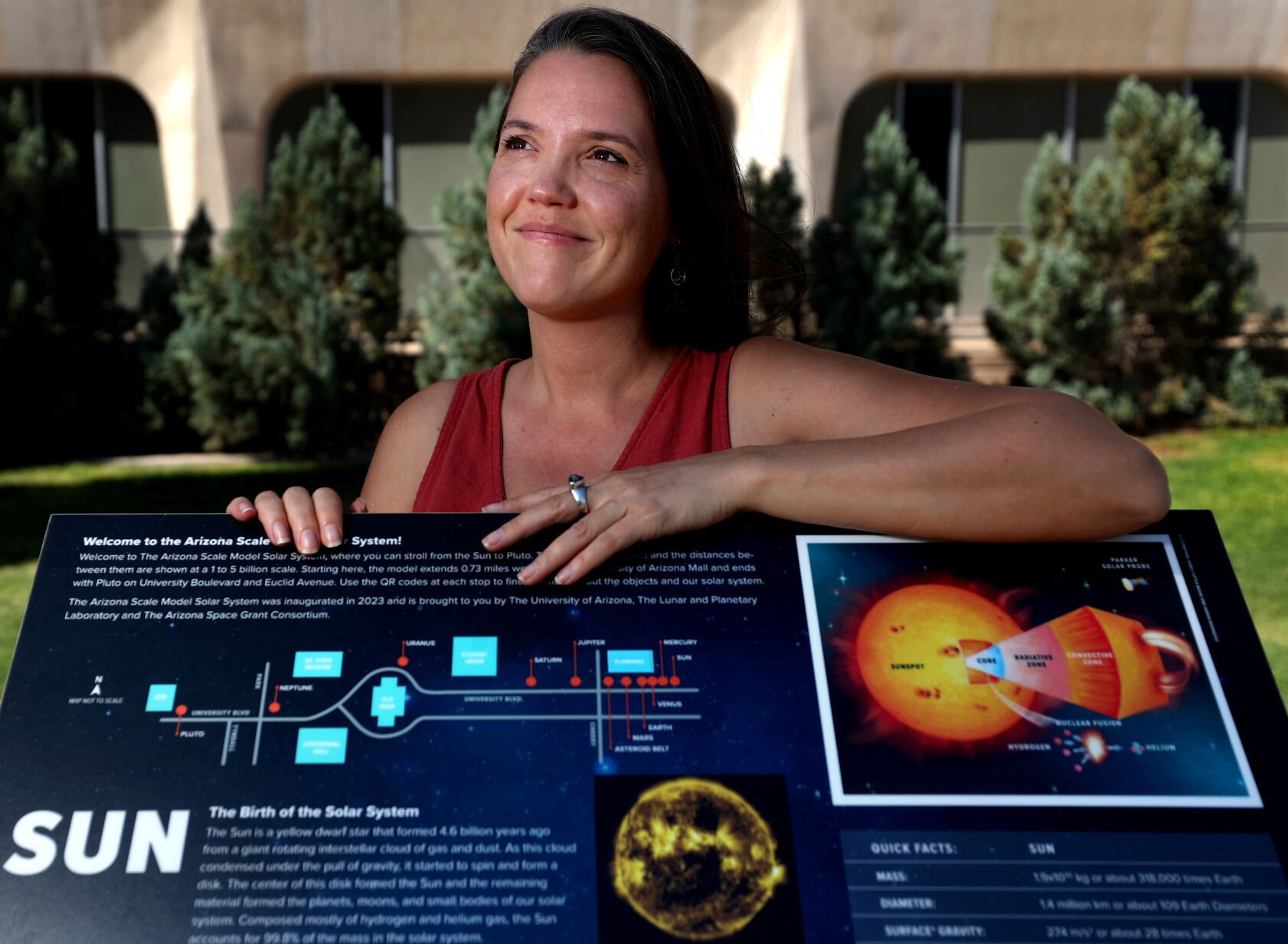


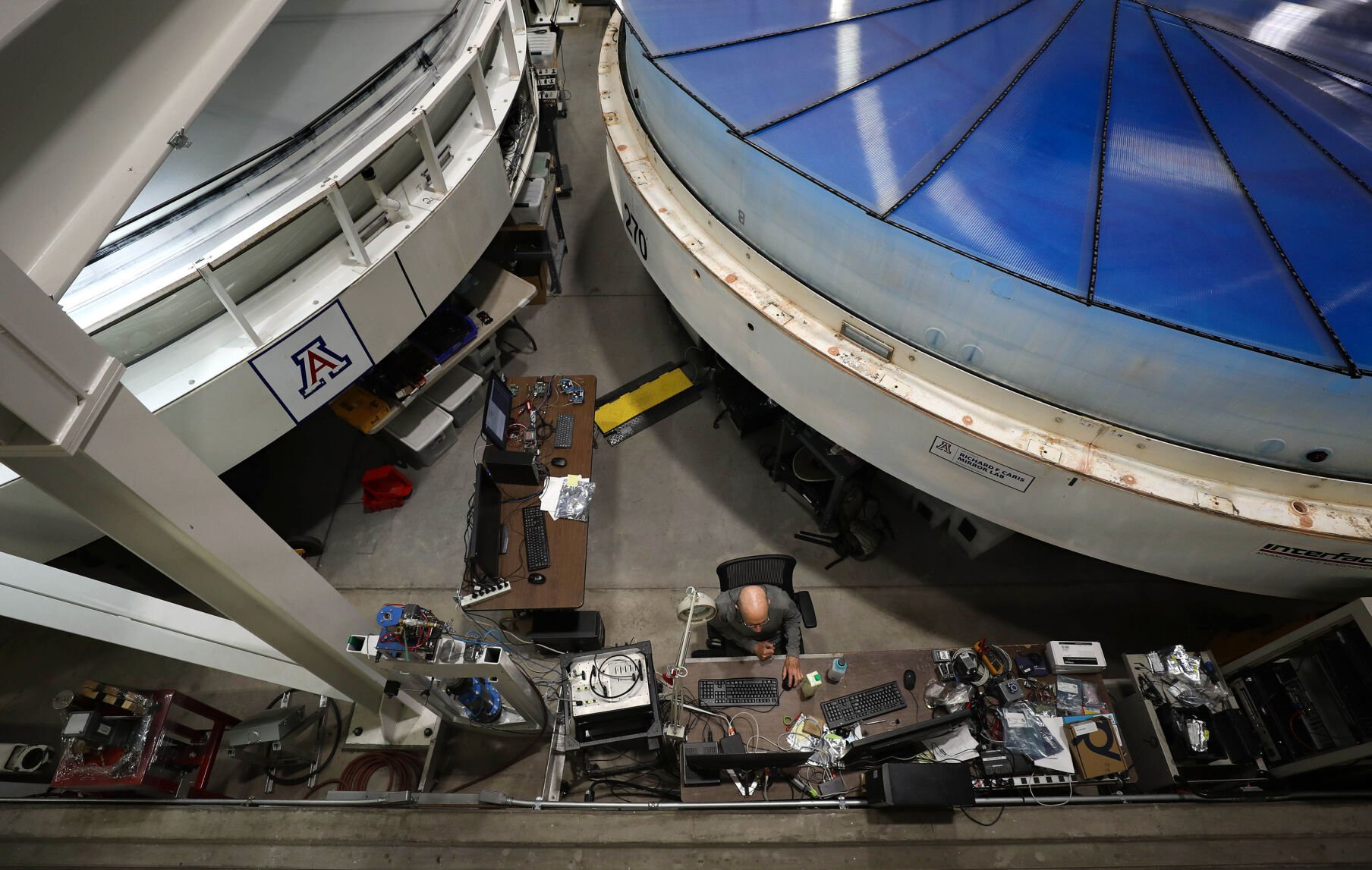


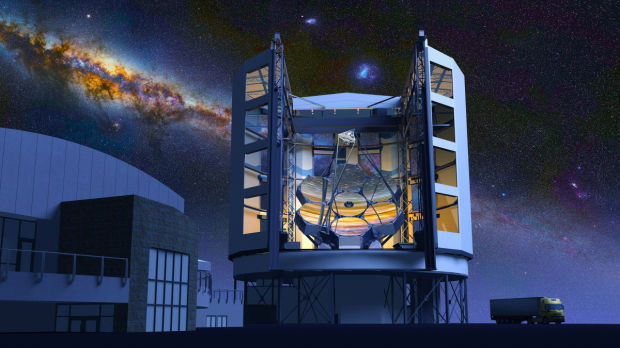



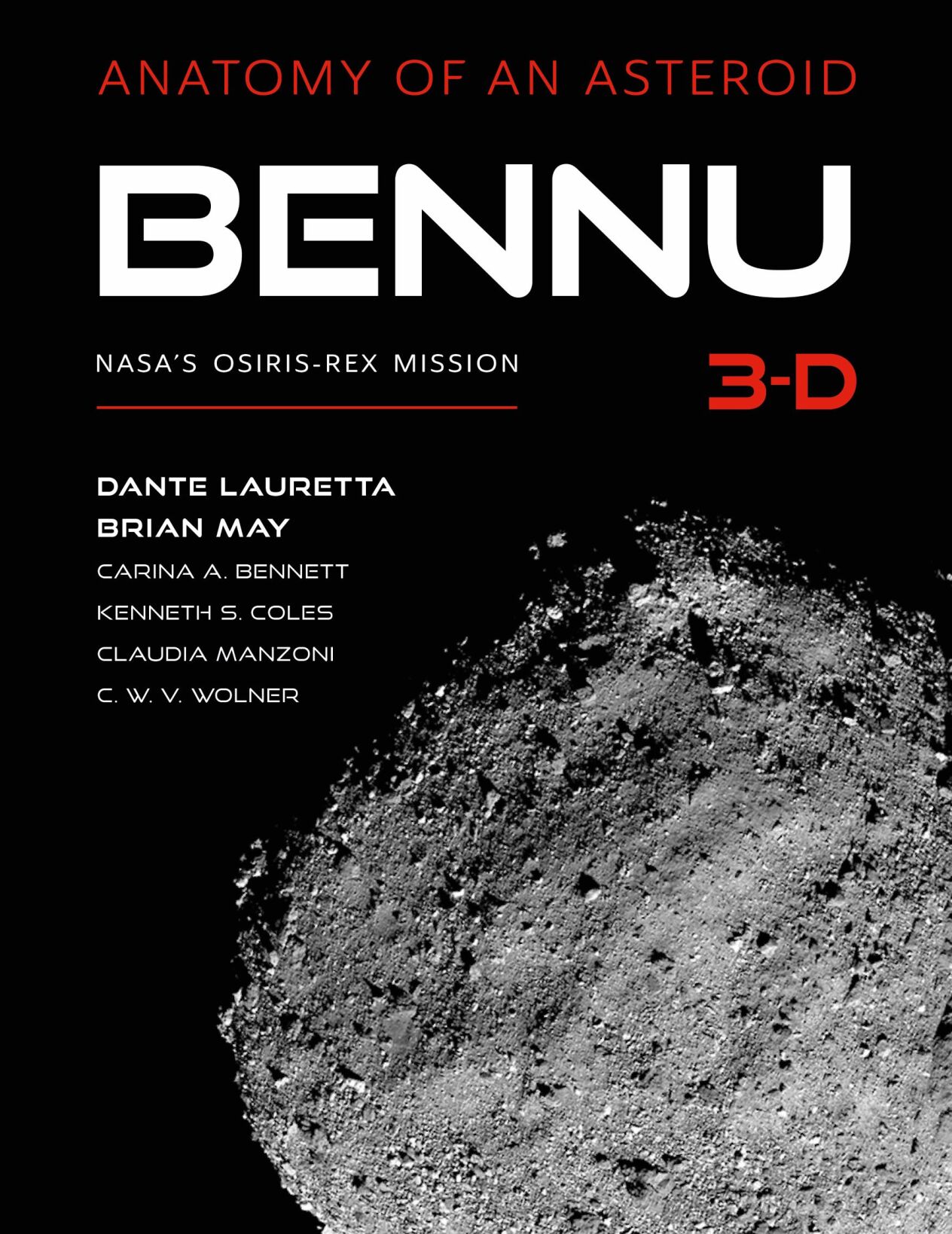




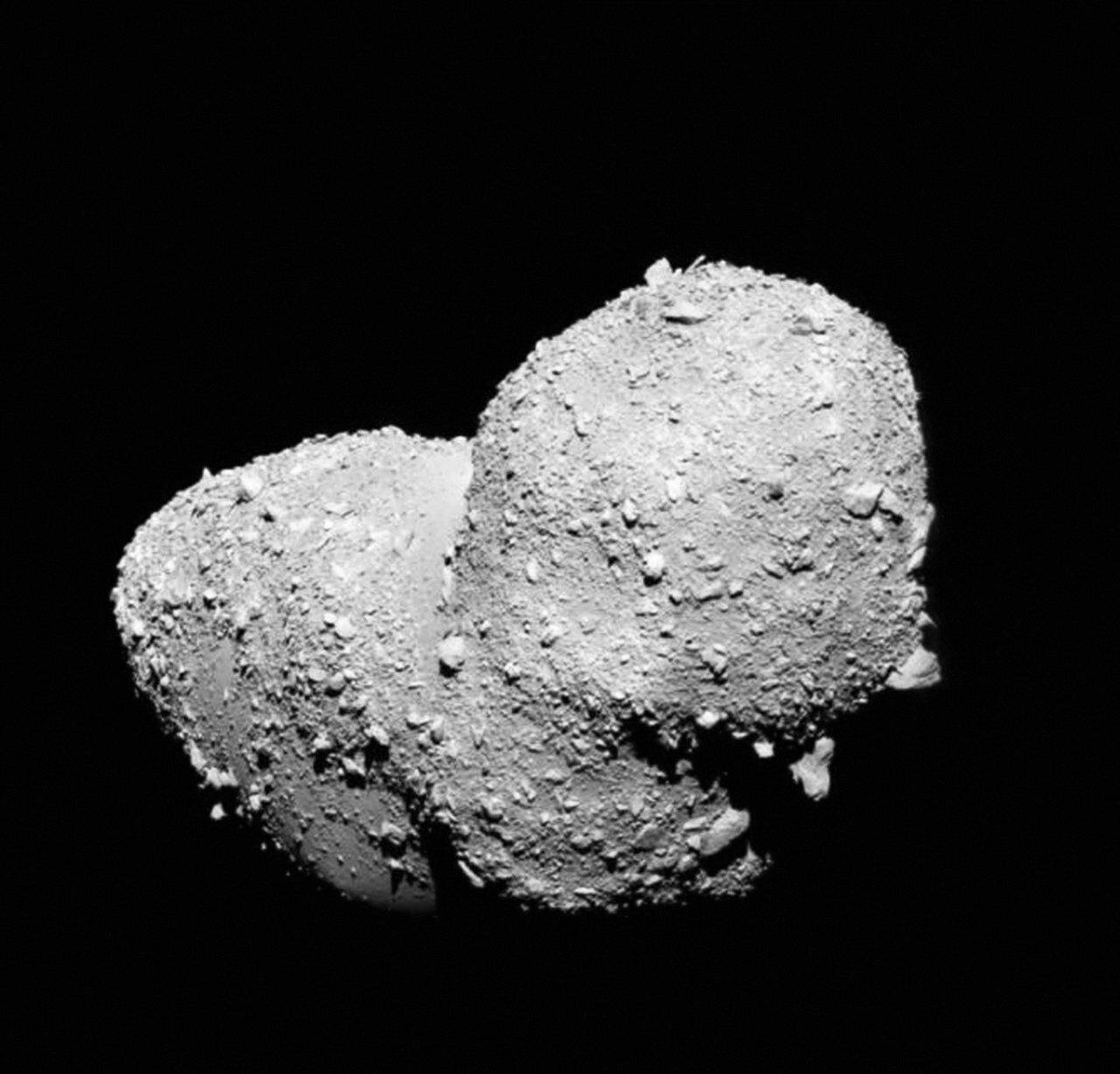


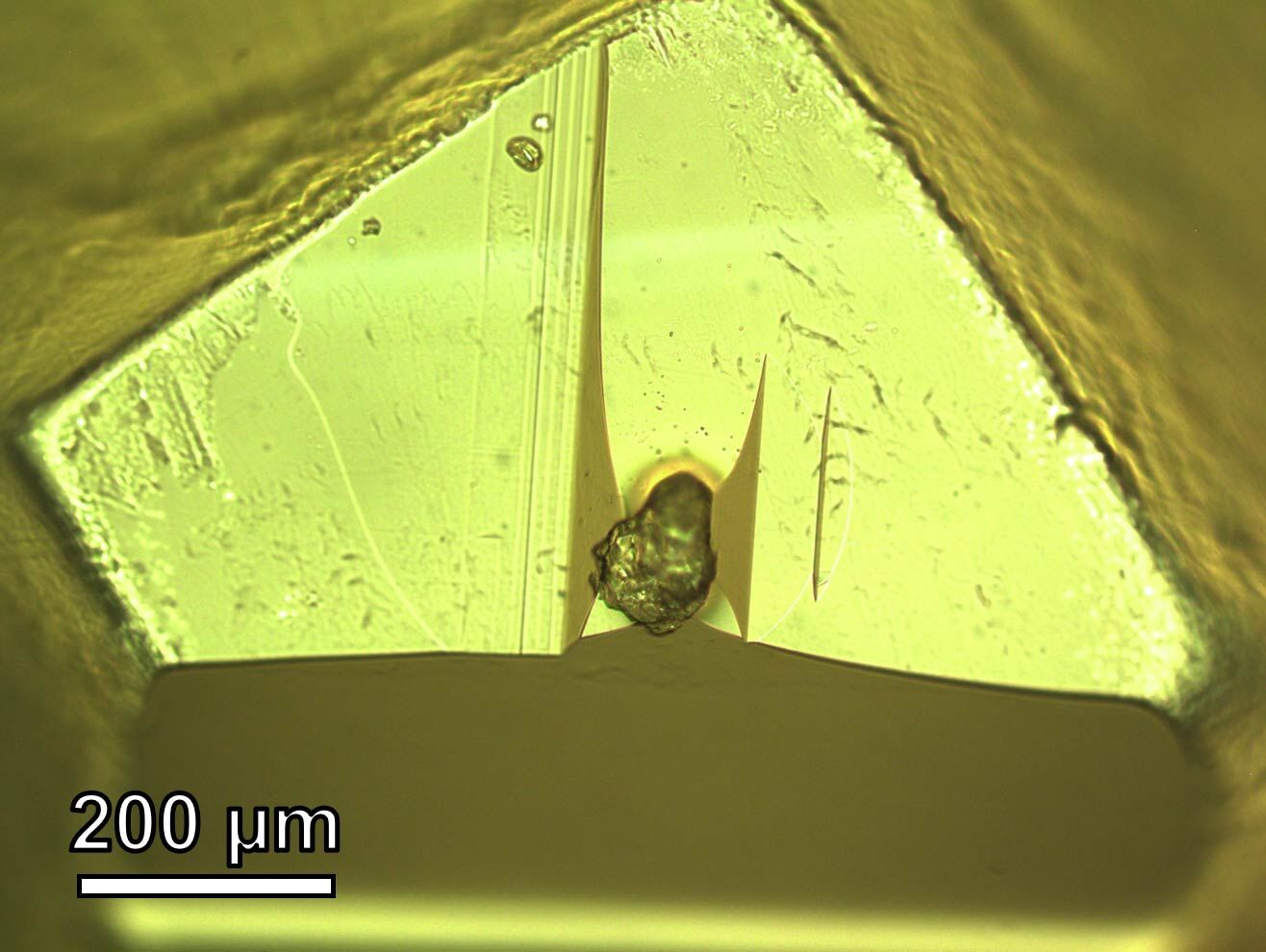


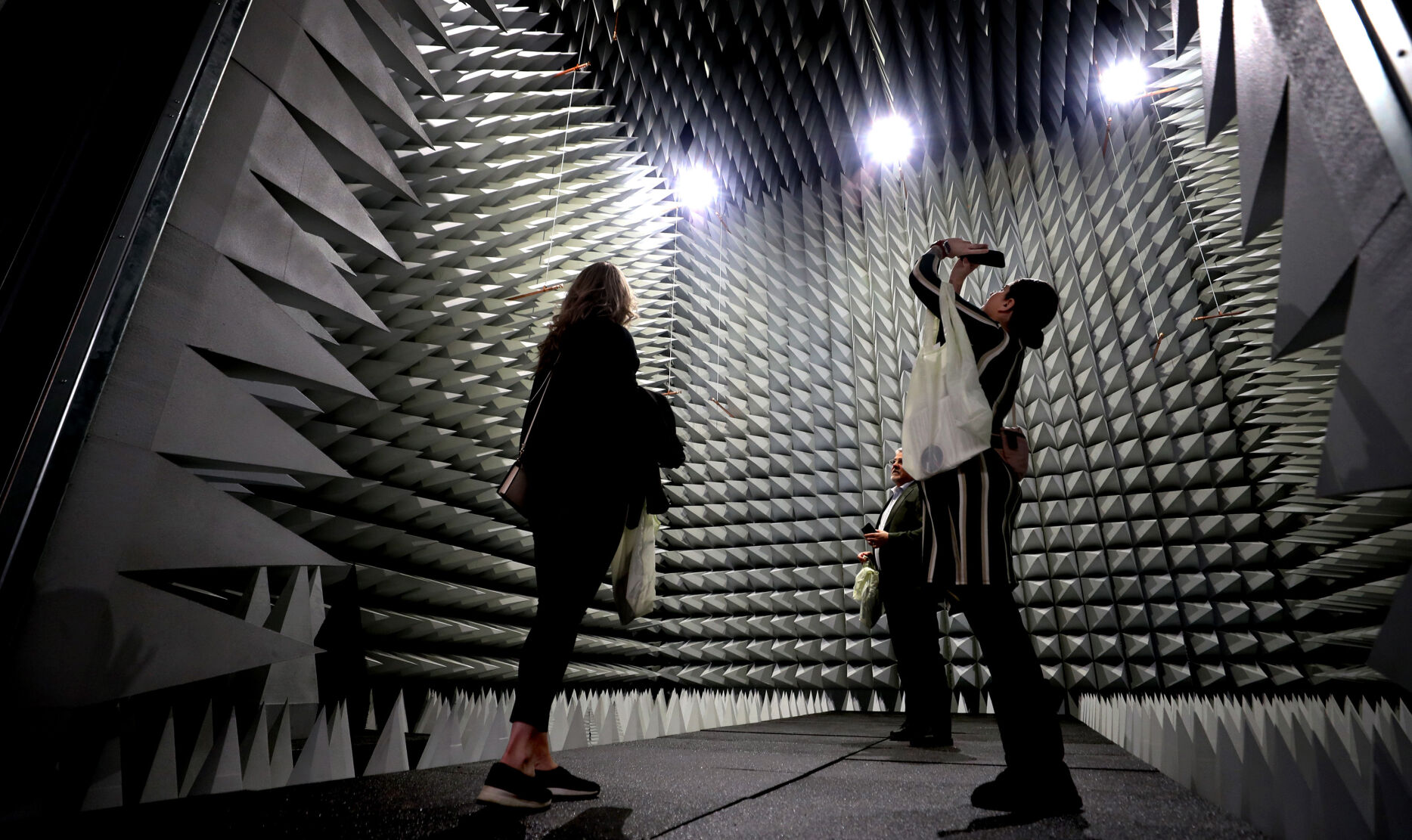




 U of A researcher helps find evidence of dinosaur-killing asteroid's 'little sister'