

Q: Any information on the origins of my antique highchair-and-stroller combo? It's a family piece. Value?
A: Thanks for the very clear images. They're a big help. From its simple design and basic stick construction, I'd date the mass-produced wooden highchair that converts to a push stroller to the first decades of the 20th century.
The wood is hard to make out, but it does not appear to be oak. Perhaps poplar or pine. The cast-iron wheels appear original.
Note the pattern of holes drilled into the seat. At one time, the surface where the baby sat was woven cane or rush. Such seats typically deteriorated with time - and dampness. Many were then covered with tooled leather circles, such as the one on this chair. The replacements were a quick, lasting fix.
When pondering the value, a smart collector thinks, "Who is the potential buyer?" Considering current child-safety standards, a new parent is certainly not your target buyer. Beyond safety, considering the chair as a possible utilitarian piece is ludicrous. The spindles would be a nightmare to wipe down and clean.
People are also reading…
Alternatively, the buyer could be an antique lover who finds the combo charming. But it is big. It takes up space and collects dust. It seems, in 2011, to have no earthly use but as a plant stand.
There is a collector who could love the piece, and that's a doll person. Traditionally, that is the individual who buys antique highchairs, the better to display dolls.
But that buying pool is small and very, very picky. Highchair hunters look for decorative, preferably over-the-top Victorian examples. Or they go for ones with technical innovations. Basic later chairs are a much harder sell.
Chairs that are top examples from a clearly identifiable period such as the 1950s, or clearly Edwardian or deco-like chairs, are exceptions.
Prices for old baby chairs have, like much in the collecting arena, tanked. On the subscription database, www.worthpoint.com, we found that a decorative Victorian oak combo sold on eBay in 2007 for $200. A technically advanced 19th century model in superb condition that adjusts to three heights brought $850, retail, in 2004.
On the free site www.liveauctioneers.com, we found a Victorian chair combo with a solid seat that brought $20 at auction in late 2009. It was the only highchair sale listed. You can see what's happening.
In brief, the reader's chair has value as a cherished family piece. The open market is a different story. This is not the time to sell. If and when you decide to jump in, be ready to take a hit unless you find a buyer who just has to have a basic early 20th-century chair combo.
Q: How do I sell my four "Pride of America's Indians" music boxes? They're from the Danbury Mint.
A: A set of eight plates, not musical boxes, with that title was released in 1986 by Artaffects Ltd. Many are on eBay offered for $4.99 and up. When we looked, the only completed sale was an entire set for $24.95. That amounts to $3 and change per plate.
Q: How do I find a buyer for my several dozen Zippo lighters? Most are never used, and most are Camel.
A: Zippo collectors - and there are many - hunt online. Check completed sales on eBay for similar models and sale results. See if better prices were obtained by bundling or grouping lighters.
AUCTION ACTION
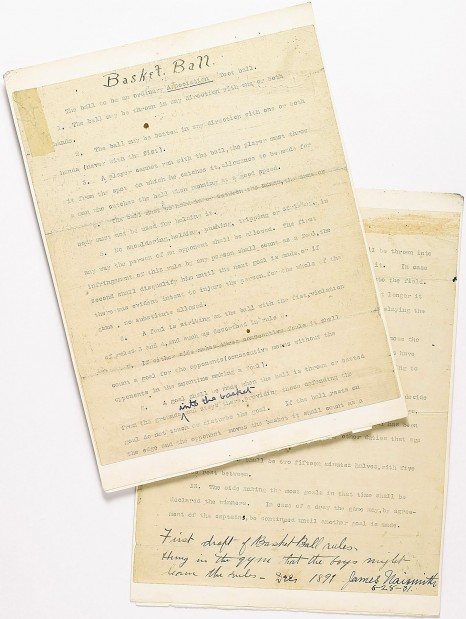
Who could have dreamed back in 1891 that two pages of typed rules for a new game that 30-year-old James Naismith tacked up in a Massachusetts YMCA gym would sell for $4.3 million? They did, recently at Sotheby's New York.
Then a P.E. teacher at a YMCA training college, Naismith created "basket ball" to keep students challenged between football and baseball seasons. As a team sport that could be played indoors and avoided physical contact, it became an instant success. Naismith's original 13 rules remain the core of the game.
In 1898, Naismith brought the game to the University of Kansas.
The original rules were sold by Naismith's relatives to benefit a family foundation that promotes good sportsmanship. They were bought by a University of Kansas alum who hopes to bring the rules to the school.
COLLECTOR QUIZ
Q: Naismith's first game was played with what equipment? How did the equipment later change?
A: The first game was played with a soccer ball and peach baskets. By 1906, the goals were metal hoops with backboards - adopted to keep fans from interfering with the flight of the ball. Naismith, who became an ordained minister and medical doctor, lived to see his invention adopted as an Olympic sport in 1936. He died in 1940.
Danielle Arnet welcomes questions from readers. She cannot respond to each one individually, but will answer those of general interest in her column. Send e-mail to smartcollector@comcast.net or write to Danielle Arnet c/o Tribune Media Services, 435 N. Michigan Ave., Suite 1400, Chicago, IL 60611. Please include an address in your query. Photos will not be returned.