It felt like something different was brewing.
In the end, it was same old, same old.

Michael Lev is a senior writer/columnist for the Arizona Daily Star, Tucson.com and The Wildcaster.
Arizona still can’t beat BYU. The 15th-ranked Cougars dominated the Wildcats in the second half, shutting them out after halftime en route to a 28-17 victory Saturday at LaVell Edwards Stadium in Provo, Utah.
BYU has won six consecutive games in the series. Invariably, the Cougars’ physicality gives them just enough of an edge.
So it was again Saturday, leading to a result that’s disappointing but hardly backbreaking.
Here are my top five takeaways from a defeat that drops Arizona to 1-1, 0-1 in the Big 12:
1. Second thoughts
The Wildcats held a 17-14 lead at halftime and executed their game plan to near-perfection.
People are also reading…

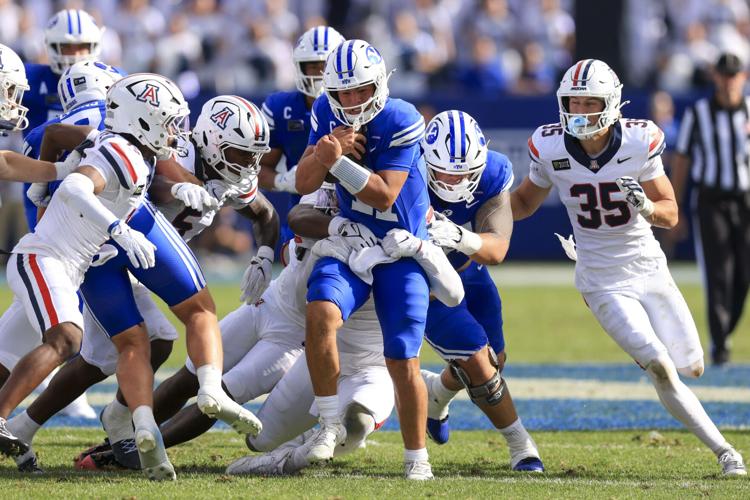
BYU quarterback Bear Bachmeier runs the ball for a first down against Arizona during the second half at LaVell Edwards Stadium on Saturday, Sept. 12, 2026, in Provo, Utah.
Arizona kept possession of the ball. The Wildcats capitalized on scoring opportunities. They controlled the action.
What changed after the break?
First off, BYU showed greater patience with its run game. The Cougars had just eight rushing attempts in the first half — seven if you exclude Leroy Palu’s sack. That isn’t their game.
BYU began the third quarter with a methodical 75-yard touchdown drive. Four of the nine plays were rushes — including quarterback Bear Bachmeier keeping the ball on an option play and converting a third-and-7.
Miscues on the other side of the ball put Arizona in precarious positions.
On the next possession, a holding call against guard Rhino Tapa’atoutai turned a second-and-7 into a second-and-20. The Wildcats couldn’t make up the yardage and had to punt.
After the defense forced a three-and-out, penalties again proved problematic. Arizona overcame Tapa’atoutai’s first-down facemask but couldn’t overcome a second-down false start by Matthew Lado.
In the first half, the Wildcats converted 4 of 7 third downs. Their average to gain was 4.4 yards.
In the second half, the Cats converted just 1 of 5 third downs. Their average to gain ballooned to 13.6 yards.
Chalk it up to a combination of ineffective running plays — minus-2 net rushing yards in the second half, including sacks — and breakdowns in pass protection.
But it was a decision on fourth down that arguably swung the outcome.
2. Take the points
With the score still 21-17, Arizona faced fourth-and-10 at the BYU 36-yard line late in the third quarter.
That should be well within Michael Salgado-Medina’s field-goal range. Or maybe you decide to go for it with the ball sitting in football’s “no man’s land.”
Brent Brennan chose option No. 3. He elected to punt.
Counterpart Kalani Sitake wisely declined a delay-of-game infraction that would have pushed the ball back 5 yards. Gavin Hunter nearly kept Chase Ridley’s punt from landing in the end zone, but one of his cleats touched the goal line.
It’s easy to second-guess Brennan’s decision when the net gain is just 16 yards. I didn’t like it regardless of the outcome.
Brennan repeatedly showed faith in Salgado-Medina last season, even when it wasn’t necessarily warranted. I don’t get why he wouldn’t in that situation. Salgado-Medina had a great offseason, and colleague Justin Spears reported that he made a 57-yarder during warmups. It would have been a 53-yarder from the 36, maybe 54 depending on the exact spot.

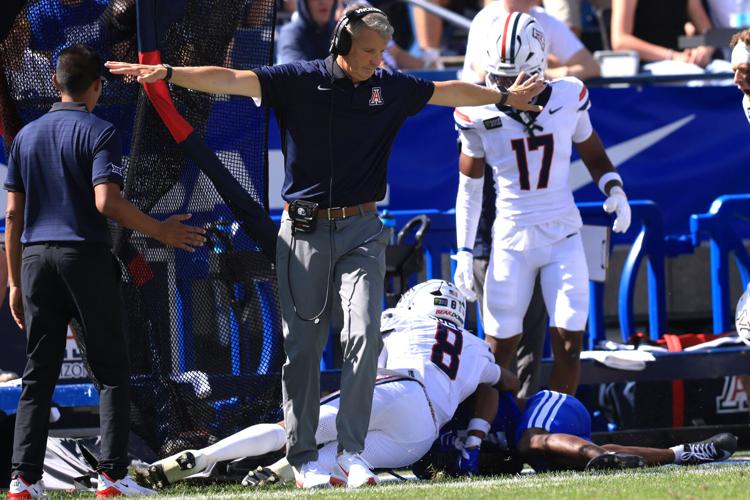
Arizona head coach Brent Brennan reacts to a play against BYU during the second quarter at LaVell Edwards Stadium on Saturday, Sept. 12, 2026, in Provo, Utah.
A made field goal at that juncture would have made the score 21-20. Even if BYU had responded with a touchdown, Arizona still would have been within one possession.
The decision had downstream consequences.
After the defense got the ball back, Arizona drove to the BYU 21, where it faced fourth-and-4. If the score had been 21-20, maybe you kick the field goal there to try to take the lead. Down four, Brennan felt compelled to go for it.
Noah Fifita completed a shallow cross to Rodney Gallagher III, who was tackled just short of the first-down marker. The officials originally gave Gallagher the first down, but replay overturned the call.
Gallagher took over the slot position for Giovanni Richardson, who was injured in the first half. His absence proved costly.
3. Next man up?
Richardson had a breakout performance in Week 1, and he was on track for another stellar outing against BYU.
At the time he got hurt, Richardson had five catches for 48 yards. It was still the first quarter.
Richardson would end up tied for the team lead in catches (with Gallagher) and receiving yards (with tight end Cole Rusk).
Arizona needed other receivers to step up when Richardson went down. They didn’t do enough to help Fifita and keep the offense rolling.
Starting wide receivers Chris Hunter and Tre Spivey combined for three catches for 26 yards. Hunter was quiet in the opener too (one catch, 11 yards) and wasn’t at all efficient against BYU, snagging just one of six targets.

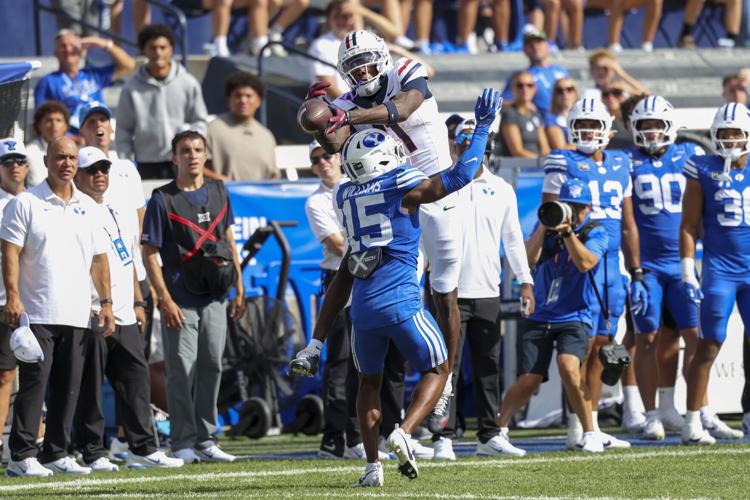
Arizona wide receiver Chris Hunter (11) and BYU cornerback Jayven Williams (15) battle for a pass during the second half at LaVell Edwards Stadium on Saturday, Sept. 12, 2026, in Provo, Utah.
Spivey had four catches for 45 yards in Week 1 but was targeted just two times against the Cougars.
You’d expect more production and playmaking from two veteran receivers who had strong offseasons.
Gallagher caught all five passes thrown his way, and Brandon Phelps had a 30-yard catch-and-run. But collectively, the wide receivers didn’t win enough battles.
Credit the Cougars’ secondary for its sticky coverage and their pass rush for getting home, especially in the fourth quarter. But depth was supposed to be the strength of this unit. It was never Giovanni Richardson and everyone else. This isn’t 2024, when the receiving corps lacked playmakers beyond Tetairoa McMillan.
The next game vs. Northern Illinois offers an opportunity for Hunter and Spivey to get back on track, regardless of Richardson’s status. These are players Arizona was counting on coming into the season. They’re still players the Wildcats need.
4. Growing pains
Arizona didn’t succeed in its mission to stop BYU’s power-running game — although the Cougars’ 148 rushing yards were 110 fewer than their total in last year’s meeting.
Bachmeier scored a touchdown on the ground but had just 37 net rushing yards. He passed the ball much more efficiently than a year ago.
The sophomore quarterback took advantage of a secondary that’s enduring growing pains.
One example: Bachmeier’s 25-yard touchdown pass to Reggie Frischknecht in the second quarter.
Frischknecht was one of two receivers on the right side. Bachmeier faked a screen pass to the other, Legend Glasker. That action drew deep safety Quinn Olson toward the line of scrimmage — and out of position to defend Bachmeier’s slant pass to Frischknecht.

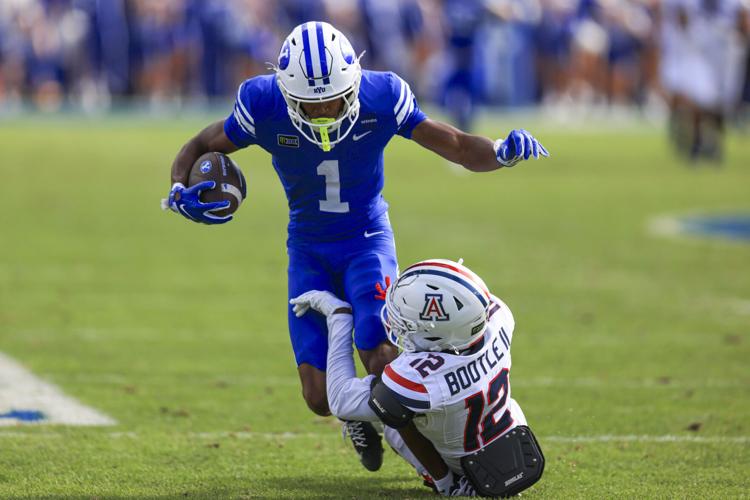
BYU wide receiver Legend Glasker runs after a catch against Arizona cornerback Dwight Bootle II during the second half at LaVell Edwards Stadium on Saturday, Sept. 12, 2026, in Provo, Utah.
Maybe last year’s free safety, Genesis Smith, would have made the same mistake. But keep in mind, this was just Olson’s second career start. He’s learning on the job.
Transfer cornerback Dwight Bootle II got caught in traffic on a crossing route to yield a touchdown in the third quarter. Bootle got beat deep by Glasker in the fourth.
It was never realistic to expect Arizona’s defensive backfield to perform at the same level as last year’s unit, which sent five players to the NFL.
Then again, last year’s group wasn’t completely locked in early in the season either. Remember the Iowa State game? That was the fourth game of the season, and the secondary got torched for 288 yards. It didn’t give up as many as 200 the rest of the regular season.
Give Arizona’s secondary coaches, Brett Arce and Chip Viney, a little time. They’ll get their guys right.
5. No panic
Fifita took the loss hard. I’m sure his teammates did, too. The coaching staff won’t sleep easy either.
But as frustrating as it was for all parties involved, the loss doesn’t torpedo Arizona’s season.
Did the Wildcats miss out on an opportunity to jump into the Top 25 and ascend the Big 12’s power rankings? Yes. Can they still accomplish everything they want to accomplish this season? Also yes.
Four of the next five games are very winnable, with the only exception being an Oct. 10 trip to West Virginia. It’s still conceivable Arizona will be 6-1 when it visits Texas Tech on Halloween — 5-2 at worst.

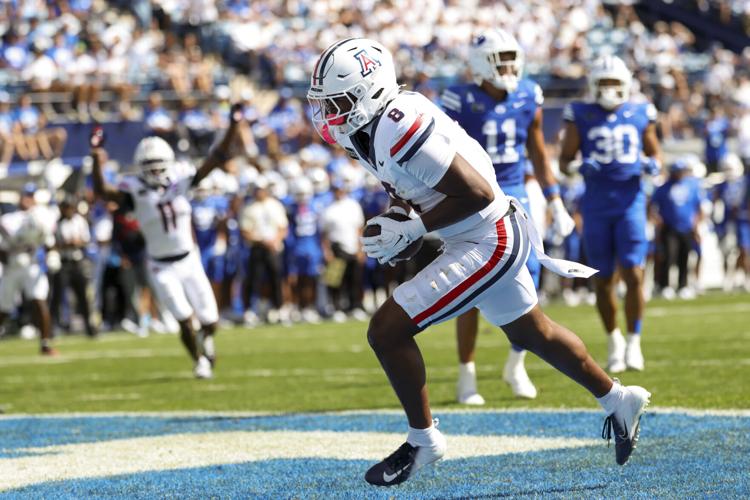
Arizona tight end Shane King makes a catch for a touchdown against BYU during the second quarter at LaVell Edwards Stadium on Saturday, Sept. 12, 2026, in Provo, Utah.
(It’s probably a mistake to take Washington State for granted on Sept. 26; bad things often happen to the Wildcats in Pullman. I just don’t think this WSU team is on the same level as recent editions.)
It’s critical that the Wildcats figure some stuff out this upcoming week against NIU. BYU exposed Arizona’s flaws in a variety of areas.
The Wildcats need to play a cleaner game. They need to build confidence. They need to determine their best 11 on each side of the ball. They need to get the Turnover Sword out of its case.
Time and the schedule are on their side.
Contact sports reporter/columnist Michael Lev at mlev@tucson.com. On X (Twitter): @michaeljlev. On Bluesky: @michaeljlev.bsky.social

Michael Lev
Sports Reporter/Columnist


 On Arizona’s massive opportunity at BYU and other Week 2 thoughts | Michael Lev