The following is the opinion and analysis of the writer:

Julia Butterfly Hill
Twenty-nine years ago, I climbed into the branches of an ancient redwood named Luna in Humboldt County, California. I expected to stay a few days to stop loggers from cutting the tree down. Instead, I spent 738 days living in its branches.
People still ask what compelled me to climb. The answer is simple: Standing on the ground no longer felt like enough.
Now a group of brave activists in the borderlands of southern Arizona and northern Mexico have reached the same conclusion. They recently climbed into the last surviving Fremont cottonwoods standing in the path of Trump's dual border wall construction.
It is the first tree sit ever mounted to stop border wall construction — and, with activists on both sides of the line, the first binational tree sit in history.
People are also reading…
For nearly a month now, they've lived in its canopy and stopped heavy machines from destroying other beautiful, ancient trees.
Some people may dismiss them as too extreme. I know better.
Tree sits are not acts of aggression. They are acts of love. They happen only after every other avenue has failed. No one chooses to put their bodies on the line because it's comfortable. They do it because an ancient living being cannot move to save itself.
Three neighboring cottonwoods have already been cut down, each of them over 200 years old. Their shattered trunks remind us that once these decisions are carried out, they can't be undone.
Cottonwoods are more than wood and leaves. They anchor waterways, cool desert streams, and shelter migrating birds. They feed insects, fungi, mammals and countless unseen lives. They are elders in landscapes where elders have become heartbreakingly rare.
When we destroy ancient trees, we erase relationships that have taken centuries to grow.
Living in Luna's branches taught me something I have never forgotten: The struggle is never about one tree. Luna was not just a single redwood. She forced us to look inward and ask: What kind of society are we? What do we protect when power tells us to look away?
That same question now hangs from the branches of these borderlands cottonwoods.
These trees stand in one of North America's great wildlife corridors, where jaguars, black bears, pronghorn and countless other species have moved across the landscape for millennia. They stand beside a border that has become increasingly militarized, even as the natural world continues to remind us that rivers, birds and wildlife recognize no political lines.

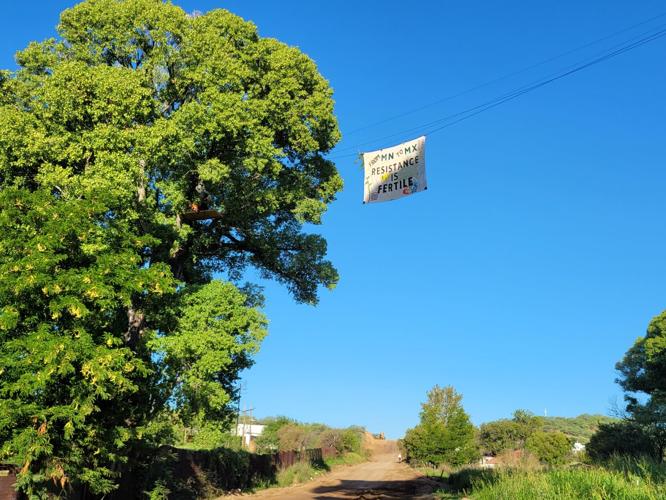
A banner hangs between Fremont cottonwood trees on both sides of the U.S.-Mexico border at Lochiel, Arizona, as part of a tree-sit protest against border wall construction.
I understand that people hold deeply different views about immigration and border security. Those conversations matter. However, reducing this moment to a political debate overlooks what's really at stake. These trees are not the cause of our nation's challenges. Destroying more ancient cottonwoods will not solve them. What it will do is leave another wound on a landscape that has already sacrificed too much.
Throughout history, ordinary people have placed their own bodies at risk to fight for what was right. They sat at lunch counters, stood in front of tanks, and crossed bridges knowing they would be beaten.
Others climbed trees.
Peaceful, direct action begins with a moral question: If the law permits an irreversible wrong, what responsibility do ordinary people have? The tree sitters in Arizona have answered that question with courage, patience and remarkable restraint.
Whether or not you think you agree with them, I ask that you recognize that they're compelled by love for a living world that cannot speak for itself as well as for future generations.
Long after this news cycle has passed, the question will remain: When the last ancient cottonwoods stood alone, who stood with them?
For nearly a month now, and counting, the answer has come from high in its branches — on both sides of the border.
Follow these steps to easily submit a letter to the editor or guest opinion to the Arizona Daily Star.