



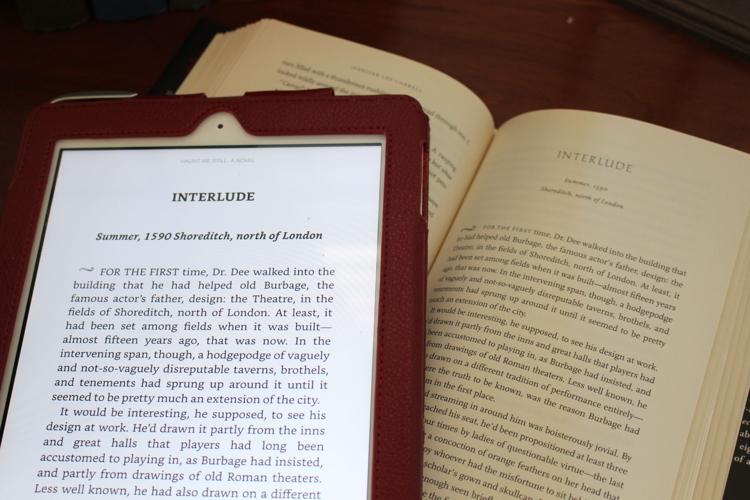

The temperature in the Old Pueblo crossed the century mark, you’re ready for the beach or a cool mountain hideaway and to catch up on your reading. As you pack your suitcase, the question is whether to take print or digital books.
Since digital books flickered on e-reader screens almost 20 years ago, the doom of printed books has been predicted. Despite the dire forecasts, print books continue to rule. According to bustle.com, e-book sales have never made up more than a third of all book sales and sales of e-books seem to have leveled off.
Likewise, the percentage of people reading print books rose 4 percent in 2013, after two years of decline, according to Time magazine.
People are also reading…
Time reports a study by the Pew Research Center that says half of American adults own either an e-reader or a tablet capable of reading e-books; only 4 percent are “e-book only” readers.
The research on the print vs. digital debate is mixed. Some studies find readers absorb less material digitally while others find no discernible difference, according to a May 28 NPR story, “Technology Of Books Has Changed, But Bookstores Are Hanging In There.”
Science and statistics probably are not considered your vacation planning, so here are some things to keep in mind.
- Print books are a tactile experience: feeling the paper, holding the book adds to the reading experience. It is an olfactory and auditory as well: the subtle scent of the paper and ink and the gentle crack of a book’s spine and the distinct sound of the flip of a page add to the overall reading experience.
"The books just look better," said paper industry analyst Thad McIlroy. He noted in the NPR story that publishers are paying more attention to such tactile qualities as a book's cover and the quality of paper. - E-readers cannot be beaten for convenience. They are lightweight, portable and do not need to be removed from your carryon bags at airport security. You can pile on a stack of electronic books and not dislocate your shoulder.
Likewise, it’s easy to pullout an e-reader during down times — say waiting in line at Disneyland. (Though I, um er, I mean this woman I know read Amy Tan's "The Kitchen God's Wife" in the mid-'90s while waiting in line for the Big Thunder Mountain Railroad roller coaster. We — oops!, they — rode it several times, to say the least.) - Print editions may make it easier to become immersed in a book, some studies indicate.
- E-readers — especially tablets — can be distracting. Imagine you are reading a book and an alert for an email, text message or Words with Friends play pops up. You will probably want to see what great word your pal played.
- E-readers can be a pain. Even though the font, font size and page color are adjustable on an e-reader, eyestrain and headaches and physical discomfort have been reported.
- E-reader dictionaries are fab. Don’t know the meaning of a word and can’t figure it out from context? Touch it, linger on it and a definition pops up. Much easier than telling yourself you’ll look the word up in the dictionary later and don’t get around to it.
- Print books do not run out of battery power and the sun’s glare does not make them unreadable.
- E-readers don’t do well in water, like an inadvertent dip in the lake or being overtaken by a wave. Sand in the charger port? Not good.
Print books don’t fare well in water, either, but you're not out as much money. - Print books are easier to share. There’s nothing like giving a friend a book you’ve enjoyed. E-book sharing options can be cumbersome.
- Print books can be signed by the authors and a beloved book becomes a treasure. We’ve seen a few authors at the Tucson Festival of Books signing tablet and e-reader covers.
- Print books are the reason for bookstores. Exploring a bookstore and discovering a treasure can be a vacation in itself.
"We are not only what we read but how we read," Maryanne Wolf, a professor at Tufts University and author of “Proust and the Squid: The Story and Science of the Reading Brain,” said on NPR.
Wolf said that she embraces what she calls the "bi-literate brain," one equally at home in the digital and analog worlds.
Our best packing advice — take your e-reader and a couple of print books, too.


