

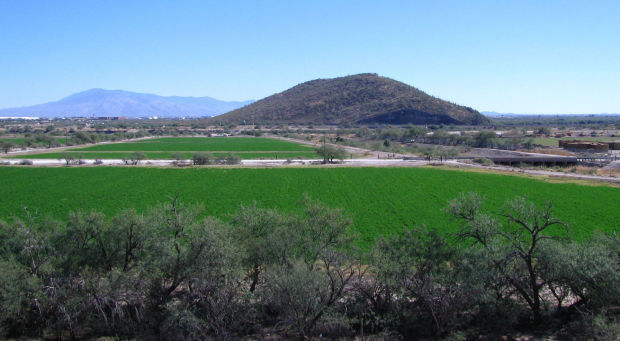
Martinez Hill Drive takes its name from nearby Martinez Hill, a volcanic outcropping that once was the home to Hohokam Indians. The hill is named in honor of Jose Maria Martinez.
Martinez was born around 1806 to 1811, likely in the Pimeria Alta, encompassing present-day northern Sonora, Mexico and southern Arizona. His father may have been Juan M. Martinez, who served in the Mexican military and was assigned to the Presidio San Ignacio de Tubac, then part of Sonora, Mexico, in 1801.
Around 1833 Jose married Felipa Yrigoyen, likely in Tubac, Sonora. The couple had nine children, including Maria and Nicolas Martinez.
From 1836 to 1838, Lt. Col. Jose Maria Martinez served as commandant of the Presidio de San Agustín del Tucson and overall commander of the Mexican troops stationed at Tubac, Altar and Santa Cruz while their usual commander, Capt. Antonio Comaduran, was assigned elsewhere.
People are also reading…
On March 5, 1836, prior to becoming commander of the Tucson Presidio, he was one of several people to sign a peace treaty between the Pinal Apaches, represented by war chiefs Navicaje and Quiquiyatle, and Mexican troops, commanded by Col. Jose Maria Elias Gonzalez. The treaty helped reduce hostilities between this band of Apaches and Mexicans in Sonora.
Shortly after taking command in Tucson, Martinez offered a reward of fine clothing to Chief Azul, leader of the Gila River Pima Indians, for military campaigns made against hostile Apaches (non-Pinal Apaches). But in the summer of 1837, “Chief Azul confronted Martinez with fifteen pairs of Apache ears, but was told the garb would not be granted since the comandante considered it highly probable that the ears had been attached to Pinal heads shortly before,” James E. Officer wrote in, “Hispanic Arizona 1536-1856.”
In 1838, Martinez retired from the Mexican military and was granted land in Tubac by the Presidio commander, Don José M. Villavacencuia. The land was surveyed to verify its boundaries by Martinez’s father-in-law, Justice of the Peace Don Trinidad Yrigoyen.
Ten years later, in December 1848, an Apache attack left Tubac abandoned, with many residents relocating to Tucson but some, including the Martinez family, taking refuge at San Xavier del Bac.
The laws of Sonora on Feb. 4, 1851, said that each family that was forced to flee Tubac should be given vacant land at San Xavier Mission or Tucson. Martinez petitioned for land under these laws and, at a meeting called by the Justice of the Presidio of Tucson, Ignacio Saens, his petition was approved. The hill that bears his name was either included in this land grant or was close to it. The Martinez family built a house on the west side of the plaza in front of San Xavier church, drew water from his fields from an irrigation ditch called ‘Ojo de Agua,’ or spring, and loaned his oxen to neighboring Indians to cultivate their own land.
In 1856, two years after the United States bought Southern Arizona, Mexican troops left Arizona and handed keys to the San Xavier and Tumacacori churches over to Martinez. His wife died that same year.
On March 2, 1859, Martinez sold his land holdings in Tubac to Manuel Otero, the father of Sabino Otero (Otero Avenue).
Martinez remarried between 1860 to 1864 to Jesusa Quintero and they had four children.
In February 1863, while looking after his cattle at the foot of the Black Mountain at San Xavier, he was attacked by Apaches and suffered a rifle shot to the left side and an arrow through the left shoulder. Tohono O’odham Indians rushed to his aid and likely saved his life, but he ultimately died from the wounds he suffered during that fight, on Sept. 22, 1868.
Note: Martinez Hill is on the San Xavier District and access is restricted.
Sources:
Special thanks to Ron Zack of Law Review Radio on KVOI 1030 AM.
Byrd H. Granger, “Will C. Barnes’ Arizona Place Names,” The University of Arizona Press, 1985
James E. Officer, “Hispanic Arizona 1536-1856,” The University of Arizona Press, 1987
Ken Lamberton, “Dry River: Stories of Life, Death, and Redemption on the Santa Cruz,” The University of Arizona Press, 2011
Judith Williams, “Plaza of the Pioneers,” Tucson Museum of Art, 1982
Kieran McCarty, “A Frontier Documentry: Sonora and Tucson, 1821-1848,” The University of Arizona Press, 1997
Unknown Author, “Removing Settlers: From the San Xavier Papago Reservation, Statements of Principals to the Trouble,” Arizona Weekly Citizen, Jan. 24, 1885
Ray H. Mattison, “Early Spanish and Mexican Settlements in Arizona,” New Mexico Historical Review, Oct. 1946
James E. Officer and Henry F. Dobyns, “Teodoro Ramirez: Early Citizen of Tucson,” Journal of Arizona History, Autumn, 1984
J. Homer Thiel “Pioneer Families of the Presidio San Agustín del Tucson” (online)
Winston P. Erickson, “Sharing the Desert: The Tohono O’odham in History,” The University of Arizona Press, 1994
Norman E. Gabel, “Martinez Hill Ruins: An Example of Prehistoric Culture of the Middle Gila,” University Dissertation, 1931 (University of Arizona Library)

 Analysis: These 9 TUSD schools are at highest risk of merging or closing


