These Americans lined up at food banks and charities around Tucson are not our priority.
The system is telling them that every day.
Anaix Felix, a 37-year-old mother of two, told me she had previously received hundreds of dollars in Supplemental Nutritional Assistance Program money per month. It supported her 2-year-old and 6-month-old child.
But trying to renew her food stamps, which recipients in Arizona have to do every six months, has proved impossible this year, Felix said. She's applied online and by mail.
"It was supposed to begin," she said in Spanish. "They haven't sent it to me."
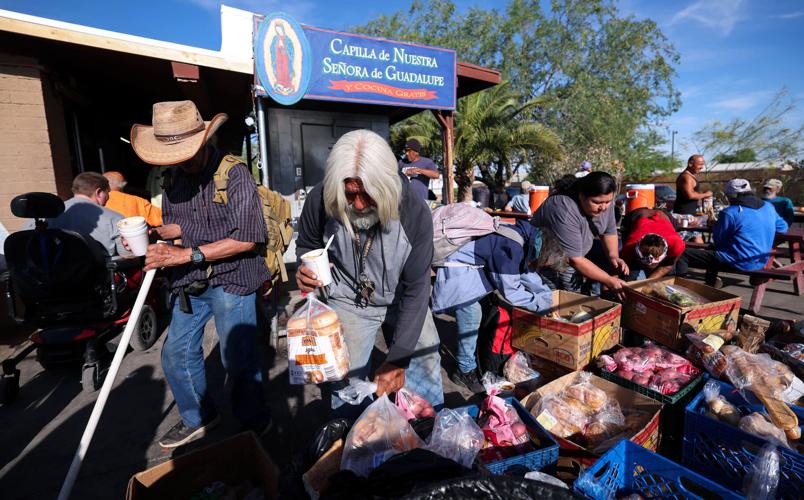
She was among about 70 people waiting for the doors to open at noon Thursday at the Community Food Bank of Southern Arizona.
People are also reading…
It's one of three food banks I've visited in recent weeks, all now experiencing surging demand.
That's in part because Arizona has cut recipients of food stamps faster than any other state, leaving the number of people on SNAP about half of what it was, and about 400,000 people without the food aid they previously relied on, even as inflation accelerates again due to the Iran war.

Casa Maria soup kitchen offers the community free food from 8:30 a.m. to 11:30 a.m. daily at 352 E. 25th St.
This is in large part the result of the One Big Beautiful Bill Act, the tax-and-spending bill that was the subject of months of debate before Congress narrowly passed it last summer, with Vice President J.D. Vance casting a tiebreaking vote in the Senate, allowing President Trump to sign it on July 4.
The bill slashed the number of people eligible for food stamps and Medicaid, cut income-tax rates, and poured money into immigration enforcement and the military, among other changes. You can see its impacts in the mass deployment of immigration agents around the country, the purchase of warehouses for detention centers, and in people like Felix lining up for food donations.
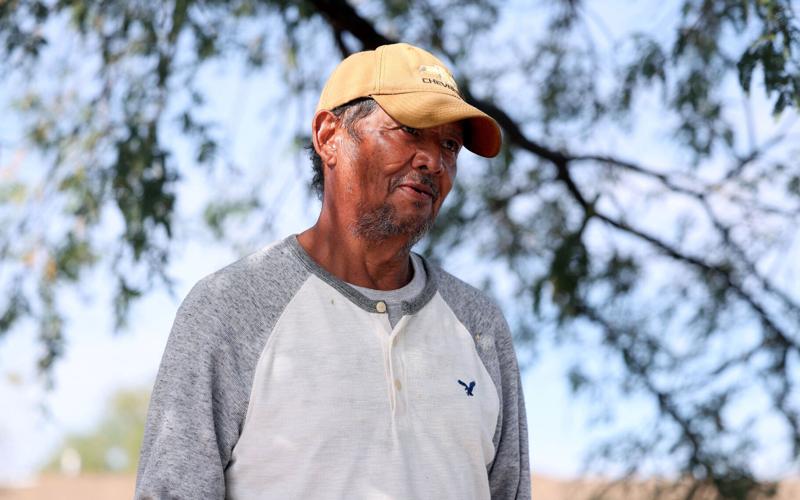
Also, people like 60-year-old Mario Romero, who was eating Friday morning at Casa Maria Soup Kitchen. He told me he had been on food stamps for about four years, averaging about $280 per month, but he was unexpectedly denied benefits in recent weeks, even though he has diabetes and depends on the food aid to stay healthy as well as to stave off hunger.
He thinks they mistook his application for either his son, who has the same name, or another Mario Romero in the system, because they seemed to misunderstand his individual circumstances.
"I come here to eat because they cut off my food stamps," he said in Spanish.

Mario Romero, age 60, seeking food at Casa Maria soup kitchen, speaks about recently being cut off from his food stamps after four or five years on them. Romero says he believes DES has mistaken him with his son who shares the same name, or another Mario Romero in the system.
'So, starvation'
It would be great if people were leaving SNAP because they simply didn't need it anymore. But that's not what's happening at all. The government is forcing them off as part of a bigger effort to shift spending away from social welfare and toward tax cuts, immigration enforcement and the military.
The One Big Beautiful Bill Act cuts spending on SNAP by an estimated $187 billion over 10 years, and it also makes technical changes that make it harder for people like Romero to keep getting the aid.
Previously, work requirements did not apply to people over age 55, but now they are expanded and include people up through age 64, like Romero.
The bill also imposed time limits on groups of people who previously didn't have them — such as children aging out of foster care, homeless people and veterans. And it made it harder for people to continue qualifying by requiring more regular evidence of qualification.
It also forces states to reduce the error rates in their enrollment of recipients to no more than 6%, which has them demanding more and more information from recipients. The error rate is calculated by taking a sample of SNAP payouts and finding how much of it was paid out in error. If states go over 6%, they will now have to pay the federal government an amount that, in Arizona's case, could reach over $100 million.
What's catching many of the people I've spoken with is all the paperwork.
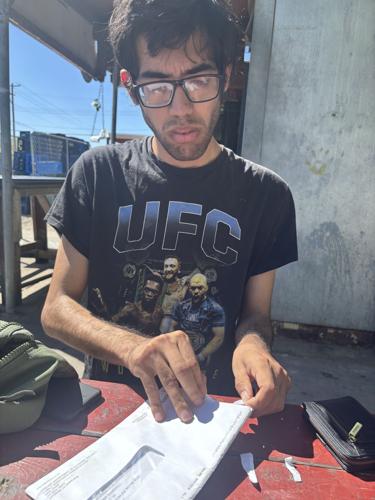
When I spoke with 25-year-old Adrian Andrade at Casa Maria, he happened to be carrying a letter from Arizona's Department of Economic Security with him as evidence of his local residence. He opened it for me to show page after page he needed to fill out.

Adrian Andrade, 25, carried a letter from Arizona's Department of Economic Security with him to Casa Maria soup kitchen as evidence of his local residence. He opened it to show page after page he needs to fill out, with documentation he doesn't have, if he hopes to get Supplemental Nutritional Assistance Program money for food.
"They want me to bring a bunch of documentation I don't have access to anymore," said Andrade, who told me he rents a room in a mobile home and was homeless for a month.
"They need more information and I don't have that information, so starvation," he added with a grim shrug.
'A moral obscenity'
A few different things are happening on top of the Big Beautiful Bill Act's changes, said Natalie Jayroe, who is president of the food bank. Even before current Gov. Katie Hobbs took office in 2023, 120 jobs were cut at DES among people who check SNAP eligibility, she said.
"DES just can’t handle the workload," she said. "They’re three, four months behind. People who applied in November are just getting answers."
But the bottom line is that Americans, through our members of Congress, have decided that feeding and insuring our neediest citizens is less important than feeding the gaping maw of the military-industrial complex and prison industry. And using that overfed military to attack Iran has made it even harder to be a poor American, as the closing of the Strait of Hormuz had led to soaring gas prices and started driving up prices for everything again. That's in addition to the hundreds of thousands of people losing food aid.
Nobody made our priorities clearer than Trump on April 1 when he said, "We're fighting wars. We can't take care of day care."
This statement of priorities also came to life in the administration's recent budget request for the Defense Department. They asked for a $1.5 trillion military budget, a 44% increase.
Public Citizen, a consumer advocacy and pro-democracy group, summarized the proposal nicely when they called it "a moral obscenity."
It is obscene when people like Junior Rodriguez, 46, who works in construction and is aiming to become a pastor, can't get the little they need to get by. He told me he was denied his $200 per month in food stamps last month because of his job that pays him barely above minimum wage.
"They told me I make too much," he said. "How do I make too much when I'm living paycheck to paycheck?"
Contact columnist Tim Steller at tsteller@tucson.com or 520-807-7789. On Bluesky: @timsteller.bsky.social

Tim Steller
Columnist


 Tim Steller's column: Marana should stop ignoring ICE detention concerns