

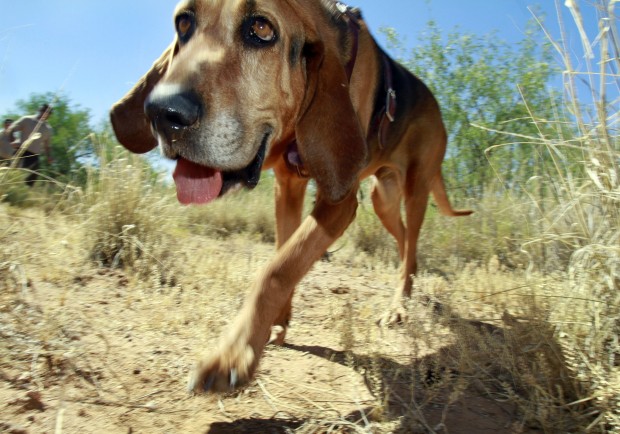
When tracking down an escaped prisoner or dangerous felon, state prison officers in the Tucson area can rely on two trusted partners: Missy and Carrie.
The two are not corrections officers; they're bloodhounds who are bred, raised and trained by the Department of Corrections to work in its prisons.
Thirty bloodhounds statewide are serving the Arizona Department of Corrections. Missy and Carrie are the only law-enforcement bloodhounds in Pima County.
The hounds live in kennels at the Arizona State Prison complex on South Wilmot Road, south of Interstate 10.
Their main job is to track anyone who escapes from the prison, but they can assist other law enforcement agencies in searches, said Kenny Vance, a service-dog trainer for the Department of Corrections.
The dogs track only human scent, Vance said.
People are also reading…
Statewide, prison bloodhounds are called out to help other agencies about three or four times a month, he said.
Carrie and Missy were most recently called out on June 23 to help Tucson police search for three people who fled the scene of a fatal crash near South Kolb Road and East 22nd Street.
That crash occurred after the driver, Henry T. Dennison, 37, who was killed, and three others stole beer from an east-side convenience store, authorities said. The three eluded arrest.
Dogs from the Douglas state prison also helped in the search for the killer of rancher Robert Krentz on March 27 in Cochise County, Vance said.
The bloodhounds are affable compared with other service dogs who are trained to detect drugs or provide protection, and their ability to track scent is invaluable.
Sometimes they can sniff a scent that has been in a location for a couple of days, he said.
"It's environmental. The weather plays a role," Vance said. "The evenings, nights and early mornings are the best times because of the cooler temperatures."
The dogs' endurance, even in the summer heat, allows them to follow smells for dozens of miles.
The bloodhounds that were brought to the scene of the Krentz shooting followed a scent trail for almost 30 miles before they were called off, he said.
"That's what these dogs were built for," he said.
The dogs proved to be a valuable resource for the Tucson Police Department after the June 23 crash on the east side, said Sgt. Fabian Pacheco, a Tucson Police Department spokesman.
Tucson police dogs work mostly in the evening, though they are available during the day. They were not on duty at the time of the crash, which happened in the morning, Pacheco said.
That likely was a factor in Tucson police requesting the hounds instead, he said.
Tucson police dogs are not as effective at tracking human scents as the hounds are, Pacheco said.
"During the summer, it's harder for our dogs to track . . . because of the heat. It tends to affect them a little bit," he said.
The DOC dogs are bred and trained at the prisons in Florence and Douglas, Vance said.
The dogs' parents are usually mixed bloodhounds that have a high success rate in tracking.
They usually begin their training when they're puppies. "The initial training depends on the dog," he said.
Carrie, who is 2 1/2 years old, was ready for service after 18 months of training.
Missy is 8 1/2 years old.
Missy has been successful over the years in helping local law enforcement with criminal and missing-persons investigations, Vance said.
She once helped locate the area on Mount Lemmon where a group of teenagers was accused of firing pellet guns at motorists on the Catalina Highway, he said.
Bloodhounds typically work for up to 10 years before they retire.
Once a dog completes its service, it usually spends its retirement living with one of the canine-unit officers.
During training, officers give the hounds a command word, which directs the dogs to identify the scent and begin searching.
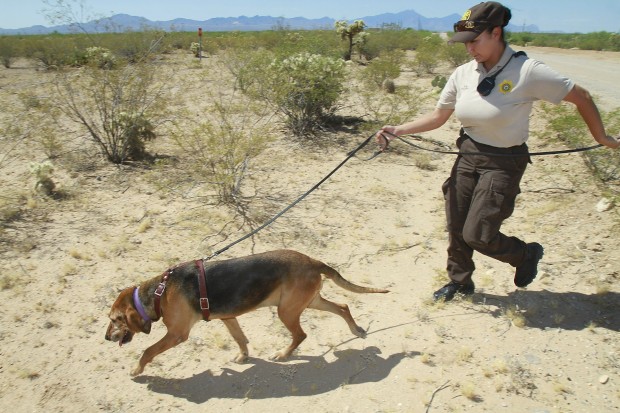
The dogs can identify the smell from sniffing a piece of clothing or a footprint.
On a recent day, Missy tracked the scent of a K-9 officer by sniffing a footprint and circling a small swath of desert near the prison complex on Wilmot Road.
Once Missy found the officer, the animal was rewarded with affection.
Then it was time to relax.
"When it's work, that time is all about work, Vance said. "When it's off time, it's all about being a dog," he said.
Contact reporter Jamar Younger at jyounger@azstarnet.com or call 573-4115.


