

There is a universal sign for "Eeew, I can't believe I touched that."
Its effectiveness at actually combating germs may be questionable, but it usually starts with a vigorous shaking of the hand, followed by a long swipe down the pants and an exaggerated grimace.
The sign was on full display at Wrightstown Elementary School recently as a handful of students reached into a large cardboard box and pulled out surprises like gnarled sinew and a dried cow patty.
The student volunteers approached the box with trepidation. The week before, a cow bladder and a buffalo tail had emerged.
Retired teacher Lynne Wright Urias and her husband, Tony Urias, aren't trying to prepare the students for a future version of "Fear Factor." Instead, they've been volunteering their time since winter break to teach students about Tucson's rich history, and the way people who settled here survived.
People are also reading…
Sinew fibers were used for bows and arrows, buffalo excrement was used to make fire and the bladder served as a water canteen.
The buffalo tail? A fly swatter. A dried corn cob? Well, let's just say this was before the mass manufacture of Charmin. (That really got the hands shaking.)
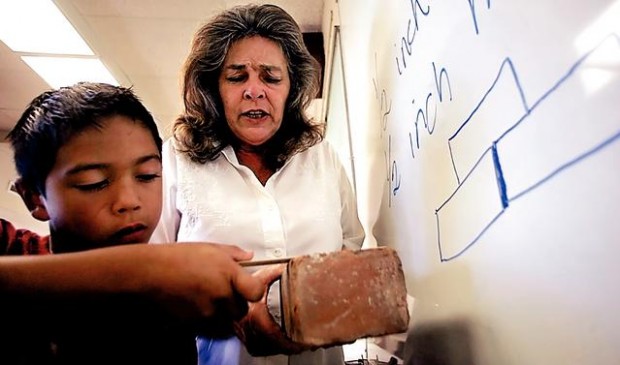
A former special-education teacher, Wright Urias hung up the chalk five years ago, only to find herself covered in it twice a week, as she and her husband volunteered to teach the local history curriculum they've developed for kindergartners through fifth-graders.
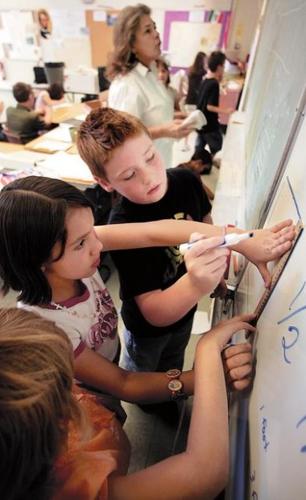
The students have chipped shapes into flagstone to create their own petroglyphs. They've ground corn on a metate and fingered elk pelts. They've sampled prickly pear pads, or nopalitos. They've shaped paintbrushes from leaves and built primitive drills, imagining they'd be using them to carve holes into shells for jewelry. They've played American Indian stick games.
Next year, kindergartners and first-graders are expected to grow a native food garden. Second- and third-graders will build a pit house, while fourth- and fifth-graders will make adobe brick.
"This is something I've wanted to do for years," said Wright Urias, who made sure the program meets state standards. "I remember when I was going to school, history was about learning dates. This way, kids learn about history through things they can touch and experience."
The couple, who can count back seven and eight generations in Tucson, come from an impressive educational lineage. Tony's great-grandfather was John Spring, an important Tucson pioneer and one of the state's first public educators. Lynne's grandfather was Fredrick Wright, a homesteader who donated land to open Wrightstown School in 1914.
So when Wrightstown showed up on a list two years ago of schools within the Tucson Unified School District slated for closure, Wright Urias decided to do whatever she could to enrich the programs offered there.
Tony Urias, a retired industrial printer, didn't anticipate getting up at 5 a.m. to go to school in his retirement, but said the students give back.
"They'll hug you. They'll wipe their noses on your trousers. It's like a petri dish in here and it seems like we catch everything. But just look at them. It's worth it when the lights go on."
The pair teach the program at retirement communities, using the proceeds to provide materials for the school program. They also are actively seeking grants, even as they gear up to volunteer their time teaching an abbreviated version of the program at Steele Elementary School over the summer.
Terri Rosenbalm, who runs the after-school program at Steele, was observing the organized din and said she couldn't wait for her students to have the chance to connect with history. "She's just phenomenal and generous to be offering this," Rosenbalm said. "We live in a society in which so many kids don't know the backgrounds of their cultures. And with the budget cuts, we need to stay focused and make sure we keep the kids engaged in learning."
Wrightstown Principal Jon Ben-Asher said with budget cuts threatening programs across the district, schools need all the support and volunteers they can get. And such specialized historical information about Tucson isn't readily found in history textbooks, he said.
Plus, it provides a chance to marry history with the school's forward-looking focus on technology. He's envisioning students interviewing elders about Tucson history and using technology to tell the stories, by using PowerPoint and collecting digital photos.
"We're hopeful that one good thing can begin another," he said. "It's just a little gem we've been polishing here this year."
DID YOU KNOW
Wrightstown Elementary School was one of four TUSD schools targeted for closure in the 2008 school year, as Governing Board members sought ways to stave off a budget shortfall.
Ochoa, in the Downtown area, the East Side's Wrightstown and Midtown schools Rogers and Corbett all were targeted.
Wrightstown was the only school that actually came up for a vote before the Governing Board. It eked by with a 3-2 vote, with board member Bruce Burke joining with then-board President Alex Rodriguez to close schools in an effort to "right-size" the district as enrollment continues to drop.


