

Editor's note: This story first appeared in the Star on Nov. 7.
Holly Bergay wouldn't mind seeing herself on a Wheaties box or on the side of a McDonald's cup.
She's got her sights set firmly on the Olympics, though it's rare for equestrians to garner the kind of exposure that lands them on cereal boxes.
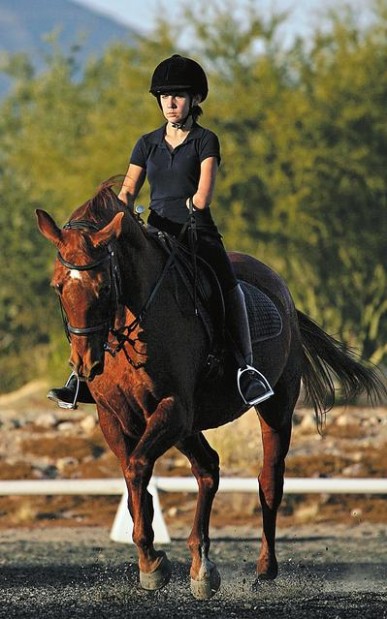
When Holly runs through equestrian exercises on an autumn evening as the sun sets, it's easy for the casual onlooker to miss the precise nature of the dressage techniques she uses.
Her mount, Lilly, appears to skip and dance as she moves gracefully around the arena.
It's also easy to miss the most unusual aspect of the show, which is that Holly has no left hand or lower arm.
Holly, a 14-year-old dressage champion many times over who lives on the far Northeast Side, has never taken part in a disabled competition since she began competing as a 7-year-old.
People are also reading…
For the past four years, she's worked under the tutelage of Pat Baker-Hutter, a trainer, instructor and licensed dressage judge willing to work with a rider who has a physical challenge.
Last weekend, she went to the state championships in Scottsdale, where she was named third-level state champion and second-level reserve champion, and she twice won third-level musical freestyle.
And for the first time, she's working toward qualifying for a competition for physically disabled athletes. The U.S. Paralympics Team already is scouting her for the 2008 Paralympics in Beijing, though she can't begin sending scores to them for another year.
In the near term, Holly hopes to make the Junior Team of the International Federation for Equestrian Sports, which is for ages 14 to 16, before moving on to the federation's Young Riders category for ages 16 to 21.
Sometime during those years, she plans to compete as a Paralympian — "She doesn't discount that at all," said her mother, Mary Bergay — before eventually heading off to the Olympics, she hopes.
She would like to become the first disabled rider to compete in the main Olympics, she said.
Holly says riding dressage with one hand is a blessing in some ways. A lot of dressage — a nonverbal form of communication between horse and rider which, if done properly, appears as if the rider isn't doing anything — requires keeping both hands steady, and Holly doesn't have to worry about that second hand becoming jittery, she said.
Sometimes kids ask what happened to her arm, and she tells them a shark bit it off before she tells the truth, which is that she was born that way, she said.
She sporadically wore a prosthetic lower arm until she was 8 and decided she didn't want it anymore.
"I wore it for show and tell and that was it," she said.
"She'd dig in the sand with it. It was a $20,000 arm," her mother said.
Holly's youth and attitude inspire other riders who see her, said fellow dressage rider Carol Bratt, 52, who first saw Holly about six years ago at a show.
"I was very new at it. It was my very first show," Bratt said.
First she noticed how young Holly was, and then that she was riding an Arabian — the same kind of horse Bratt was riding. Then she noticed Holly's left arm.
"The horse just seemed to be completely listening and complying and performing for his little girl," Bratt said. Holly said that's exactly what she's shooting for when she competes.
"It's really empowering. When you're up there, and the horse is really going to its full potential and you're doing everything right that you can, it's a powerful feeling."


