

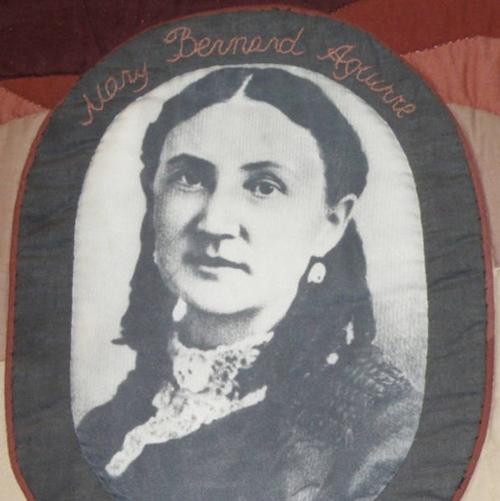
Mary "Mamie" Bernard Aguirre once taught Spanish and history at the University of Arizona.
That was in the 1890s, about 10 years after a saloonkeeper and a pair of gamblers donated a patch of desert scrub land to build a college, the UA.
Aguirre, a pioneer and educator, is one of a number of Hispanic women who will be honored Tuesday evening at the UA Women's Plaza of Honor, on the west side of Centennial Hall.
The Tribute to Hispanic Women, sponsored by the UA Hispanic Alumni, is the latest addition to the plaza, sponsored by the UA Department of Gender and Women's Studies.
At the landscaped plaza, which recognizes women's contributions to the state of Arizona, there is a computer kiosk containing bios of the women who have helped build the state and the UA, like Aguirre.
People are also reading…
She was born in St. Louis and married Epifanio Aguirre, a Mexican cattle rancher and territorial trader. They traveled along the Santa Fe Trail, where her husband delivered beef and merchandise to hamlets and military outposts. After her husband died near Sasabe, Aguirre returned east, only to come back to Arizona, said her great-granddaughter, Rowene Aguirre Medina of Mesa, who plans to attend Tuesday's ceremony.
Aguirre came to this rugged hamlet in 1876, and that May was appointed teacher of an all-girls public school.
"There were about 20 girls in the school when I took charge," she wrote in her memoir. "With a few exceptions, they were the most unruly set the Lord ever let live. They had an idea that they conferred a favor upon the school and teacher by even attending. … The recess bell was a signal for those girls to climb out the windows into the street, to whoop and scream like mad, and to generally misbehave.
"I let the first recess pass, but when the afternoon recess came, I would not allow a girl to leave her seat. Of course, there was rebellion and muttering dire, but I told them that the first one who left her seat should go home and stay there. So order was restored and no one left the room."
By the time Aguirre left the school in 1879, the school of 20 girls had grown to 80, no doubt a tribute to her teaching and disciplinary skills.
Medina, her great-granddaughter, said she delighted in hearing stories about Mamie while growing up.
One of Aguirre's strengths was her ability to bridge a cultural and language divide in Tucson, which was still a largely Mexican town 20 years after it became part of the United States.
Aguirre, who spoke Spanish, embraced her new town, culture and language, said Medina.
In turn, "she was embraced by the community," added Medina, a 1963 graduate of the UA.
In 1895, the fledgling UA appointed Aguirre head of the Spanish language and English history departments. "She was a department of one," said Medina.
Aguirre, who traveled all her life, died on May 24, 1906, in San Jose, Calif., from injuries she suffered in a train wreck.
While not all the Hispanas who will be honored are connected to the UA, many are.
From the beginning, Hispanas have been a critical part of the UA, said Edith Auslander, a consultant to the UA Foundation and former UA vice president, senior associate to the UA president and member of the state's Board of Regents.
The committee behind the tribute worked to collect $25,000 to erect the memorial, a boulder with inscribed text.
During Tuesday's ceremony four women of different ages will unveil the memorial: Velia Jiménez Morelos, a longtime activist; Veronica Leyva, a UA student; and Araceli and Malia Miller, young sisters and future leaders.
If you go
What: Tribute to La Mujer Hispana
When: 5 p.m. Tuesday
Where: UA Women's Plaza of Honor, west of Centennial Hall
Cost: $30 ($15 is tax deductible)

 Analysis: These 9 TUSD schools are at highest risk of merging or closing


