

For the doulas with Heartsounds Mother and Infant Care, dedication comes from the heart.
“It is the best job in the world because you see what a powerful difference you can make by just being with a mother and her baby for 20 hours,” said Betsy Stunz, who co-founded the local doula service with Carol Arnold in 2007.
“The mother begins to feel less anxious and depressed and feel that she is not struggling alone. She knows that she will get better and she and her baby will be all right. And it is just so rewarding because we meet great people and fabulous little beings.”
The organization, which attained nonprofit status in 2011, has helped almost 100 low-income mothers and their infants since inception with free, in-home care in the form of postpartum doulas (an ancient Greek word for woman caregivers).
People are also reading…
These doulas are dedicated to providing new mothers and babies with comfort, guidance and one-on-one attention to help make a smooth transition from pregnancy and birth to parenthood.
The organization focuses on women identified as “at risk” for perinatal mood disorders such as anxiety, postpartum depression, postpartum obsessive compulsive disorder, postpartum post-traumatic stress disorder and postpartum psychosis.
According to the Tucson Postpartum Depression Coalition, postpartum depression is the most common complication of childbirth, with 10 to 25 percent of all new mothers experiencing some form of perinatal mood disorder or depression; the National Center for Children in Poverty estimates 40 percent of teenage mothers and those dealing with financial stress experience postpartum depression.
Symptoms can include fatigue, sadness, hopelessness, change in appetite or sleep, confusion, poor concentration, lack of interest, uncontrollable crying, over-concern for the baby, fear of harming oneself or the baby or of being alone, desire to leave the situation, rapid heart rate, panic, chest pain, shaking and dizziness.
“This is not the baby blues that often occur right after childbirth and are related to hormones and the body readjusting after birth. Postpartum depression can occur anytime during the first 18 months of the baby’s life,” Stunz said.
She emphasized that increased risk factors for developing a perinatal mood disorder can include not only poverty or financial stress but also a history of depression or anxiety disorders, fertility problems, difficult pregnancy or childbirth, a difficult marriage or relationship, difficulty with breastfeeding, isolation and lack of family support.
Heartsounds and the Tucson Postpartum Depression Coalition (tucsonpostpartum.com) use the Edinburgh Postnatal Depression Scale, a 30-question screening tool, to help determine if a new mother is at risk or may be experiencing depression and if referral to a healthcare professional is needed.
The stigma surrounding postpartum depression is significant. Consequently, many women remain silent, according to Stunz. She said diagnosis is essential for the health and well-being of both mothers and babies.
“An article called ‘How Sad Moms Change a Child’s Brain’ was published in 2011 by The Daily Beast, and research has shown that when a mother has postpartum depression the part of the baby’s brain that interprets emotional experiences (the amygdala) grows too large. The baby becomes hypersensitive to threats, and their learning and social skills are significantly negatively affected, so not only the mother suffers but also the baby suffers,” Stunz said.
Overall, Stunz and her team of doulas want new mothers to be aware that perinatal mood disorders are treatable and that Heartsounds can offer referral to resources and information about recovery.
The organization also provides each client with at least 20 hours of hands-on help with basic baby care — lactation counseling and bottle feeding support; childcare while the mom sleeps or attends appointments; light housekeeping; and information and emotional support about parenting.
Doula duties are many and varied, according to Carolyn Matthiasson, who said she has used diverse techniques ranging from cooking to massage to calm and comfort mothers during her seven years with Heartsounds.
“We show them how to do the kinds of things others don’t always think about but are very important, such as singing to the baby and talking with the baby: We really work on strengthening the mother-baby bond. And we try to figure out what is most stressing the mother and help with that. Our goal is a top-notch mom and top-notch baby,” Matthiasson said.
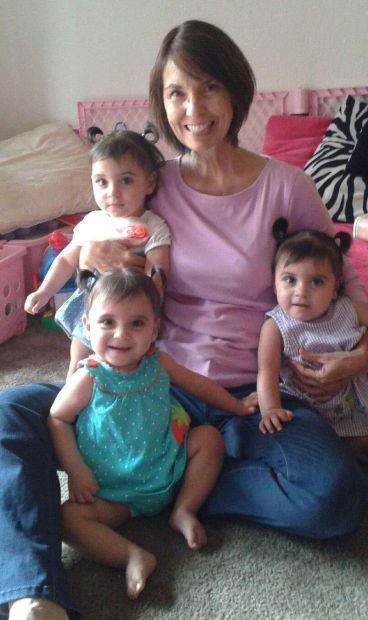
Anne Marie Debbaudt has been a recipient of the Heartsounds doula services provided by Matthiasson and Monique Kundrat. The mother of triplets, 36, became a client almost a year ago when her babies were six weeks old and she was sleep-deprived and desperate.
“I needed two doulas because with triplets you need extra hands. They have been like angels in my life. I am a single parent and I don’t have family in town and being by myself with three little ones has been rough. I don’t know if I could have done it without them,” Debbaudt said.
The doulas have gone beyond feeding, bathing and holding babies or washing bottles and doing laundry: They have helped during pediatrician appointments and emergency room visits as well, Debbaudt said.
“They have helped me to not be so overwhelmed with everything going on with three little ones and they have helped me to find other resources to get things the girls needed,” she said.
“They have just been so helpful and I know they can help others in the same boat that I was in. I want people to know that if they support Heartsounds, other parents like me will really be helped by that.”


