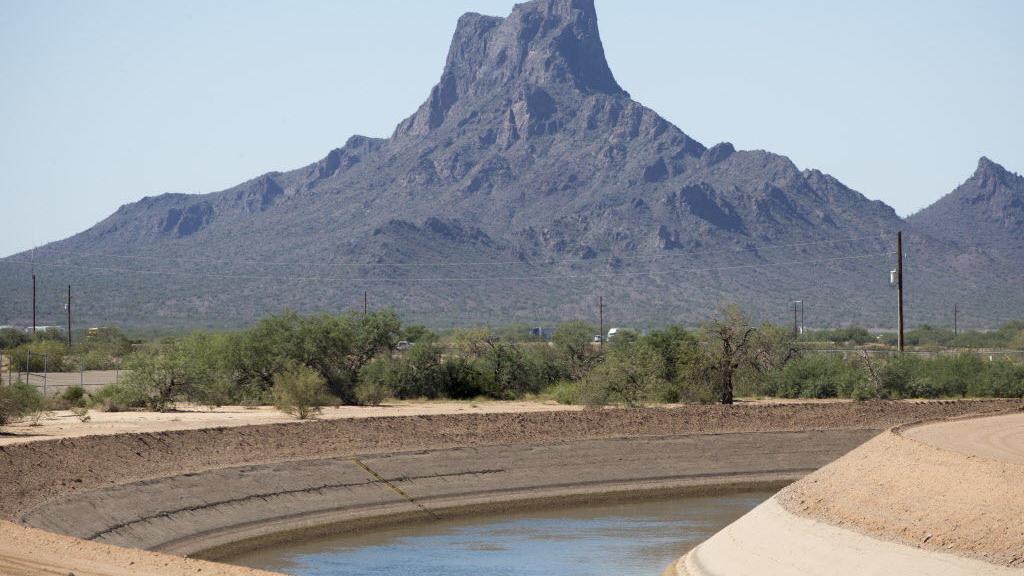
Nearly 75 groups and other entities representing a wide range of interests want Congress to pony up at least $2 billion to invest in water conservation and efficiency programs and "smart, targeted" projects to increase available supplies in the drought-stricken Colorado River Basin.
In a letter last week, the groups said the money is needed to advance drought mitigation efforts beyond the common practice in recent years of investing federal dollars to save river water by temporarily taking farmland out of production or getting cities to leave some of their water supplies in Lake Mead for a few years.
The letter marks one of the first, if not the first, organized efforts to obtain long-term funding for Colorado River water conservation programs, as opposed to the short-term programs that have dominated conservation efforts.
People are also reading…
In recent years, the U.S. Bureau of Reclamation has invested billions of dollars in water conservation efforts in Arizona, California and Nevada, using federal dollars provided by the Inflation Reduction Act of 2022. While some has been spent on longer-term projects, such as building plants to treat wastewater for drinking in Tucson and Phoenix, the majority has gone to shorter-term efforts in which the conservation ends when the money runs out.
"A near-term drought mitigation program will need to provide additional resources and authorities ... to advance momentum on conservation and augmentation, improve system reliability, and efficiencies, and build resilience against drought and wildfire under increasingly dire hydrologic conditions," the May 13 letter said.
Otherwise, "the basin risks remaining in a repeated cycle of reactive, emergency-driven operations that are more costly, less effective and more disruptive to Colorado River communities, economies and ecosystems over time," the letter said.
The letter was sent to the Republican chairman and the ranking Democratic member of the Senate Committee of Energy and Natural Resources and the House Committee of Natural Resources. The letter was also sent to all members of the congressional delegations of Arizona and the other six Colorado River Basin states.

Groups want Congress to invest at least $2 billion into Colorado River water conservation efforts.
Of the 74 groups and other entities signing the letter, more than 25% are from Arizona. The signers included a number of electrical districts along with the state-run Arizona Power Authority, which markets Hoover Dam's dwindling power supplies to customers, the Arizona Wildlife Federation, the Navajo Nation and the Yuma County Agricultural Water Coalition.
Other signers include a half-dozen Arizona irrigation districts, Southern California's Imperial Irrigation District — holder of the largest share of river water rights, major water utilities in Denver and Albuquerque, the Environmental Defense Fund, the National Audubon Society and the San Diego County Water Authority.
"What we're saying is take a holistic approach. If we continue the Band-Aid approach, are we saving water, where is it going, is it getting to places we need? Is it helping the environment? Are we securing our food supply and our long-term future?" asked Samantha Barncastle of the Family Farm Alliance, strongly implying that the answer is no.
Barncastle is executive director of the alliance, which has members in 17 Western states, including Arizona. Its stated mission is to "ensure the availability of reliable, affordable irrigation water supplies to Western farmers and ranchers" while keeping the environment healthy.
The advocates signing the letter would like to finance water efficiency programs that enable farmers to leave more water in the river, said Barncastle.
For cities, Haley Paul of Audubon used the Tucson wastewater plant — under construction on the northwest side — as an example of the kinds of urban projects they'd like to see done on a larger scale.
"You're using dollars to invest in your systems to be more efficient and diversify your water resources," said Paul, senior policy director for Audubon Southwest. "You leave water in Lake Mead, the system becomes more resilient."
And while federal funding for water projects is always a struggle to get, the letter-signers got one piece of good news the day they sent their request in.
Barncastle received an invitation from a a House subcommittee on water, wildlife and fisheries to testify Wednesday at a hearing on the "the federal reclamation program's next century."
Contact Tony Davis at 520-349-0350 or tdavis@tucson.com. Follow Davis on Twitter@tonydavis987.

Tony Davis
Reporter