President Donald Trump said Monday that Iran would "pay" for killing U.S. soldiers after multiple service members were killed over the weekend as part of the United States' war against Iran.
The number of U.S. troops killed in the war on Iran rose to 17 over the weekend, with the remains of an additional service member being examined. Two of the personnel were confirmed to have been killed when Iran attacked U.S. personnel in Jordan.
"Every time Iran kills an American Soldier they will pay for that killing many times over," Trump wrote on social media.
The weekend was one of the deadliest for U.S. troops since the war started in February. In March, six U.S. troops were killed when an Iranian drone slammed into a U.S. military facility in Port Shuaiba, Kuwait.
About 430 U.S. troops have been injured in the conflict so far.
People are also reading…
The White House said Trump would attend the dignified transfer at Dover Air Force Base in Delaware for the service members killed.
In the past week, Trump threatened to expand the targets being struck in Iran to include energy plants and bridges, sending ground forces to seize Iran’s Kharg Island oil hub and bombing a deep-underground nuclear-linked site known as Pickaxe Mountain.
Sources told Reuters that recent waves of U.S. strikes on Iran aimed at forcing open the Strait of Hormuz are also targeting Iranian military capabilities the U.S. would want to destroy before executing more complex operations against Iran.
The war, including its monetary cost, is set to dominate a congressional hearing on Tuesday with Defense Secretary Pete Hegseth and Chairman of the Joint Chiefs of Staff Daniel Caine
New blockade
Meanwhile, Yemen's Iran-aligned Houthis said on Monday they imposed a naval blockade on Saudi Arabia, a move that opens a new front against the United States in its war on Iran and widens the threat to global energy supplies and trade beyond the Gulf.
The announcement came despite signs that Tehran and Washington wanted to resume diplomacy to halt an escalating cycle of attacks that has all but wrecked a fragile interim agreement signed last month. Oil prices briefly rose after the Houthis' statement but fell back due to traders' hopes for a diplomatic breakthrough.
Iran pressed the Houthis to close the Bab el-Mandeb gateway to the Red Sea if the U.S. continued to attack Iranian power infrastructure. The full closure of the strait would cut global oil supply by 7% as it would leave most Saudi oil exports unable to leave the region. The disruption would add to the massive cut to global oil flows from the war in the Gulf, which has already reduced shipments by 10% of global supply.
In their statement, the Houthis' armed forces said they were declaring "a maritime embargo against the criminal Saudi enemy, based on the equation of 'an eye for an eye', effective immediately" in response to what they called "an unjust and oppressive siege" imposed on Yemen by the Saudis.
There was no immediate response from Saudi Arabia.
Diplomatic push
A senior Iranian official told Reuters on Monday that Tehran received a proposal from mediators for a 10-day ceasefire in an effort to salvage the interim deal, intended to pave the way to a lasting agreement to end the war that began Feb. 28 with U.S.-Israeli attacks on Iran.
Iran's Foreign Ministry said mediators recently presented proposals to Tehran, signaling that diplomatic contacts remain active.
Neither the ministry nor the official who spoke to Reuters gave any further details on the putative ceasefire discussions.
Separately, two Pakistani government sources said Iran's Interior Minister Eskandar Momeni, on his second visit to Islamabad in less than a week, had asked Pakistan to resume its mediation role in Iran's conflict with the United States.
The diplomatic push followed another night of U.S. strikes on Iranian cities and attacks by Iran's Revolutionary Guards on U.S. military assets across the region.
Trump is under mounting political pressure at home over rising gasoline prices. Average U.S. gas prices crossed the $4 a gallon mark Monday after the renewed hostilities between the U.S. and Iran.
National average retail gasoline prices climbed more than 30% since the U.S. and Israel attacked Iran at the end of February. The average pump price on Monday was $4.0030 a gallon, according to data from the American Automobile Association.
Tankers exploded
The Islamic Revolutionary Guard Corps said two oil tankers exploded after attempting to transit the strait via an "unsafe" route. On Sunday, the IRGC said two ships were involved in an "accident" in the same area. It was unclear whether the two incidents were related.
Reuters could not immediately verify the incident. The IRGC statement gave no details about the vessels or casualties.
Separately, an unknown projectile hit a vessel off Oman's coast, overlooking the Strait of Hormuz, the United Kingdom Maritime Trade Operations agency said. The vessel remains adrift but the crew are safe, it said.
U.S. Central Command said its ninth consecutive night of strikes against Iran aimed at "degrading" the country's ability to attack commercial vessels in the strait's vital shipping lanes. It gave no further details.
In Iran, explosions were reported in Tabriz, Chabahar, Konarak, Bandar Mahshahr and Bandar Imam Khomeini. One person was killed and several others wounded southwest of Tabriz, according to state news agency IRNA.

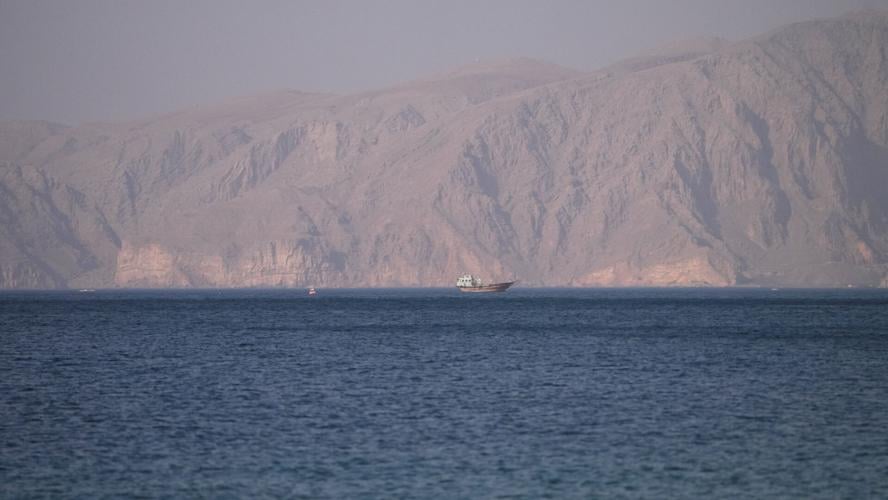
Vessels are seen Monday in the Strait of Hormuz from Musandam, Oman.

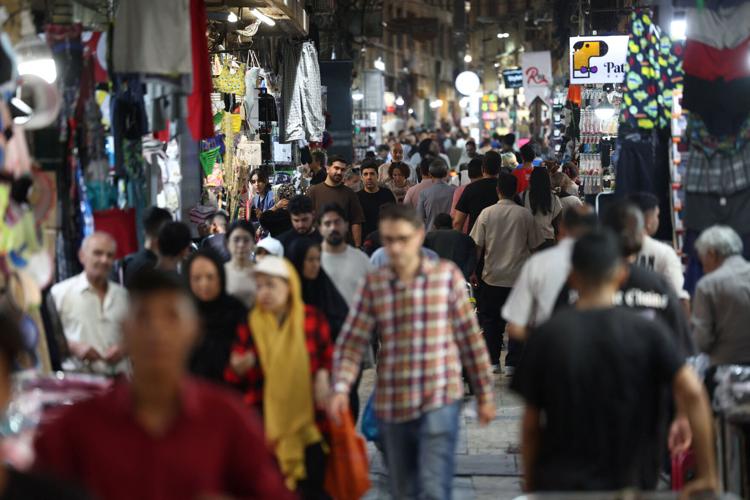
People walk Monday in the Grand Bazaar in Tehran, Iran.

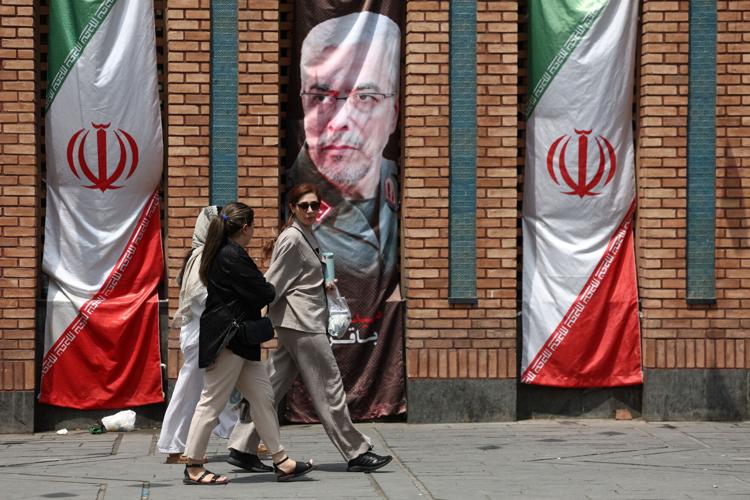
Iranian women walk past a banner with a picture of the former Chief of Staff of the Iranian Armed Forces, Mohammad Bagheri, on Monday in Tehran, Iran.

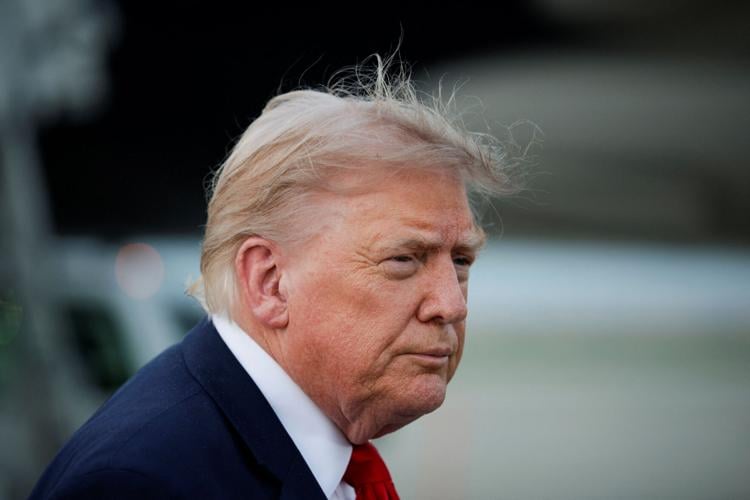
President Donald Trump speaks with the media Sunday as he arrives at Joint Base Andrews in Maryland.