WASHINGTON — The United States launched new strikes against Iran, Central Command said, after it earlier announced two U.S. military personnel were killed in Jordan and another was missing following an Iranian attack.
Before the strikes Saturday, Iran's supreme leader said Washington would pay for "seeking to escalate the conflict."
Central Command said the airstrikes began at 6 p.m. ET at President Donald Trump's direction.
"The strikes are designed to further degrade Iran's ability to threaten commercial shipping in the Strait of Hormuz and swiftly punish Islamic Revolutionary Guard Corps forces who launched attacks against American service members in Jordan last night," it said, without providing further details.
Iran's Mehr news agency said the U.S. carried out an attack near Sirik in southern Iran, adding that no casualties or damage to infrastructure have been reported.
People are also reading…
The U.S. and Iran intensified attacks since an interim ceasefire deal signed a month ago fell apart a week ago, raising the possibility of a return to all-out war.
The US military launched strikes against Iran for the seventh night in a row on Friday, July 17th. US Central Command released footage saying forces hit surveillance sites, military logistics infrastructure, and weapon storages.
Central Command said the two deaths occurred Friday and a third U.S. service member was missing in action. The announcement brought the number of U.S. service members killed since the war began to 16, while more than 420 have been wounded.
"Godspeed, heroes,” Defense Secretary Pete Hegseth posted on social media. “Their sacrifice only stiffens our resolve."
Iran appeared to target Saudi Arabia as well as other U.S. Gulf allies and Jordan on Saturday after U.S. attacks on Iranian bridges, power facilities and other infrastructure.
In a written statement carried by the official social media accounts of Iran's supreme leader and Iranian state media, Supreme Leader Ayatollah Mojtaba Khamenei said repeated U.S. breaches of the interim deal showed that Trump's signature was "utterly worthless and devoid of credibility."
"Now that the American enemy is seeking to escalate the conflict thereby incurring even heavier costs and further humiliation, it should know that the noble nation of Iran and the Resistance Front have unforgettable lessons in store for it," the statement said. The White House did not immediately respond to a request for comment.
Khamenei's whereabouts remain undisclosed.
The conflict, which began when the U.S. and Israel launched strikes on Iran on Feb. 28, hoping to disable its missile program and its regional proxies, led to major disruption to energy supplies, fears over global inflation and a battle for control of the Strait of Hormuz.

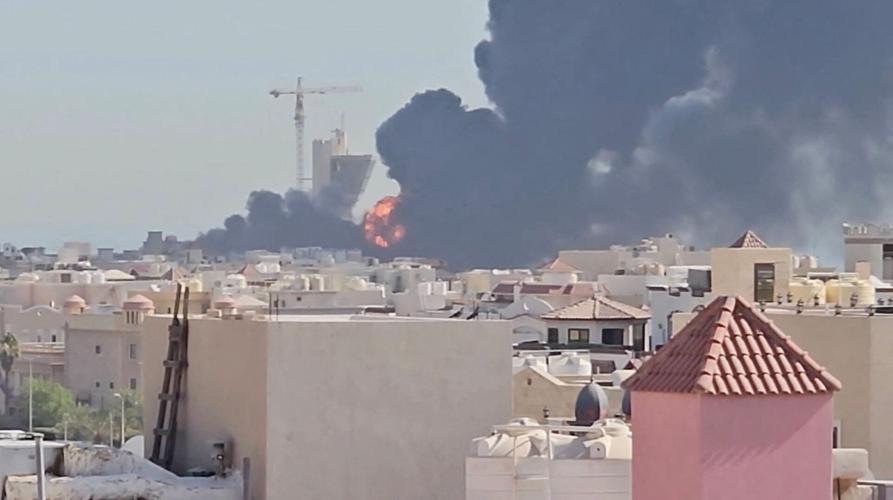
Smoke billows Saturday near the oil facility in Mangaf, Kuwait, in this screen grab obtained from a video on social media. Kuwait Petroleum Corporation said one of its oil facilities was hit in "repeated Iranian attacks," causing significant damage and some injuries, according to the state news agency.
Iranian strikes reported in Kuwait, Bahrain, Jordan, Saudi Arabia
On Saturday, Kuwait came under sustained attack, with the armed forces saying they intercepted Iranian ballistic missiles and drones, and some firefighters and oil sector workers were injured while responding to the attacks.
Iran's Revolutionary Guard said it struck a U.S. military support center at Kuwait's Camp Arifjan and destroyed a radar facility at Ali Al Salem Air Base. Kuwait Petroleum Corporation later said one of its oil facilities was hit in "repeated Iranian attacks," causing significant damage and some injuries, according to the state news agency.
As well as hitting Kuwait, the Revolutionary Guard targeted a site in Bahrain where U.S. combat aircraft were gathered at Sheikh Isa Air Base and an intelligence data center, Iranian media said.
The Revolutionary Guard also destroyed at least two U.S. fighter aircraft and three other aircraft during a missile and drone attack early Saturday on the U.S. base in Al Azraq, Jordan, according to Iranian state TV.
Reuters could not independently verify the reports.
Saudi Arabia's early warning system issued alerts early in the morning urging residents of Al-Kharj and Yanbu to seek shelter. Al-Kharj, east of Riyadh, is home to a military base that hosts U.S. troops, while Yanbu, on the Red Sea, has a key oil export terminal.
Two people briefed on the matter said an Iranian missile attack, the first on Saudi Arabia in more than three months, triggered the alerts. Saudi state media did not say what prompted the alerts and the government media office did not respond to a request for comment.
The Revolutionary Guard made no mention of an attack on Saudi Arabia.

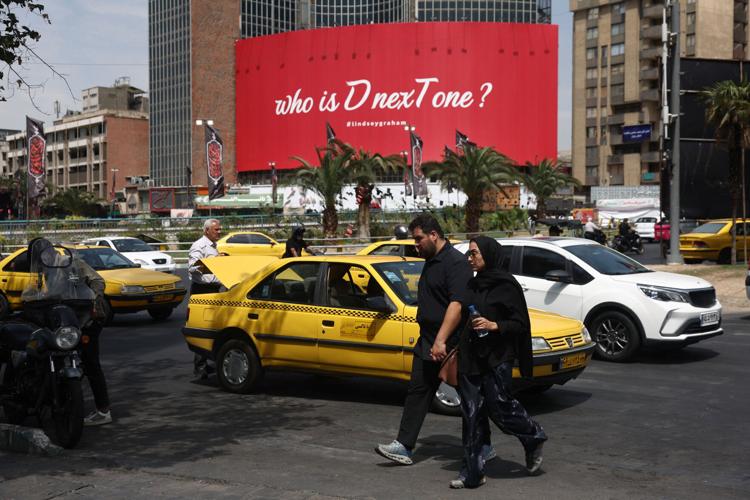
A billboard, seen Saturday, threatens U.S. President Donald Trump on a building in Tehran, Iran.
Battle for control of the strait
Earlier, U.S. Central Command said it hit Iranian surveillance sites, military logistics infrastructure, underground weapons storage and maritime capabilities.
U.S. airstrikes early in the morning killed three people and wounded eight others in the southern Hormozgan province, which borders the Strait of Hormuz, while two bridges and a road tunnel were damaged, Iranian state TV reported.
The U.S. carried out further airstrikes in the same province in the afternoon, the semi-official Fars news agency said, quoting provincial authorities.
US strikes damaged bridges and a water desalination plant in Iran after a seventh straight night of attacks.
Iran's Health Ministry said 50 people were killed and more than 500 wounded in U.S. strikes on the country over the past three weeks.
Iranian Foreign Ministry spokesperson Esmaeil Baghaei accused the United States of seeking control over the Strait of Hormuz, which usually handles about a fifth of the world's oil supply.
Both sides took aim at shipping traffic, with the U.S. saying it is enforcing a naval blockade and Iran saying it targets vessels violating its rules on navigating the strait.
The European Union and Gulf states called on Iran to immediately and unconditionally halt all attacks and interference with maritime navigation and to keep the strait open without conditions or fees, according to a joint statement reported by Saudi state TV.