


When Ashton Reed voted for President Donald Trump in 2024, he was drawn by Trump’s vow to recharge the economy and curb the inflation that many around his hometown of Jackson, Missouri, blamed on then-President Joe Biden.
Reed, 22, has since seen prices rise and a war in Iran of the kind Trump promised to avoid. He also has been uneasy about Trump's aggressive immigration enforcement tactics.
A few months ago, Reed priced an Affordable Care Act health insurance plan for his wife and discovered it was too expensive after Trump and congressional Republicans allowed pandemic-era subsidies to expire. More recently, Reed was laid off from his HVAC job.
“A huge chunk of why I voted for him in 2024 was because of economics,” Reed said of Trump. “Obviously not happy with him at all.”
Since Trump first ran for president a decade ago, white working-class and rural voters have been an important base of support, drawn to his vows to bring back manufacturing and crack down on immigration. In 2024, 2 in 3 white working-class voters backed him, according to research group PRRI’s post-election survey. Trump won 69% of the rural vote in 2024, according to Pew Research Center exit polling.
People are also reading…
But polling over recent months has shown rising disapproval from those groups, especially on the economy.
A CBS News-YouGov poll in May found 54% of white, non-college voters disapproved of Trump’s performance, up from 32% in February 2025. That disapproval hit 49% in a June NPR/PBS/Marist poll and 51% in an April Fox News poll. Among rural voters, a June Reuters/Ipsos poll found 48% disapproved of Trump, up from 34% the month after he returned to office.
“The decline is significant given that white working-class voters were a pretty stable support between 2016 and 2020 for Trump after trending Republican since the early 1990s,” said Noam Lupu, a Vanderbilt University political science professor.
The main driver of discontent is higher prices for necessities like gas and food, pushed up by the Iran war and tariffs, experts said.
White House spokesman Kush Desai said gas prices and inflation will drop once the Iran conflict resolves. And the Treasury Department recently sought to highlight how families have benefited from tax cuts.
Although Trump won't be on the November ballot, growing disapproval could bleed into the GOP’s midterm fortunes, Lupu said.
Reed, who no longer supports the MAGA movement, said plenty of people in his largely conservative part of Missouri still do. But he predicted he won’t be the only former Trump voter who is "going to possibly vote for a Democrat for the first time in their lives” in the midterms.
Economic pinch driving disapproval
In Hazard, Kentucky, Denver Feltner also had high hopes when he voted for Trump.
The 38-year-old father of five who works two jobs felt Trump shepherded the economy well in his first term before the COVID-19 pandemic. He believed he could do it again.
“Not anymore,” he said in July.
Feltner's grocery bills have spiked and his health insurance premiums went up fourfold after the ACA’s enhanced premium tax credits expired.
Feltner lives in Perry County, part of an eastern Kentucky region with high rates of poverty and chronic disease. About 44% of residents there relied on Medicaid in 2024, according to Kentucky Center for Economic Policy.
Medicaid rolls are expected to drop because of Trump's “Big Beautiful Bill,” which is projected to cut nearly $1 trillion from Medicaid and a related children’s health program.
In Feltner’s part of Kentucky, many coal unions and residents historically backed Democrats as the party of the working class. Over time, the region has evolved into a Republican stronghold.
This fall, the region’s Republican Rep. Hal Rogers, who has served in Congress since 1981, is being challenged by an attorney running as a Democrat who has highlighted Medicaid cuts. It’s widely viewed as an uphill campaign.
Whichever candidate is “wanting to try and fix the medical situation, he will more than likely get my vote,” Feltner said.
Farmers strained, but some say Trump on right path
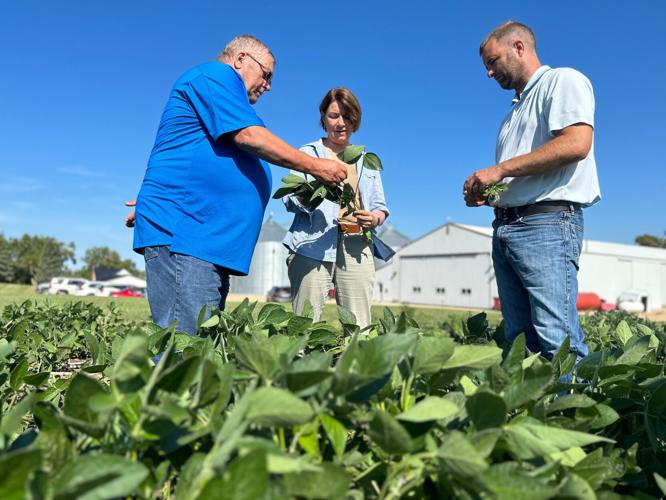
In southwest Minnesota, Bob Worth farms 1,700 acres of soybeans and corn.
“It’s a rewarding life, but it's a very tough financial life,” the 73-year-old said, noting struggles with prices and costs during the Biden administration that helped fuel his vote for Trump in 2024.
In 2025, U.S. soybean growers were hit hard by disputes over Trump's tariffs that halted sales to China. Since then, China has agreed to buy a certain amount of U.S. soybeans each year through 2028.
But Worth said low prices for crops and high costs for fuel and fertilizer combined to create ongoing challenges.
In other parts of the country, Trump’s immigration crackdown has at times made it harder for farmers and milk producers to get enough farm labor. Farm bankruptcies increased 46% in 2025 from a year earlier, according to the Farm Bureau.
The Fox News poll from April found that 69% of white rural voters said the economy was getting worse.
But Trump supporters have long given the president leeway, and Worth believes the Iran war was worthwhile to keep the regime from developing nuclear weapons.
“I still have hope and faith in him to get it done; he's a businessman, he's not a politician,” he said.
Will dissatisfaction affect midterms?
It’s typical that a president’s party loses congressional seats in midterm elections. During Trump’s first term, the GOP lost 41 House seats but retained the Senate.
But in 2018, working-class white voters still approved of Trump's economic management by margins of 30 percentage points, a New York Times analysis of polling found. Now, polls show them disapproving by anywhere from 14 to more than 30 points.
Disapproval from former Trump voters does not mean they will necessarily cross party lines.
Still, an April NPR/PBS/Marist poll found 44% of white non-college voters said they were more likely to vote for a Democratic congressional candidate than for a Republican, up from just 30% ahead of the 2018 midterms. That could come into play in rural states.
The larger question, Lupu said, is whether the polling represents a temporary, price-driven grumble that reverses once inflation cools, or if it marks cracks in working-class and rural voters’ yearslong move toward Republicans.


