

SAFFORD — In the middle of the desert and a deep drought, this city's public-works manager worries a single storm could force mass evacuations and cause deadly flooding here.
The Graveyard Wash Dam that protects Safford is one of 17 Arizona dams considered "unsafe" by state water officials.
Nearly all of the state's unsafe dams are earthen mounds less than 50 feet tall that were built decades ago for flood control. All are rated as "high hazard" because their failure or improper operation would likely kill people and destroy property downstream.
For each of the unsafe dams, the repair bill is typically in the millions of dollars. But government funding is scarce, and some dam owners complain the unsafe label stems from technicalities, rather than engineering problems.
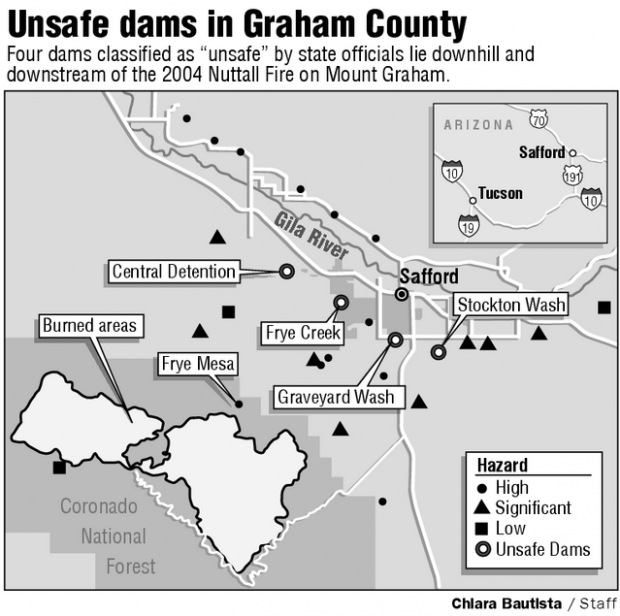
Graham County has four unsafe dams — more than any other Arizona county. All were identified as deficient in 1981. That was 23 years before the 2004 Nuttall wildfire charred nearly 30,000 acres upstream from the dams and dramatically increased runoff in many areas.
People are also reading…
"If we see a significant amount of rainfall on the watershed, we'll have to evacuate much of the city," public works director Robert Porter said.
How much rainfall is a threat? Last summer, a monsoon thunderstorm dumped 4 inches of rain in two hours on the south side of Mount Graham. Had the storm unloaded just a few miles north, Porter said, officials probably would have started evacuating large portions of this city of 9,000.
Despite monthly tests of a new emergency siren, most Safford residents don't realize the "big pile of dirt" protects them, Porter said.
Those living below Graveyard Wash Dam were evacuated in 1978 after warm rains melted the snow on Mount Graham and caused cracking in the dam.
"They woke us up in the middle of the night … it was pretty scary," resident Otis McWhorter recalled.
McWhorter has seen the now-dry reservoir fill faster since the fire, but he said he's not too worried.
"The city is staying on top of it a lot more than last time," he said.
Owners of two nearby dams labeled as unsafe – Graham County and the town of Thatcher – say they're not worried about the structures. What concerns Terry Hinton, Thatcher's manager, is the prospect of his town of 4,000 being forced to spend a fortune to fix a dam that isn't broken.
"The structure is perfectly fine," he said. "There's no danger."
Thatcher's annual budget and the state's estimated cost to modify Frye Creek Dam are both around $3 million.
"It's nothing we'll do without kicking and screaming," Hinton said of the potential repairs.
Statewide, the bill for modifying 14 of the unsafe dams is $70 million, with another $230 million tacked on to fix 14 flood-control dams in Maricopa County. The state's dam safety fund has only about $500,000.
Wildfire boosts runoff
Even before the lightning-sparked Nuttall Fire, 10,720-foot Mount Graham was subject to dramatic runoff. There's an elevation loss of 7,000 feet in seven miles as the crow flies from the forested peak down to the desert. Much of the intervening terrain consists of rocky canyons that can shed water like a parking lot.
In Southern Arizona's other forested "sky islands," hydrologists have concluded wildfires can boost runoff by three to five times. Gone is the layer of leaves and pine needles on forest floors that once deflected the impact of raindrops and delayed their entry into the soil. In severely burned areas, the ground may prevent water from seeping in.
The Tucson area has no unsafe dams. But downstream of the Santa Catalinas, flooding has been more pronounced in Sabino Canyon and the Cañada del Oro since three fires charred 117,745 acres in 2002 and 2003.
In August 2003, publisher Jim Huntington was killed near Oracle when a thunderstorm dropped 1.5 inches of rain in 25 minutes on blackened slopes, sending an 8- to 12-foot wall of water toward his home.
Federal scientists who studied the Nuttall Fire projected that flooding could threaten downstream dams and communities. The U.S. Forest Service spent nearly a half-million dollars on post-fire recovery work, including seeding of burned hillsides. The flooding threat is supposed to decline over time as ground cover sprouts.
Still, state officials are considering slapping the unsafe label on another Graham County dam because of the fire.
Frye Mesa Dam, a 107-foot concrete arch that plugs a steep canyon in the Coronado National Forest, had much of its 4-square-mile watershed burned severely. The National Weather Service estimates a 10-year storm could exceed the 77-year-old dam's spillway capacity. Such a flood has a 41 percent chance of happening in the first five years after the fire.
For all the unsafe dams in Graham County, the label stems from changing standards for emergency spillways, which act like relief valves that let water bypass a dam, rather than overtop it. As Hurricane Katrina showed, overtopping is a threat to the integrity of any dam or levee, especially earthen ones.
Dams built to 1960s codes
The dams owned by Safford, Thatcher and Graham County were built to code in the early 1960s by the Natural Resources Conservation Service. They were designed to handle a 100-year flood, which has a theoretical 1 percent chance of being equaled or exceeded in any given year. Such a flood would follow a storm that dumped about 3.5 inches of rain on Mount Graham in six hours.
Because of the Nuttall Fire, Graveyard Wash Dam no longer provides Safford with 100-year protection. A city-funded study concluded such a storm would cause several feet of water to flow down Eighth Avenue, one of Safford's main streets, as the emergency spillway dumped too much water into the downstream channel. Inundation maps show hundreds of structures would be threatened.
Federal standards changed in 1979 when the 100-year storm was replaced by a new criterion: the probable maximum flood, the biggest flood Mother Nature can deliver in a watershed.
The new standard led to the raising of Central Arizona's Roosevelt Dam by 77 feet in the early 1990s at a cost of $424 million. Arizona dams whose emergency spillways can't handle half the probable maximum flood are considered unsafe.
The probable maximum flood is so rare that scientists don't calculate how often it's expected to recur. For the Graveyard Wash watershed, it amounts to about 11.5 inches of rain in six hours.
It may sound impossible, but a decade ago that much rain fell in a day in the nearby Gila Mountains. And in 1983, a storm around Prescott produced three-quarters of the maximum probable flood.
"If that storm occurred in Safford, it would have likely overtopped any of these dams," said Mike Johnson, dam safety section manager at the Arizona Department of Water Resources.
Are repairs worth it?
A federally funded study is taking a fresh look at the dams owned by Safford, Thatcher and Graham County to determine the repair options and whether they're worth the expense. The state estimates each dam may require $3 million to $5 million in rehabilitation.
"We're hoping the study shows it's not necessary to do anything," Graham County engineer Michael Bryce said.
The Nuttall Fire did increase runoff in spots, Bryce said, but costly work on the county's Stockton Dam could be pointless: Storm water entering a bigger spillway would still go downstream and that could still cause serious flooding.
"That doesn't really provide any better protection to people downstream," Bryce said.
Spillways are meant to prevent overtopping, but water flowing over the dam might not last long enough to cause the structure to fail, Bryce said.
Modifying the dams could take three years to complete, and the alternatives range from widening their spillways to increasing their height, said Don Paulus, assistant state conservationist at the Natural Resources Conservation Service.
Dams built by the service are eligible for a matching program in which the service pays 65 percent of the repair bill and the dam owners pick up the rest.
State water officials consider several other unsafe dams to be a higher priority than those in Graham County. Dams near Florence, Coolidge, Williams and Fredonia all have cracks.
Arizona dams will also face stiff competition for federal funding. The Association of State Dam Safety Officials says it will cost $10 billion to fix the nation's most critical dams, but states only have $29 million in their dam-safety programs.
Arizona dams: 334
Dams considered "unsafe": 17
Average height: 53 ft.
Average length: 2,344 ft.
Percent that are earthen: 74
Average year built: 1952
SOURCE: National Inventory of Dams, Arizona Department of Water Resources


