

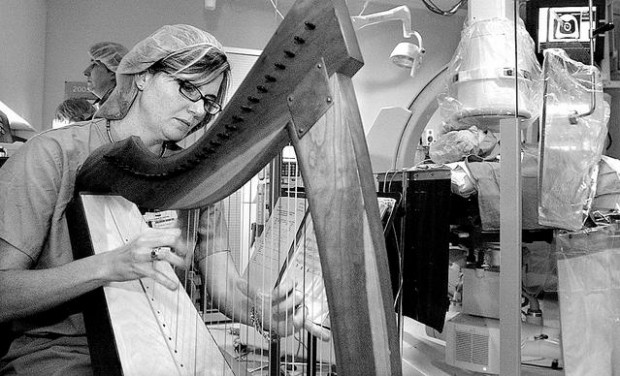
URBANA, Ill. — When a harpist wearing blue hospital scrubs started playing the familiar strains of Pachelbel's Canon during Edith Zook's heart procedure, the scene couldn't have been more surreal.
Surrounded by cutting-edge medical equipment, the 83-year-old patient lay unconscious and sedated, with skinny electrode-equipped catheters snaking from veins in her right thigh and shoulder into her heart. They provided a conduit for a video monitor showing the squiggly waves of Zook's irregular heartbeat.
Like some weird sci-fi melding of heaven and high-tech Earth, the musician strummed serenely on her 4-foot Irish harp just a few feet away, while the patient snored and her doctor silently examined the ups and downs of rainbow-colored heart waves on the screen.
The music sounded lovely — but it was meant to help heal, not entertain.
People are also reading…
Zook suffers from atrial fibrillation, a fast, irregular heartbeat caused by mixed-up electrical signals generated by the heart's upper chambers. Zook's symptoms include unnerving palpitations and troubling fatigue that make her suddenly collapse without warning.
Her doctor, Abraham Kocheril, chief of cardiac electrophysiology at the Carle Heart Center in Urbana, says he has found signs that harp music might help sick hearts like Zook's beat more normally.
The theory is based partly on work by Dr. Ary Goldberger of Harvard Medical School showing that varied rhythms created by healthy hearts are similar to note patterns in classical music.
Kocheril's work also fits with a growing music therapy movement, whose supporters believe music can alleviate some of the mental and physical symptoms of disease.
"People know that music relaxes you. We're just trying to get more medical validation," said Kocheril's harpist and co-researcher, Dr. Jennifer Mac-Kinnon, 35, a Chicago internist. She took up harp-playing at age 10 and as a child, used to play for patients of her father's, also a physician.
Some enthusiasts believe the harp has special healing qualities, and Kocheril said resonant vibrations from live harp music may be particularly effective at regulating quivering heart rhythms. Other musical instruments and recorded music might offer similar benefits, he said, making a "music prescription" easier to follow.
"Potentially, there could be a prescription for music five days a week … to keep the heart healthy in general and specifically to keep rhythm disorders under control," Kocheril said.
While he doesn't foresee the elegant but unwieldy harp becoming a routine fixture during heart operations, others have used harpists in intensive-care units to help normalize sick newborns' heart rates, after surgery to reduce patients' anxiety, and during childbirth to soothe mothers in labor.
Harp therapy also is commonly used to soothe dying patients in hospices.
Zook, a retired high school cafeteria cook from tiny Fisher, Ill., was dumbfounded when Kocheril told her he wanted a harpist play during her procedure.
"I said, 'You've got to be kidding,' " Zook recalled from her hospital bed. "I thought it was kind of crazy."
Her two daughters were also incredulous, and a doubting son-in-law sarcastically asked, "Is Gabriel going to be in there with the trumpet?"


