

In the year since his autism was diagnosed, 24-year-old Cody Fuhrman has learned the art of the "social fake" — pretending to be interested, even when he's not.
"You look at the person and nod," explained Fuhrman, who said his high-functioning autism had for years been misdiagnosed as attention-deficit (hyperactivity) disorder.
Though Fuhrman lives on his own and drives, he's not currently working or going to school — both goals he's hoping to reach with the help of a local life skills program for young adults on the higher end of the "autism spectrum."
The program, which began last year, is one of several ways the four-year-old Tucson Alliance for Autism is expanding. As diagnoses of autism increase and awareness of the brain disorder continues to grow, the local non-profit alliance is stepping up with new classes and campaigns to both help those who are affected and to educate the public.
People are also reading…
Between 300 and 400 people with autism are making use of the alliance and its programs, and leaders say participation has been steadily increasing.
Among the alliance's expanded offerings — a new Web site; a team that does autism spectrum diagnoses; summer camps for autistic kids; life skills and social thinking groups for teens and young adults; and a new series of videos intended to not only help parents navigate the system once their child has been diagnosed, but also help the public understand autism in its various forms.
One of the major misconceptions, its leaders say, is that autistic people are all unable to work, go to school, live on their own or have families. In fact, many earn college degrees, drive, live on their own and have children — though those achievements do not come without effort.
"Everybody thinks kids with autism can't function," alliance director Kim Crooks said. "But there are no two kids in the same spot. They go from being very profound — those who sit and rock and have no communication — all the way up to some kids with Asperger's who are very high-functioning."
Asperger's disorder — aka Asperger's syndrome, and sometimes called "high-functioning autism" — is part of the autism spectrum. It is a developmental disorder that affects a child's ability to socialize and communicate effectively with others. Yet it would be inaccurate to think people with Asperger's don't like social interaction.
"I like feeling like I'm part of a larger group. In school, my group was Sara, and I was the only person in it," said Sara Goralnik, a 20-year-old with Asperger's who attends Pima Community College and wants to become a veterinary technician.
Goralnik, who is from Phoenix, is currently living at Chapel Haven West — a residential program for young adults with autism spectrum disorder, which operates in a partnership with the University of Arizona.
Asperger's and "high-functioning autism" are the diagnoses of a majority of the young people, including Goralnik, who attended the Tucson Alliance for Autism's life-skills class last Wednesday night. The class meets for 90 minutes once per week and is currently being sponsored by Cox Communications.
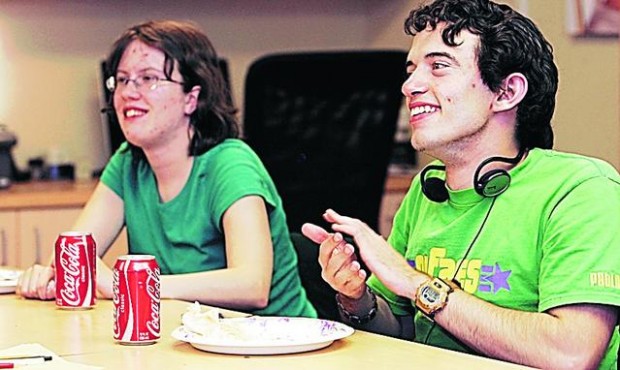
Seated around a table, the young people look like a typical group of college-age students — eating sandwiches and chips, sipping on soda and debating subjects ranging from spots where it snows in Arizona to whether the musical "Stomp" should be classified as a play or a concert.
At the beginning of the class, they have what's called "social time," when any subject is up for grabs. Then speech-language pathologist and group facilitator Allison King structures the discussion, asking each one to list some good and bad things from the week.
Fuhrman said his mother and grandmother left town that day — that was a bad thing. But he was excited about speaking at the alliance's charity golf tournament the prior weekend.
"I kept nodding off at church, so that was bad," said 23-year-old J. Karl Jensen, who also has Asperger's, in addition to attention-deficit disorder and anxiety, he said.
"And the good thing?" Jensen said.
He then reaches into his pocket and proudly takes out a Final Fantasy Tactics A2 video game that he purchased with money from the job he has as a greeter at Fry's Food and Drug.
Wednesday was the last class of the most recent 10-week life skills session, King reminds them as they groan in displeasure. The next one begins in July. She asks whether they wanted to start their own weekly support group to fill the gap, and they all raise their hands.
"You could meet independently; I think it could work," King said.
For the next 40 minutes or so, the group members make a plan for a weekly meeting, which includes appointing two leaders. They decide anyone between the ages of 18 and 30 with an autistic disorder or severe attention- deficit disorder would be welcome.
"Can we exclude Sun Devils fans?" joked Fuhrman, a UA Wildcat devotee.
Though some want to meet in a Starbucks, Jensen says he doesn't feel comfortable in coffee shops. So they settle on meeting in the alliance's offices at North Country Club Road and East Speedway. First, they go around the table to make sure all will have a ride or a bus that will get them there.
"And topics?" King asked.
"No politics or religion," Fuhrman said.
"Definitely do not discuss your sex lives," Jensen said.
"And please, no swearing," Goralnik said.
The group members say that before they began doing life skills training, they had trouble listening to other people. Sometimes they'd say inappropriate things, or walk away from people mid-conversation. Several only looked at the ground when they spoke.
"Even if you can't understand what they are saying, you need to be patient," Jensen said.
Within the next five years, alliance director Crooks would like to see the organization have a 13,000-square-foot building and act as a community education and resource center for autism. The alliance is a collaboration with the University of Arizona, the Autism Society of America's Pima County chapter and the Tucson Autism Community Center.
"We can actually be more of a teaching facility and participate in more research," Crooks said. "Another dream is to have a charter school or to be able to work with one."
But for now one of the most unusual and popular programs at the alliance is the life-skills classes for high schoolers and young adults, Crooks said, explaining that so many other autism programs are geared toward young children and their parents.
Life skills covers subjects like time management, budgeting, and everyday interactions, such as reserving a table in a restaurant and ordering food.
But it's also a chance for people with autism to meet people like themselves.
"I met a lot of friends here," said 20-year-old Kyla Cox, who has been diagnosed with Asperger's and currently works for the alliance. "It's nice to know I'm not alone in the world. I'm the only one on the spectrum in my family — so that can be tough."
About Autism
It's a brain disorder that affects a person's ability to communicate, to reason and to interact with others. It affects individuals differently and to varying degrees of severity, and it is often found in combination with other disabilities. The terms "autism" and "autism spectrum disorder" are often used interchangeably and refer to pervasive developmental disorder; autistic disorder, Asperger's disorder, and pervasive developmental disorder that's not otherwise specified; childhood disintegrative disorder; and Rett's disorder. One out of every 150 babies born will develop some form of autism. This means that an estimated 1.5 million Americans have autism.
Summer Camp for Autistic Kids
Local sessions, scheduled to begin June 1, are open to children between the ages of 8 and 14 with high-functioning autism spectrum disorder and Asperger's, their siblings and friends. There will be a concentration on leisure skills, social communication, friendships and fun. This summer's emphasis is on science. Sessions are Monday to Thursday from 9 a.m. to 1 p.m. and cost $160 per child. Limited financial assistance is available. For more information, go to the Tucson Alliance for Autism Web site at www.tucsonalliance forautism.org or call 319-5857
Autism Workshop
The Tucson Alliance for Autism on July 16 will sponsor a daylong workshop focused on practical treatment strategies for people with social cognitive deficits. The event, titled "Teaching 'Social Thinking' and Related Social Skills," is scheduled to begin at 8:45 a.m. at Northminster Presbyterian Church, 2450 E. Fort Lowell Road. The workshop is designed to help parents, teachers and professionals understand individuals high on the autism spectrum, or those with attention-deficit (hyperactivity) disorder, non-verbal learning disability or those who have no working diagnosis but fit the clinical picture. Cost is $50 for professionals, including speech pathologists and teachers, $25 for parents. Registration is limited. Call the alliance at 319-5857 for more information.

