

PHOENIX — Pairuch Kanthong, a Thai Buddhist monk, was busy building a temple when, in August 1991, two teenagers massacred him along with five monks and three other people at Wat Promkunaram, a Buddhist temple in Waddell.
On Thursday, it will be 15 years since Arizona's worst mass murder. Instead of abandoning the temple, the new abbot, Winai Booncham, six monks and the Thai community have worked hard over the years continuing to build on Kanthong's dreams.
Booncham arrived a day after the slayings. He helped clean blood from the carpet where his friend died.
After the tragedy, monks were too scared to stay there. Except for Booncham.
In spite of his fears, Booncham left his Thai Buddhist temple in Southern California and moved into the Arizona temple.
Booncham and Kanthong had known each other in Thailand. The two monks had come to America at the same time and had kept in touch.
People are also reading…
He took Kanthong's body back to Thailand for cremation.
Then Kanthong began appearing in Booncham's dreams. Kanthong, the temple's abbot, told his successor that he needed the monk to take over where he had left off.
In the days leading up to the anniversary, Booncham is anxious. In the beginning, Booncham had no time to cry.
After all these years and several attempts, Booncham concedes that he is unable to honor the monks with his words.
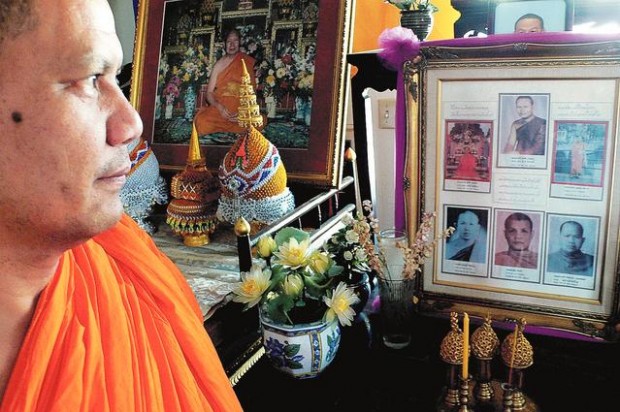
Inside the L-shaped temple, golden Buddhas and pink roses, Kanthong's favorite, crowd the altar that rises behind Booncham's bare shoulders.
"On memorial day," he says, "I cannot speak. I cry.
"I see everything in this temple, like a dream, I see my friend. I see what happens in my mind. And how my friend suffered before he died."
Booncham remembers one of Kanthong's treasured Thai Buddhist sayings, "Don't brood over the past."
"When we talked," Booncham said of Kanthong, "he'd say, 'It's in the past, don't think about it.' "
If Buddhists believe in rebirth, then around the temple it feels as if Kanthong has returned.
The heavyset grinning monk seems to be everywhere.
The painting of Kanthong — the portrait that he liked so much that he often mused about how that was the image he would most like to be remembered by at his funeral — still hangs on a wall near where he died.
The community hall that he envisioned, where the monks eat their two meals a day, where young Thais study language and where new monks have their heads shaved, was built from donations after the killings and cash from cans that he collected.
"He loved this temple. He built everything," Booncham said.
"Before I do anything at the temple, I ask Pairuch to help me."


