

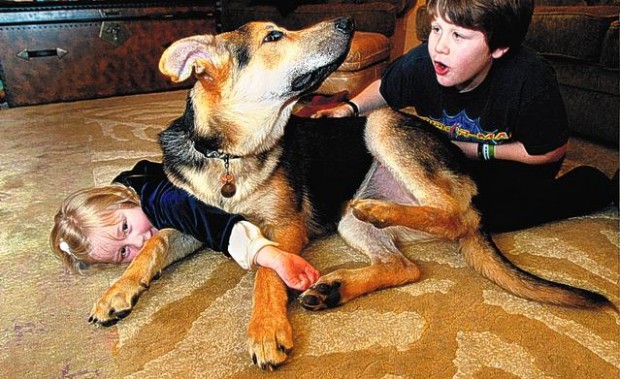
When it comes to dogs, Jonya Vollmer is pickier than Goldilocks.
It took her and her Bellingham, Wash., family about 40 dogs to find their perfect pooch: T-Rex, a Rottweiler-shepherd mix named for his gigantic paws.
"I just can't imagine a house without him now," Vollmer says.
Neither can her three children — Reece, 12, Korbin, 8, and Ledora, 5.
For many families like the Vollmers, kids and puppies just seem right together. Having a puppy can teach a child responsibility and provide a playmate.
"Children love pets. They love dogs. They become like brothers and sisters to the children," says Brian Sobi, pet trainer at Petsmart. "It teaches them responsibility early on."
But before you whip out your camera to take all those adorable puppy pictures, make sure your family is ready for all the joys and challenges of finding and keeping the right dog.
People are also reading…
The ideal age for children to start taking on the responsibilities of their own dog is between 8 and 14 years old, says Sobi, the Petsmart trainer.
"Eight years old is a great time for kids to have a puppy," he says. "The child is old enough and mature enough to appreciate the puppy and take care of the puppy."
Before getting a dog, parents and children should come up with an agreement on how they will share responsibilities to avoid arguments. Usually younger children will have a smaller role in directly caring for the animal, with older children able to take on more responsibilities, such as walking, feeding and watering.
If the parents will be bearing the brunt of puppy responsibilities, then they should make sure their lives can handle the extra weight. Two full-time, working parents might not have the time or energy to dedicate to training and caring for a rambunctious puppy in addition to their kids.
If the child will have the majority of responsibilities, go dog shopping in spring and early summer. This way, kids will be home from school and have time to bond with and take care of the dog while the weather is pleasant.
Each year, the Whatcom Humane Society, in the Bellingham area, receives 3,000 animals. With so many breeds, sizes and ages of dogs to choose from, finding a family pet can be quite the process, so it's important not to be too impulsive.
Before you even buy a leash, research breeds to see which ones best fit your family's lifestyle.
So, though you may love how a hound or a herding dog looks, its breeding can make it more high-energy. Make sure to focus on personality and find a breed that matches your family.
Also make sure to consider size. If you live in an apartment or small home with little or no yard, that might not be enough space for a larger dog to roam. Though small dogs will fit more comfortably in a smaller home, make sure to choose a breed that isn't too high maintenance. The size of the dog does not always correspond to the amount of care required to keep it happy.
Though puppies are undeniably adorable, families should also consider an older dog. Dogs up to 1 year old are still young enough to bond with the family, but their personality has developed more, so a family can see what they're getting.
Though many animals are at the humane society for different reasons — a family move, divorce, or the inability to care for the animal — families should make sure to check an older dog's background.
For the most part, older dogs can work well with busier families because they are likely already trained and a lot calmer than a puppy.
"Many adult dogs have lived with children, are housebroken and already know basic commands," says Laura Clark, community outreach director at the Whatcom Humane Society.
Once you've figured out what you want, now it's a matter of where to find it.
"Designer dogs," such as poodle mixes and the beagle-pug mix — the puggle — are increasing in popularity, but if your needs aren't that specific, shelters are full of good dogs who need homes.
Before bringing home a dog or puppy, make sure your children have been exposed to animals. Give them a chance to play with friends' dogs and teach them how to treat an animal properly.
"Teaching the child to never try and take food from a dog, wake a sleeping dog, sneak up on an animal or tease an animal will not only teach the child to be responsible and caring, it will save the child from potential injury," she says.
When introducing a new dog to children 4 and younger, parents should maintain constant supervision.
To help curb bad puppy behavior and teach basic skills, the best thing a family can do is enroll their dog in training.
It creates a bond between the dog and the child, and it establishes a relationship for how to keep control of your dog.
Training should begin when the puppy is about 10 weeks old, and usually children 8 and older should participate as well.
Ultimately, a new puppy is just like any new addition to the household. It needs to be loved and cared for and taught the difference between right and wrong.


