

FLAGSTAFF — Manuelito Wheeler did not join millions of sci-fi fans who packed into movie theaters in May 1977 to see the original “Star Wars.” He was only 7 and living with his family in remote Window Rock on Navajo Nation land, hundreds of miles from the nearest movie theater and with little knowledge of any galaxy far, far away.
Eighteen years later, Wheeler was the father of a 4-year-old son, sitting in the dim light of their living room one night watching the trilogy box set on VHS.
After, an idea lingered: What if “Star Wars: A New Hope,” as the original now was called, was dubbed into Diné Bazaad, the 700-year-old language of the Navajo? There were so many parallels — of duality, of colonization, of landscape in the Indigenous land and a force that drives people to connect through shared experiences.
Most of all, he thought, lacing a pop culture movie with Navajo voices could preserve the Diné language that threatened to erode in a culture that has lived for centuries. In 1980, 93% of Navajos spoke the native language. By 2010, census data showed that number had dwindled to 53%.
People are also reading…
There were other reasons a dub made sense. “Star Wars” appeals to those young and old. Some fans can quote the movie word for word. Others are at least familiar enough with the dialogue to follow along in another language.
Nearly 20 years after watching “A New Hope” for the first time, Wheeler, by then the director of the Navajo Nation Museum, headed the translation and dub of the dialogue into Diné Bazaad. It premiered in 2013 at a dusty rodeo arena in Window Rock and now lives on Disney+ for subscribers worldwide.
The pitch
The thought of creating a Navajo language “Star Wars” kept tugging at Wheeler after that living room viewing with his son. In 1996, he started formulating the concept with his wife, Jennifer Wheeler, a linguist and Diné teacher.
He ordered the script through Amazon and asked his wife to translate the first 10 pages. He expected it back the next day. She returned in 10 minutes.
“That point is when I really thought, ‘This is possible,’” Wheeler recalled.
He started reaching out to any email he could find on the internet that was associated with Lucasfilm, the production company, and hoped for the best. After a year, he heard back. Disney and Lucasfilm signed on — so long as Wheeler could find the money.
He first turned to the Navajo Nation for funds, but tribal elders had trouble seeing how a movie could stop language erosion.
Over 36 hours, often surrounded by boxes of pizza and liter bottles of soda, the team worked line by line, with the occasional translation question. For instance, Diné has no words for “droid” or “lightsaber.”
Droid translated to beesh hxiinaanii, or “metal that’s alive.” Lightsaber, or beeshdiin, means “sword of light.”
“They would give me a friendly pat on the back, and a friendly no,” Wheeler recalled.
Then he discovered that Navajo Parks and Recreation was looking for a way to draw a crowd to the annual Navajo Nation Fair.
“Have I got the project for you,” Wheeler said.
He finally got the yes he needed in spring 2013, along with funding for a premiere at the fair. He had just four months to pull it off.
First, Wheeler placed an ad for translators, and hired five.
With a full script completed, it was time to put out a call for voice actors who not only were proficient in Diné but knew how to channel their intergalactic characters.
He advertised the audition on Facebook; news sites soon reported it. Word spread fast about the audition at the museum on the revered “Star Wars” holiday known as “May the 4th Be With You.”
The cast
The audition drew about 200 people, including Terry Teller, a pharmacist from Shiprock, New Mexico.
As a longtime “Star Wars” fan, he knew he had to go. He got the day off work, donned his Luke Skywalker cosplay and set off on the two-hour drive to Window Rock.
He didn’t stop to refuel until he was on the border of the reservation, but a freak power outage left the gas station unable to process cards. And Teller had no cash.
“I started begging people like, ‘Can I just have 10 bucks? I need to get to Navajo,’” he recalled.
Teller somehow scraped together the cash, got to the Navajo Nation Museum on time and, to his surprise, nailed his audition. He was chosen as the voice of Skywalker, a young farmer and Jedi hero.
Geri Hongeva-Camarillo of Flagstaff, a media representative and mother of three, was urged by her children to try out. She has spoken Diné fluently for most of her life — her family spoke only Navajo at home — although she can’t write the language.
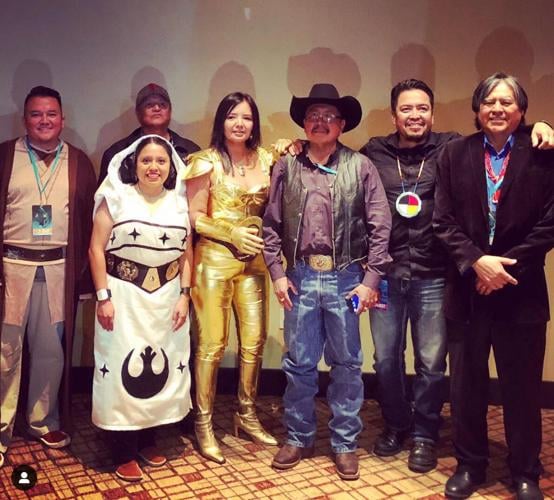
She landed the part of C3PO, making Hongeva-Camarillo the first fembot in the “Star Wars” pantheon. She credits the coaching of her 16-year-old son, an avid fan of the films.
“He kept saying ‘‘Mom, you’ve got to talk Navajo but have a British accent a little bit. And then you got to be robotic,’” Hongeva-Camarillo said.
One by one, the project cast four other central voice actors. The lineup starred Teller as Luke Skywalker, James Junes as Han Solo, Clarissa Yazzie as Princess Leia, Marvin Yellowhair as Darth Vader, Anderson Kee as Obi-Wan Kenobi and James Bilagody as the villainous General Tarkin, commander of the Death Star.
Actors spent hours in the studio rehearsing and recording lines. For those who can’t read Navajo, memorizing lines is particularly difficult.
Junes, the voice of Han Solo, remembers pushing himself to his limits on the first day.
“I stood there in the recording studio with just a light beaming down on a script that was written in Navajo, and I don’t read Navajo,” he said.
He first struggled with getting the words right. Then, his next battle was nailing Han Solo’s gunslinging attitude. After 10 hours without a steady, confident take, the producer asked whether Junes wanted to take a break.
He stepped outside and began screaming.
“I walked back into the recording studio, and I had tears in my eyes,” Junes recalled.
The producer called it a night. Junes, defeated and dead-set on quitting, started his two-hour drive back to Farmington. But on the way he had a revelation.
“I literally had to give myself a whole history lesson inside my head about the things that I was taught, the things that I needed to persevere through — how it’s going to help somebody, how, if I finish this, that I’ll be the part of something that’s going to be probably etched in stone for the rest of my life and for the rest of Navajo history.”
When Junes returned to the recording studio the next morning, he began to find his groove.
And a few hours into the session, the producer said: “Aadi k’ad, ashkii. Didííłdǫǫł dóó hooghanóo dooleeł.” “You’re all clear, kid, now let’s blow this thing and go home!”
The premiere
On July 3, 2013 — the world premier of the Diné dub — more than 2,000 people, many clad in cosplay, crowded onto the Navajo Nation Fairgrounds in Window Rock.
Instead of theater seating, the audience piled into a rodeo arena and watched the film on a screen stretched out on a semi-truck — although they had to wait for the dust to clear from the rodeo earlier that day.
The first triumphant note of the “Star Wars” theme blasted through the speakers, and the crowd erupted, applauding.
The first line of the movie, spoken by Hongeva-Camarillo, followed.
“Did you hear that? They shut down the main reactor. We’ll be destroyed for sure. This is madness.”
“Disínts’ą́ą́’ísh? Béésh naat’a’í bijéí deineestsiz. K’ad éí nihik’ihodoolchííł. Tsi’adeesdee’.”
Hongeva-Camarillo was nervous, concerned that fans would reject a woman voicing C3PO. Instead, her performance was met with hoots and hollers.
Junes, too, felt immense excitement and pride when Han Solo first flashed on-screen, and his voice filled the arena. But it’s an image off-screen that sticks with him.
“There was a grandchild and a grandma sitting three rows up from me, watching the same movie in one language. And they both could understand it,” he said.
Junes, his voice catching as he recalls that night eight years ago, said he grew up in a violent home and overcame drug and alcohol addiction as a young adult. Reflecting on his personal journey, he spoke softly.
“That’s my proudest moment,” he said.
The language
The “Star Wars” appeal spans generations, and the translation started conversations on the tenacity of the Navajo language.
After decades of language degradation in boarding schools that Indigenous children were first forced to attend in the 1860s and newer difficulties in sustaining language education and engagement in young generations, many Native languages are either endangered or extinct.
Once the Civilization Fund Act was passed in 1819, the federal government started enacting assimilation policies to “civilize” Native peoples, one of which established boarding schools to westernize Indigenous children. That meant punishing Indigenous children if they spoke their own language instead of English.
From 1860 until 1978, tens of thousands of children from Native communities across the U.S. attended schools where they experienced “physical, sexual, cultural and spiritual abuse and neglect,” according to the National Native American Boarding School Healing Coalition.
Although not every Indigenous child was sent to boarding school, the practice resulted in generations of people with little to no connection to their native tongues.
“That’s where the link was broken,” Wheeler said.
The Navajo language is traditionally passed down orally. But, as less and less of the population retained and shared the language, native speakers swiftly declined.
“We’ve learned it from our parents talking to us in Navajo, our grandparents talking to us in Navajo,” Yazzie said. “But as the generations don’t speak it, how is the language going to get passed down?”
After voicing Leia, Yazzie was inspired. She started creating short language learning videos, which she posts on TikTok alongside Star War cosplay and acting videos in Diné.
“I started using my role as Princess Leia as a pathway because that’s how people know me, that’s how people recognize me,” Yazzie said. “Now that I have your attention, let me teach you something.”
Yazzie posts basics, such as numbers and colors, and takes translation requests from followers. It’s making a difference, she said. People young and old duet her videos and follow along with her short lessons.
In one video she tackles the rainbow. Red is lichxii’ and blue is dootl’izh.
Her goal is to engage people in the language, even if it’s just for a few moments.
The art
The aura around the movie extended far beyond the premiere.
Tony Thibodeau, of the Museum of Northern Arizona in Flagstaff, first saw the dubbed film at Indigenous Comic-Con in 2016.
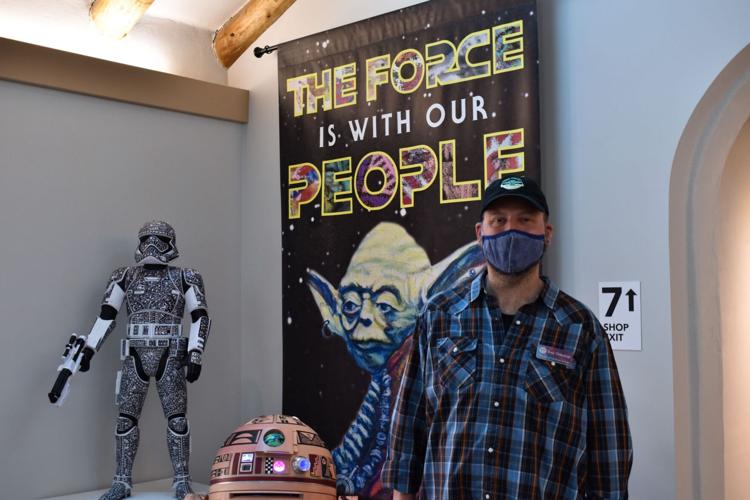
Over the next three years, he interviewed Navajo artists inspired by “Star Wars” and curated an exhibition at the museum — “The Force Is With Our People.”
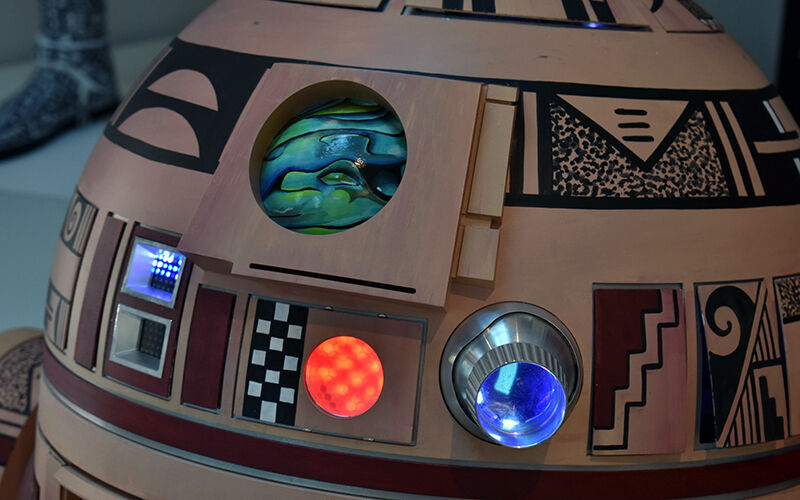
The 2019 exhibit featured works by 24 Native artists that reflect a “Star Wars” influence. The pieces — some of which remain today — included a Hopi R2D2 and an intricately designed Darth Vader helmet.
Thibodeau found that “Star Wars” resonates with Indigenous artists through three themes that connect it to Navajo culture.
The first is the Force. In Navajo teachings and oral traditions, balance and harmony remain recurring themes. In “Star Wars,” much of the plot concerns the interactions of the dark side with the light side.
Thibodeau also noted the anti-imperialist themes in the artworks echo in the plotline of the movie franchise.
“That’s literal resistance to military imperialism, resistance to the Empire,” he said. “That has resonance with a lot of Indigenous people if you look at the history between Western expansion, colonialism and Western imperialism.”
The third parallel is the similarity between the landscape of Native lands and the terrain of the planet Tatooine.
One of the artists in the exhibit, Ryan Singer, recalls playing with “Star Wars” toys at his grandmother’s house. Her backyard stretched into a vast desert, leaving Singer feeling as if he was on the outskirts of the Great Pit of Carkoon.
“You can go back and look at what this culture looked like 50 years ago, 100 years ago, but I think it’s also important to present aspects of what that culture looks like today,” Thibodeau said. “Native people are as influenced by popular culture as anybody is.”
The sequel
When Wheeler sat in a private screening of the movie with Disney executives at Disney Studios in Los Angeles, he watched as they saw firsthand the emotion and excitement that ensued when the Navajo language ricocheted off the walls of the small theater.
“That turned into a meeting, which turned into potential for a movie,” he said.
That movie was “Finding Nemo,” the animated children’s blockbuster. It, too, has been dubbed in Diné Bizaad and is available on Disney+.
There are aspirations for more dubbed movies. Or better yet, blockbusters cast with all Navajo actors from the beginning.
That will be a tough journey, Wheeler said — but Navajos know struggle well.
Diné translations in this story of lines voiced by Hans Solo, Princess Leia and CP3O were provided courtesy of Clarissa Yazzie.


