Editor's note: This story is part of 'ESA at 50,' a series that examines the past, present and future of the Endangered Species Act. Often called the "pit bull of environmental laws," the ESA has provided federal protection to nearly 2,000 animals and plants. On its 50th anniversary, it grapples with political uncertainty and unforeseen ecological challenges.
The crux comes down to flow.
And that’s a conundrum bristling with more needle-sharp barbs than a prickle of porcupines.
Seven hundred and twenty-five Arctic grayling traveled roughly 175 miles in early October from Big Timber to their new home in French Creek in a fancy steel tank in the bed of a state-owned pickup.
People are also reading…

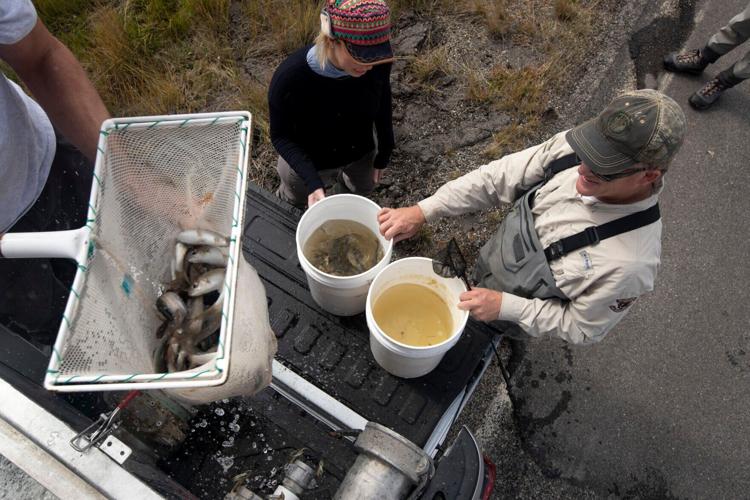
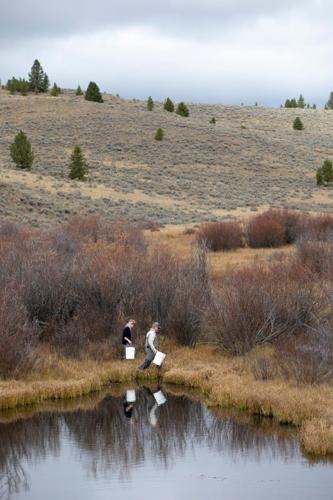
Fish, Wildlife and Parks Fisheries Biologist Jim Olsen, right, and Region Three Supervisor Marina Yoshioka hold buckets for transporting Arctic grayling during a repopulation project on French Creek on Oct. 2 in the Mount Haggin Wildlife Management Area.
Supplemental oxygen kept them perky.
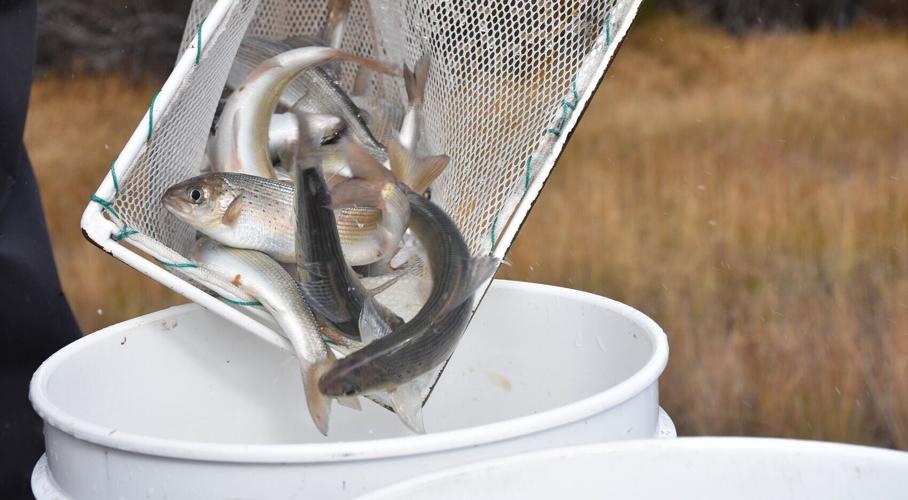
The fish were beneficiaries that day of sanctioned bucket biology. On Oct. 2, Jim Olsen, a fisheries biologist for Montana Fish, Wildlife & Parks, and colleagues toted 5-gallon buckets filled with grayling netted from the holding tank to numerous spots along French Creek in the Mount Haggin Wildlife Management Area south of Anaconda.
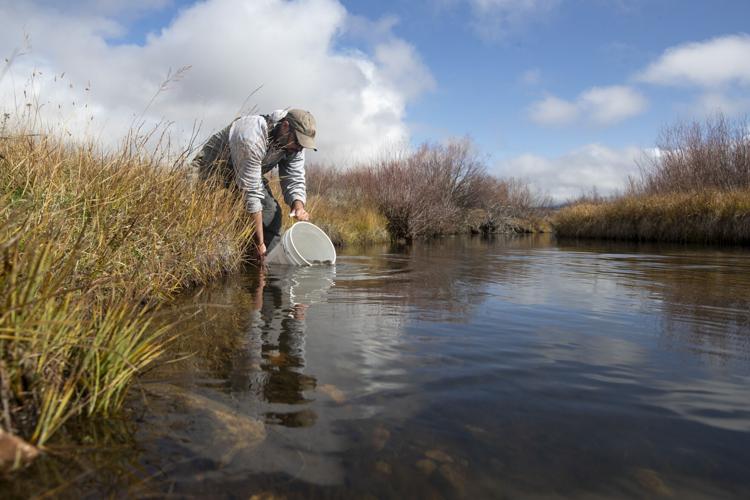
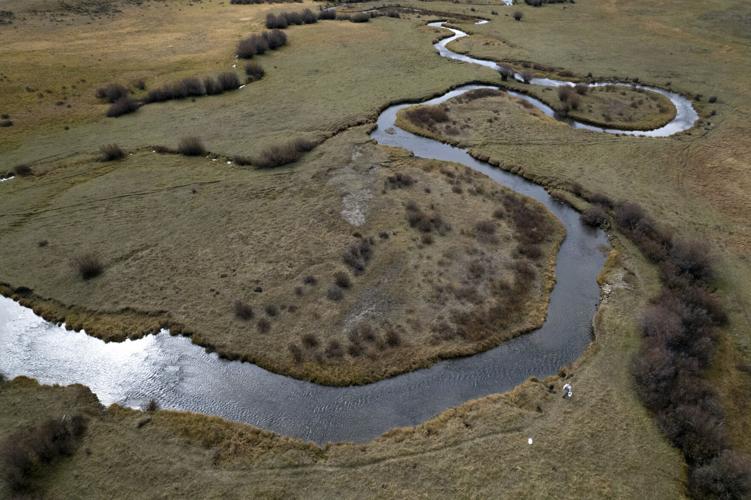
Freed in the narrow, willow-sheltered, cold and meandering creek, the fish shot like arrows toward pools of deep water.
Concerns about the viability of a small population of river-dwelling Arctic grayling in the nearby Big Hole River — the last such population in the Lower 48 states — has long stirred efforts to grant federal protections for the fish through the Endangered Species Act.
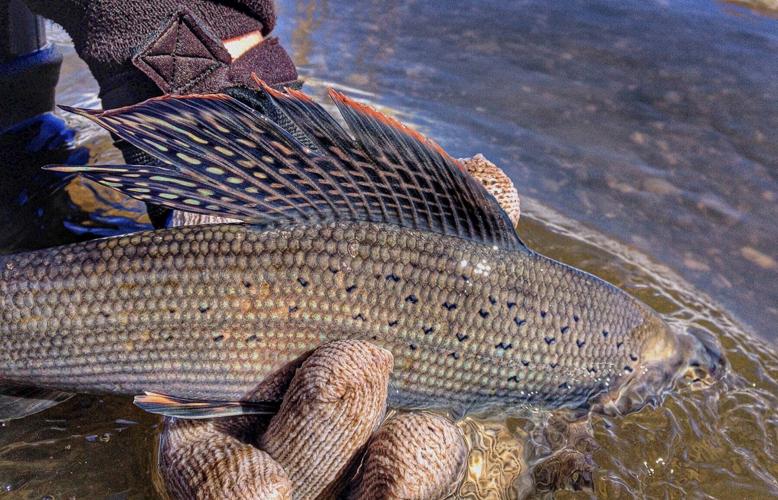
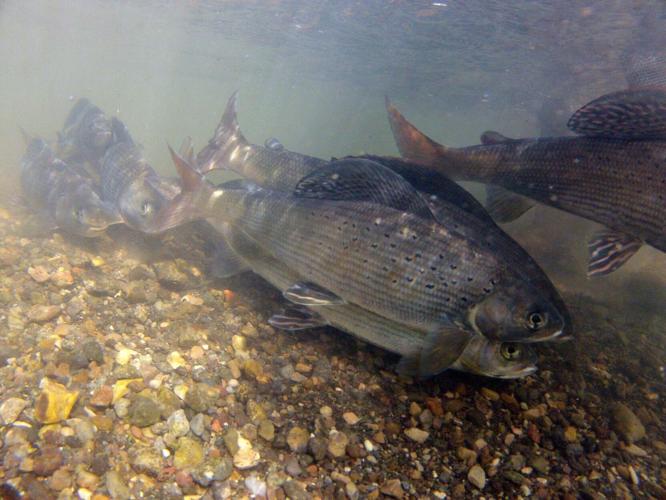
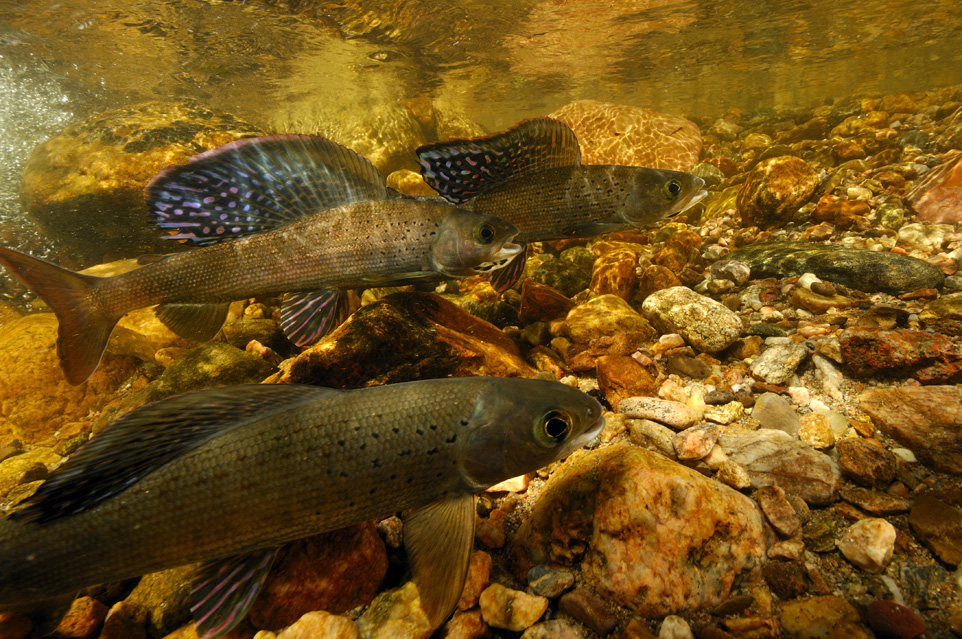
Arctic grayling belong to the same family as salmon, trout and whitefish. Adults typically average between 10 inches to 13 inches in length. The male fish’s sail-like dorsal fin stands out. It is large and vividly colored, with rows of orange to bright green spots and often boasts an orange border.

An Arctic Grayling caught in a fish trap by U.S. Fish and Wildlife Services.
Grayling are native to Arctic Ocean drainages and scientists believe Pleistocene glaciations isolated the North American populations.
Arctic grayling once occupied streams and rivers in northern Michigan, but those fish disappeared in the 1930s.
“The fluvial form of Arctic grayling is believed extirpated from about 95 percent of its historic range in the upper Missouri River basin, with the remaining fluvial population found in the Big Hole River,” according to the U.S. Fish and Wildlife Service.
Arctic grayling typically require clear, cold water. The optimal temperature ranges between 45 and 63 degrees F. Yet Olsen said he has seen grayling move into warmer water, apparently when in the midst of a growth streak.

Fish, Wildlife & Parks Fisheries Biologist Jim Olsen, right, and Region Three Supervisor Marina Yoshioka return from releasing fish during an Arctic grayling repopulation project on French Creek on Oct. 2 in the Mount Haggin Wildlife Management Area.
The fish generally spawn from late April to mid-May. Females deposit adhesive eggs over gravel without excavating a redd, or nest. The grayling in the Big Hole often migrate more than 50 miles between spawning, feeding and wintering areas. When flows are low, migration can be interrupted by predators such as osprey. They also tend to be an easy catch for anglers.
Water quality testing by the Big Hole River Foundation has found evidence in the upper Big Hole River of higher levels of nutrients, accompanied by algal growth and low levels of dissolved oxygen. The nutrients are likely tied to cow manure.
Nearly everyone agrees that low flows in the river and related increases in water temperature are threats to the fluvial Arctic grayling and other coldwater fish species during the irrigation season — realities compounded by drought and climate change. Ranchers in the Big Hole Valley withdraw water in summer to grow the hay their livestock need during the high-elevation valley’s long, harsh winters.
“I don’t think it’s any secret that the flow question is the big one that folks I talk to are most interested in,” said Brian Wheeler, executive director of the Big Hole River Foundation, a board member for the Big Hole Watershed Committee and a fishing guide. “Especially since it’s often cited by the fisheries biologists as the primary carrying capacity driver.”

Staff from the Montana Department of Fish, Wildlife & Parks re-introduced Arctic grayling in French Creek in the Mount Haggin Wildlife Management Area in early October 2023. The fish have genetic ties to river-dwelling Arctic grayling in the Big Hole River. French Creek is a tributary to the river.
Litigation as ‘bludgeon'
French Creek flows into Deep Creek, itself a tributary to the Big Hole River. A fish barrier installed in recent years is designed to block non-native fish from swimming up French Creek. But introduced Arctic grayling with genetic ties to the Big Hole population can wash downstream into the river during high water, effectively supplementing the river population.
“Extensive and widespread reintroduction in Arctic grayling historical range could play a role in efforts to save the species,” said Perry Wheeler of Earthjustice, a nonprofit environmental law organization based in San Francisco. “But any such efforts, including stocking, would be undermined if chronic dewatering is not addressed and remedied.”
One key question: Would the river-dwelling population of Arctic grayling in the Big Hole River truly benefit from federal protections afforded by being listed as an endangered or threatened species under the Endangered Species Act?
Pedro Marques, executive director of the Big Hole Watershed Committee, thinks not.
“Litigation is just a bludgeon of a tool tossed in from afar from a privileged class that doesn’t need to live the real trade-offs involved in land and resource management,” Marques said. “Litigants have been invited to the table for years but they don’t care to participate. Litigation does nothing but divide people and, if successful, will quickly erode local cooperation by imposing a big government response. ‘We’re the government and we’re here to help’ does not resonate in rural Montana.”
Legal quests for listing began more than 30 years ago. They have proceeded in fits and starts, like a grayling struggling to migrate upstream when the Big Hole’s flow drops toward a trickle. The Fish and Wildlife Service considered the Arctic grayling as a candidate for listing under the Endangered Species Act as early as 1982.
On Oct. 9, 1991, the agency received a petition from the Biodiversity Legal Foundation and George Wuerthner requesting that the fluvial Arctic grayling be listed as an endangered species throughout its historic range in the Lower 48.
In 1994, the Fish and Wildlife Service determined that listing the fluvial Arctic grayling was “warranted but precluded” by other higher-priority listings. Many in the ranching community in the Big Hole Valley feared a listing could result in FWS bird-dogging their irrigation and livestock practices. That trepidation became a catalyst to form the Big Hole Watershed Committee in 1995.

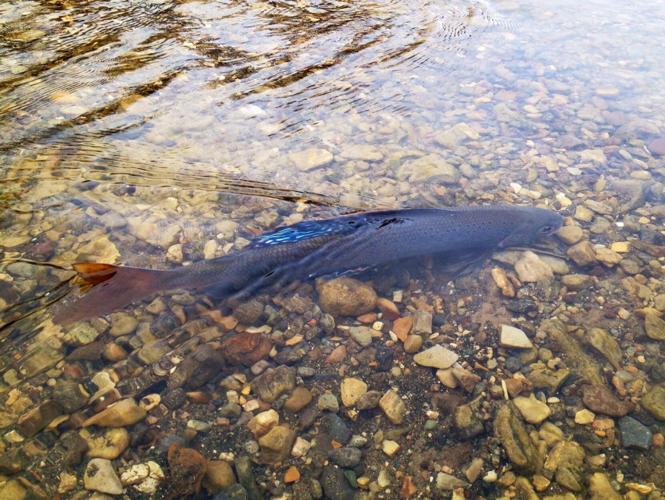
A male Arctic Grayling, a State Species of Special Concern, migrates upstream in Red Rock Creek, Montana.
That coalition of state, local and nonprofit stakeholders has tackled a host of projects, ranging from riparian zone protection to tributary and wetlands restoration and more, with the goal of keeping a federal listing at bay by improving habitat. They have included habitat improvements on California, Oregon, Moose and French creeks.
In 2006, a Candidate Conservation Agreement with Assurances, approved by the Fish and Wildlife Service, came into play for the fluvial Arctic grayling in the upper Big Hole River. Among other things, the CCAA protects landowners who agree to voluntarily work toward improving grayling habitat from additional regulatory requirements if the fish is ultimately listed. One component is agreeing to adjust water use when low-flow triggers are reached. At last count, more than 30 landowners in the Big Hole Valley were participants in the CCAA.
CCAA's grew out of the spotted owl controversy in the 1990s, when Pacific Northwest loggers objected to ESA rules protecting the owl's forest habitat. They offer a way where a species that might qualify for ESA threatened or endangered status may instead be managed under a voluntary agreement among state and local stakeholders. FWS has precluded other species from listing due to CCAAs. Among them have been the Columbia spotted frog, the Relict leopard frog, Cook's petrel and others.
Brian Wheeler described the Big Hole committee’s work as a model for collaborative conservation.
“The CCAA program work between all the agencies and landowners has definitely successfully worked towards restoring the upper river, tributary habitat and native fish, and I hope that work can expand its enrollment,” he said.

Fish, Wildlife & Parks fisheries biologist Jim Olsen walks along French Creek during an Arctic grayling repopulation project in the Mount Haggin Wildlife Management Area near Anaconda during the fall of 2023.
To list or not to list
Montana grayling remained a high priority for federal listing until 2014, when FWS found that the CCAA landowner agreements were working to ensure the species’ survival. Environmental groups appealed that decision and won, leading to another Fish and Wildlife Service ruling in 2020 finding the Arctic grayling unwarranted.
Yet Pat Munday believes the Arctic grayling population in the Big Hole River needs the protections and assets that a listing under the Endangered Species Act could yield. Munday is a Butte resident, professor at Montana Technological University and author of “Montana’s Last Best River: The Big Hole and its People.”

Fluvial Arctic Grayling
“ESA listing brings federal resources to the table and the law has been tremendously successful in recovering nearly-extinct species once seen as a nuisance or even evil," Munday said. "It protected and recovered bald eagles, gray wolves and alligators."
“What we do know with fluvial Arctic grayling is that not listing (the Big Hole population) has not worked,” he said. “There is no good evidence that there are more fish now than there were 10 or 20 years ago, and in fact there are some indications that the fish has continued to decline.”
In January, he and co-plaintiffs Center for Biological Diversity and Western Watersheds Project sued U.S. Interior Secretary Deb Haaland and FWS, asking the court to vacate a 2020 finding that the fluvial Arctic grayling did not require Endangered Species Act protections.

Explore which species in your state have made the endangered species list.
Munday said endangered or threatened species get more funding, more personnel and more attention.
“ESA listing brings both an urgency and more money,” he said.
Marques disagreed.
“There is no windfall of federal dollars when a species gets listed,” he said.
Marques acknowledged there are challenges beyond the scope of the conservation agreements in the Big Hole Valley. One of the biggest is the change in annual rainfall.
“The new normal of precipitation patterns is beyond what voluntary conservation can address,” he said.
Marques said water-storage projects, wetlands construction and even cloud seeding could help.
“The trouble I keep running into is that all water-storing technologies only go as far as the next non-cooperating irrigator,” he said.

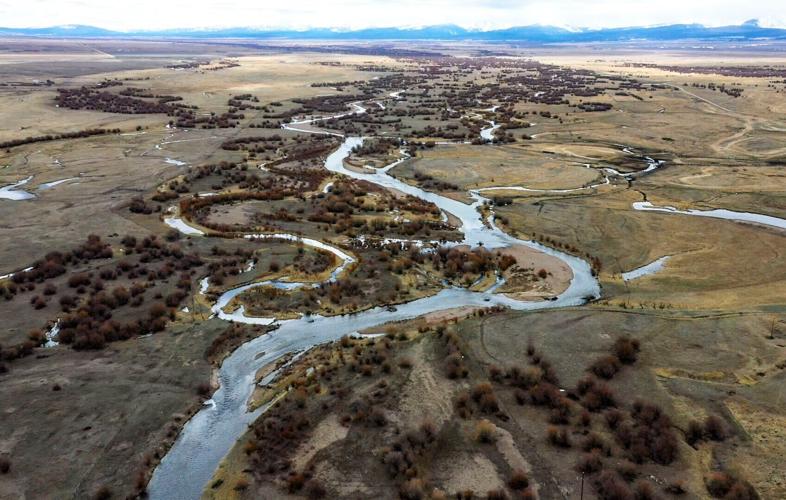
Upper part of the Big Hole River near Wisdom.
Targeting irrigation
The lawsuit filed in January by Munday and others alleged that “dewatering from irrigated agriculture and ranching is the most likely cause of an approximately 50% reduction in the Big Hole (grayling) population from the early 1990s to the early 2000s.”
Montana’s FWP does not attempt to obtain a typical population estimate of adult fluvial Arctic grayling in the Big Hole because the fish are widely dispersed in the upper river. Instead, the agency samples grayling in a handful of tributaries and side channels of the Big Hole where the fish are known to spawn.
From that, FWP’s analysis calculates the number of “effective breeders,” or successfully spawning adults. That's how many mature grayling are contributing to that year’s cohort of fish.

Montana Untamed: Often called “the pit-bull of environmental statutes,” the ESA has given federal protection to nearly 2,000 animals and plants.
In recent years, that number has declined. In 2019, the estimate for the total number of spawning adults in the Big Hole population was between 1,019 and 2,550. For 2022, that number was between 496 and 671, according to FWP.
One funding source for Big Hole Watershed Committee’s projects has been the U.S. Fish and Wildlife Service. It joined several other contributors to support a wetlands restoration project this summer on a ranch west of Wisdom. The restored wetlands could add a measure of cold water to the North Fork of the Big Hole River.
Ben LaPorte, programs manager for the Big Hole Watershed Committee, said the project’s potential to benefit grayling was first recognized by Jim Magee, an FWS biologist. Magee has long worked with landowners in the Big Hole Valley to improve conditions for grayling, stressing the importance of keeping intact ranches on the landscape. That benefits numerous species of wildlife and helps inhibit development’s habitat fragmentation.
Ranchers participating in the Big Hole CCAA program have received help with protecting riparian areas from cattle, locating off-stream water tanks for livestock, reducing fish entrainment in irrigation ditches and more.
Montana water law also allows for the acquisition or leasing of water rights to allow for boosts in instream flow by retaining water that might otherwise have been diverted. Munday and other grayling advocates want more attention put there.
Munday weighed in.
“The most productive use of Fish and Wildlife Service funding for grayling would be to pay for instream flows along with stream restoration,” Munday said.
Other fish, other problems
Tensions between ranchers and fishing outfitters have long simmered. They intensified in the summer of 2023 after FWP surveys found dramatic declines of populations in the Big Hole and other regional rivers of brown and rainbow trout — the non-native fish species that put paying anglers in rafts and drift boats.
Other kinds of Arctic grayling face other threats. Montana’s “adfluvial” grayling typically live in lakes, such as Mussigbrod Lake above the Big Hole Valley. They don’t adjust well to river currents. Separate litigation in 2023 blocked a FWS plan to boost the population of adfluvial grayling in a wilderness area in the Red Rock Lakes National Wildlife Refuge east of Lima.

Fish, Wildlife & Parks fisheries technician Lance Breen releases Arctic grayling into French Creek during a repopulation project in the fall of 2023 in the Mount Haggin Wildlife Management Area near Anaconda.
Meanwhile, the Western Rivers Conservancy, in separate announcements in September, said the nonprofit had transferred ownership to the Forest Service of two properties the organization said will ultimately help augment flows in the Big Hole River.
One was the 200-acre Eagle Rock Ranch on the Wise River. The other was the 317-acre Clemow Cow Camp east of Jackson. Western Rivers Conservancy emphasized that each acquisition and transfer would help sustain flows in the Big Hole River.
A few more cubic feet per second of cold water here, a few more over there. What about conservation agreements or re-populating grayling in tributaries? Won’t it eventually add up?
Munday said the fluvial Arctic grayling needs help now.
“We’ve waited and waited,” he said. “We can’t rely on the CCAA to save grayling in a warming world. Now is the time to act.”

In turn, Marques said the threat of listing in the 1990s “played an important role in the collaborative conservation successes we’ve been trying to have in the Big Hole.”
“After over 30 years we have a model for conservation that is working,” he said. “Listing of the grayling will raise the temperature of this already difficult situation, with no measurable benefit to the resource or the fish in question.”
And that could be. Yet research suggests the number of spawning adults in the Arctic grayling population in the Big Hole River continues to decline.
The Big Hole Watershed Committee has shepherded projects likely benefitting the fish. But the fluvial Arctic grayling faces the ominous prospect of the ongoing threat of climate change.
"Some biologists estimate that 35% of animals and plants could become extinct in the wild by 2050 due to global climate change," according to the National Park Service.
50 years of the ESA: Explore this series, in photos

Erin Fenger, conflict prevention specialist for Montana Fish, Wildlife and Park, throws old cattle bones into a dump trailer on a ranch outside Valier, Mont. in Sept. 2023. Montana FWP’s prairie bear team routinely picks up bone pits and carcasses from ranches to prevent grizzly bear attraction to the operations.

Henry Becker, pets Zia, an anatolian shepherd, on the Stickleg Ranch outside Conrad, Mont. in Sept. 2023.

Range rider Sigrid Olson rides her horse Jake on public land in search of cattle outside Potomac, Mont. in Oct. 2023.

Range rider Sigrid Olson rides her horse Jake on public land in search of cattle outside Potomac, Mont., in October 2023.

Range rider Sigrid Olson rides her horse Jake on public land in search of cattle outside Potomac, Mont. in Oct. 2023.

A major aspect of Sigrid Olson’s job as a range riding is documenting the condition of cattle on the range and signs of predators in the area. She produces a report from her notes that she shares with producers and wildlife agencies.

Range rider Sigrid Olson poses for a portrait after a day of range riding outside Potomac, Mont. in Oct. 2023.

Range rider Sigrid Olson loosens the saddle on her horse Jake after a day of range riding outside Potomac, Mont. in Oct. 2023.

Kristina Harkins of the Montana Department of Fish, Wildlife & Parks walks down a hillside near Ambrose Creek northeast of Stevensville after using a radio receiver to locate sharp-tailed grouse on Nov. 16. Harkins is a field coordinator for FWP's effort to reintroduce the species west of the Continental Divide, where they haven't been seen for decades.

Harkins uses a handheld radio antenna to listen for collared sharp-tailed grouse near the MPG Ranch in the northern Bitterroot Valley on Nov. 16.

Kristina Harkins, in the driver seat of an FWP truck near the MPG Ranch Nov. 16, listens for signals from radio-collared sharp-tailed grouse using an omnidirectional antenna mounted atop the truck cab.

Male sharp-tailed grouse dance on a lek in early morning light in spring 2023.

An estimated 300 wolverines prowl the snowy elevations of the Rocky Mountains in Montana, Idaho, Wyoming and parts of Washington, Utah and Colorado. Their hard-to-find nature has challenged the ability of biologists to confirm wolverines' population in the Lower 48 states.

A wolverine triggers a remote camera in the Helena National Forest. The elusive carnivore depends on deep snow for breeding and scavenging food. Climate change and habitat fragmentation have made it a candidate for listing under the Endangered Species Act on its 50th anniversary.
Staff from the Montana Department of Fish, Wildlife & Parks re-introduced Arctic grayling in French Creek in the Mount Haggin Wildlife Management Area in early October 2023. The fish have genetic ties to river-dwelling Arctic grayling in the Big Hole River. French Creek is a tributary to the river.
Fish, Wildlife and Parks Fisheries Biologist Jim Olsen, right, and Region Three Supervisor Marina Yoshioka hold buckets for transporting Arctic grayling during a repopulation project on French Creek on Oct. 2 in the Mount Haggin Wildlife Management Area.
Fish, Wildlife & Parks fisheries technician Lance Breen releases Arctic grayling into French Creek during a repopulation project in the fall of 2023 in the Mount Haggin Wildlife Management Area near Anaconda.

Fluvial Arctic Grayling
Fluvial Arctic Grayling

It's unusual to see Park Service personnel, or anyone, in Yellowstone National Park carrying a weapon. But this summer a crew used an air rifle to shoot darts to collect DNA samples from bison. The sampling is a small part of the work being conducted as the animals are considered for protection under the Endangered Species Act.

Bison close up in a snow storm in Yellowstone National Park.

Bison herd with calves in Lamar Valley of Yellowstone National Park.

A herd of bison in Yellowstone National Park.

A bison cow and calf walk in the road in Yellowstone National Park.

A herd of bison move through the Lamar Valley in Yellowstone National Park.

Cow and calf run through the sage in Lamar Valley in Yellowstone National Park.

The ancient bison, Bison antiquus, was taller, had longer horns, and was 25% more massive than living American bison (Bison bison). It was roughly 7.5 feet tall and 15 feet long, weighing approximately 3,500 pounds. Bison had bone horn cores on their skull that served as a base for a longer horn made of keratin, the protein that makes up our fingernails. The span of the horns of Bison antiquus was approximately 3 feet.

Attorney and former Boone and Crockett Club president Lowell Baier spent seven years compiling the "Codex of the Endangered Species Act," reviewing its 50 years of impact.

Wesley Sarmento, prairie bear specialist for Montana Fish, Wildlife and Parks, left, talks with Jennie and Seth Becker on the Stickleg Ranch outside Conrad, Mont. in Sept. 2023.