Editor's note: This story is part of 'ESA at 50,' a series that examines the past, present and future of the Endangered Species Act. Often called the "pit bull of environmental laws," the ESA has provided federal protection to nearly 2,000 animals and plants. On its 50th anniversary, it grapples with political uncertainty and unforeseen ecological challenges.
Right after the landscape around Gunsight Lake became Glacier National Park, people started “improving” on its natural bounty.
The old Indigenous trail over the U-shaped, namesake notch in the Continental Divide got expanded into a tourist-quality horse route. Great Northern Railroad hotel developers had an elaborate chalet built on its shore two years after Glacier Park’s 1910 opening. And a mule-train load of rainbow trout was dumped in its otherwise barren waters.
People are also reading…
A grizzly bear trashed the chalet kitchen and storeroom shortly after it closed for the summer of 1913. The hasty rebuild went for nothing when an avalanche wrecked the whole building during the winter of 1916. Demolition crews shoved the wreckage into the lake.
But the rainbow trout remained. The nonnative fish entertained backpacking anglers for over a century until fall 2023. The formerly fishless lake is fishless again, but not for long. Next summer it will begin a new chapter as a climate refuge for Glacier Park’s dwindling populations of native cutthroat, and eventually federally threatened bull trout under an Endangered Species Act recovery plan.

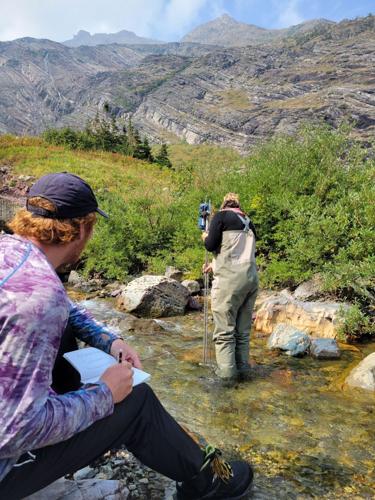
NPS fisheries technicians Ben Weber and Alexis Ballerstein measure water flows coming out of Gunsight Lake's outlet stream for a potential native fish restoration project.
In a new tactic to help recover threatened and endangered species, the U.S. Fish and Wildlife Service has authorized expanded use of experimental populations to recover animals protected under the ESA. The rule, published in the Federal Register this summer, allows at-risk animals to be transplanted in suitable habitats where they didn’t exist before.
Gunsight Lake is ideal for cutthroat and bull trout, except for one thing. A big waterfall between it and the rest of the St. Mary Lake watershed is too high for fish to swim over.
So while Gunsight sits at a lower elevation than equally famous Cracker Lake in the Many Glacier Valley, Cracker has a natural population of bull trout while Gunsight stayed empty until fish arrived on horseback.
The project raises some interesting questions about how to use the Endangered Species Act. How much can or should people manipulate habitat to recover a protected species? And is the 50-year-old ESA up to the challenge of using modern recovery methods nobody anticipated back in the 20th century?
Fragile fishery
Stocking fish in Montana lakes made lots of human anglers happy, but it fractured the existing ecosystem. Widespread placement of nonnative rainbow trout has hurt westslope cutthroat trout, which lose genetic survival fitness when they hybridize with newcomers into “cutbows.” The artificial introduction of lake trout in the Flathead watershed proved disastrous, as the predatory lakers devoured the indigenous species in lakes throughout the western half of Glacier Park. Lake trout damage to bull trout populations was one of the main factors the bull trout received Endangered Species Act protection in 1998.
Bull trout face a different threat on the east side of Glacier’s Continental Divide. There, numbers are dwindling because of hybridization with stocked brook trout (which leaves the resulting offspring sterile) and losses to a decrepit irrigation system pulling water from the St. Mary River.

So this fall, GNP fisheries biologist Chris Downs and U.S. Geological Survey aquatic ecologist Clint Muhlfeld started an ambitious effort transforming Gunsight Lake into a refuge for future cutthroat and bull trout. Shortly after the end of the summer tourist season in September, they deployed a field team to kill all the non-native rainbows in Gunsight with rotenone poison. Another crew swarmed up and down Jule Creek with electrofishing wands, and live-captured every cutthroat they could find in the little stream near the Canadian border.

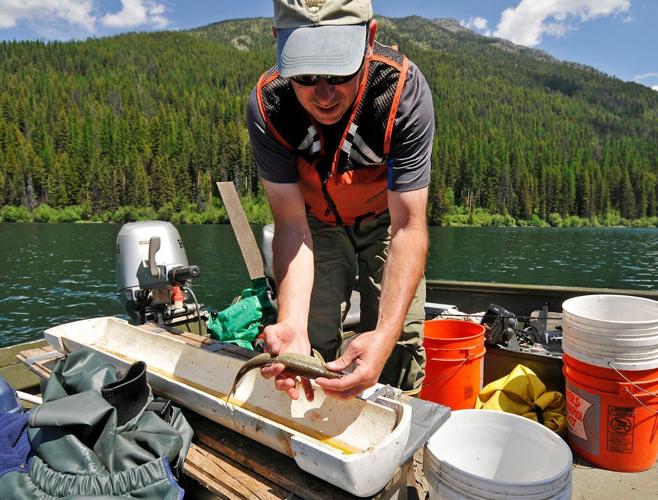
Chris Downs, GNP fisheries biologist, measures a lake trout pulled in from Quartz Lake in this 2015 file photo.
About 140 of the Jule Creek cutthroats underwent genetic testing to screen out any hybridized trout, and those with the cleanest genetics got transported to the Creston Fish Hatchery. There, they’re kept in a special pen as they grow to breeding maturity. As soon as they start producing eggs and fry, some of their offspring will be transplanted to Gunsight to restart the fishery there. Others will be returned to Jule Creek to strengthen the remaining indigenous cutthroat population.
Once the Gunsight newcomers get established, Glacier Park biologists plant to add bull trout taken from nearby waters. The goal is twofold — to have a self-sustaining foodweb supporting native trout species, and for those natives (rather than non-native rainbows) to add future fish to the downstream populations.
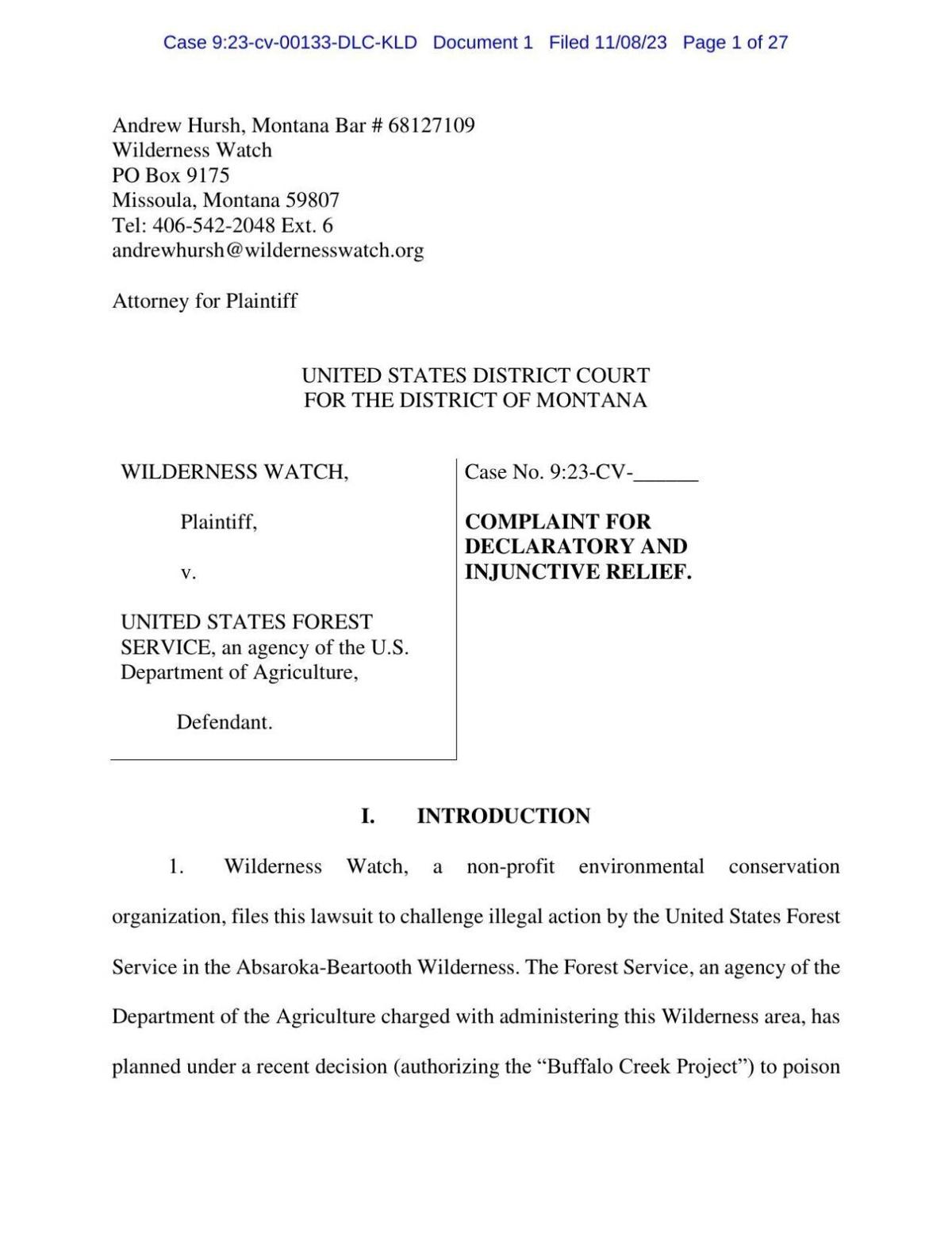
Critics have challenged the Gunsight project and similar efforts as violations of the federal Wilderness Act, which prohibits the use of mechanized equipment and technology to manipulate the landscape. In November, Wilderness Watch sued the U.S. Forest Service over a similar project to poison non-native fish in the Absaroka-Beartooth Wilderness Area north of Yellowstone National Park. The lawsuit claims “the importance of Wilderness designation was to remove the human hand from shaping the landscape and safeguard the untrammeled, wild ecosystems into the future.”
That project involves replacing non-native rainbow with Yellowstone cutthroat trout. Ironically, 20th-century fisheries managers planted Yellowstone cutthroats in many Glacier Park waters, not realizing Yellowstone and westslope had significant genetic deviations. Over the past three summers, Glacier Park biologists have been eliminating those Yellowstone cutthroats from the Camas Creek watershed north of Lake McDonald and replacing them with westslope cutthroats.
Let the right fish in
The precision DNA decision-making gets even more specific on Glacier’s east side. Genetic sampling at a University of Montana lab showed nearly all the cutthroats in the St. Mary watershed had troublesome levels of hybridization with non-native rainbows. A few fish from nearby Rose Creek and Two Dog Creek were hybrid-free, but upon further review turned out to be from hatchery transplants — most likely descended from Bob Marshall Wilderness populations.

Explore which species in your state have made the endangered species list.
That’s much too distant for the project’s requirements. Park biologists even rejected cutthroats from Midvale Creek in East Glacier — those trout were part of the Missouri River watershed genetics. St. Mary fish need to come from the Saskatchewan River watershed, which has its iconic separation at Triple Divide Peak, about 10 rugged miles southwest along the Continental Divide.
“East of the divide, we have very few populations of native cutthroats left,” Muhlfeld said. “And those that are left are fragmented and isolated. Protect what you have left — that’s the first rule of conservation.”
Shifting landscapes
At a policy level, the option to move cutthroat and bull trout into Gunsight Lake might not have been legally possible a few years ago. Several challenges to the ESA have questioned whether a recovery plan can include placing species in habitats that are suitable, but not historically used by that critter.

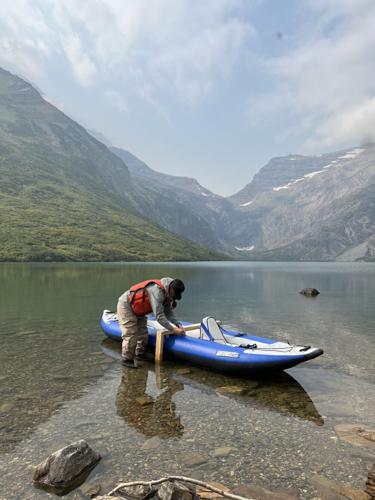
National Park Service fisheries technician Adalyn Vergara sets up a bathymetry measurement tool to map the habitat of Gunsight Lake in Glacier National Park for a potential native fish restoration project.
That doesn’t legally matter much in public land like a national park, but it’s gone all the way to the U.S. Supreme Court when private land gets included in a protected species’ critical habitat.
The plight of the dusky gopher frog in Alabama got that far, as U.S. Fish and Wildlife Service plans to save the frog included transplanting it in ponds where it had never been detected before.
As Tate Watkins of the Bozeman-based Property and Environment Research Center put it, “a law that pits people who could provide habitat for rare frogs or snakes against those very species is entirely counterproductive. That approach certainty helps explain why less than 3% of species have ever recovered and come off the list. Fights over the potential fallout from delistings account for much of the rest.”
Natural resource law expert Sean Skaggs noted that loosening the rules around moving species to novel habitats was a reasonable response to the threat of climate change. But he added that the Fish and Wildlife Service's lack of funding for recovery programs might make the change too little, too late.
"We are at a critical juncture where the effects of climate change could wipe out decades of species conservation gains," Skaggs wrote in a 2023 Environmental Law Institute review. "In the face of such exigent circumstances, focusing on habitat protection and adaptation strategies seems akin to putting a finger in the dike."

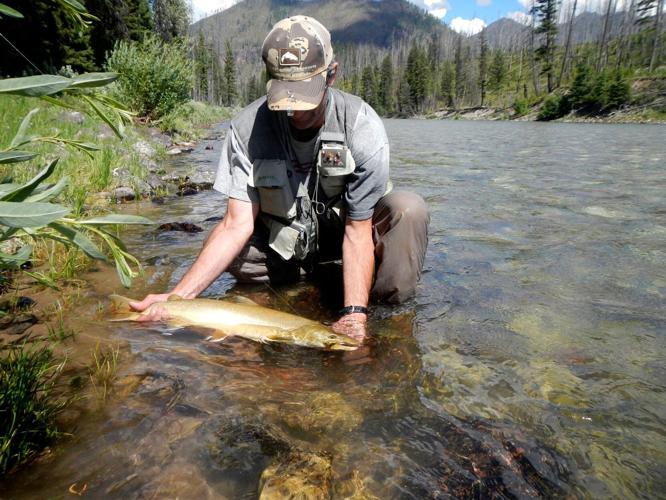
A mature bull trout can measure 2 or 3 feet long like this one captured in the South Fork of the Flathead River by Montana Fish, Wildlife & Parks fisheries manager Mark Deleray.
A 2022 Princeton University study found that funding for ESA species recovery efforts has fallen by 50% since 1985. Almost two-fifths of the fiscal 2020 ESA funding went to just 10 species, all of which were fish. One of those lucky top 10 is the bull trout.
While moving at-risk fish around hasn’t encountered too much objection, a similar effort to transplant an experimental population of grizzly bears into the Bitterroot Mountains along the Montana-Idaho border recently barged back into the news. As part of its grizzly recovery plan, the FWS had designated a 5,800-square-mile Bitterroot Ecosystem as a place to restore the historic-but-extirpated bear population. That plan was finalized just as the Clinton presidential administration handed the reins to George W. Bush’s Interior Department, which put it on ice. This fall, a federal district judge ruled that because the plan was never officially canceled, FWS had unlawfully failed to complete its duty and must get back to work.

However, in the intervening two decades, some wild grizzly bears had taken up residence in the Bitterroots. That meant the use of experimental transplanted bears needed a complete re-evaluation, the judge wrote. That will take even more time. Grizzly bears are both highly adaptable and mobile. Keystone fish species have proved far less resilient, whether faced by a too-tall waterfall or a too-tough competitor. And as those fish depend on mule trains or other artificial means to get to new habitat, they will need on humans to do the literal heavy lifting.

50 years of the ESA: Explore this series, in photos

Erin Fenger, conflict prevention specialist for Montana Fish, Wildlife and Park, throws old cattle bones into a dump trailer on a ranch outside Valier, Mont. in Sept. 2023. Montana FWP’s prairie bear team routinely picks up bone pits and carcasses from ranches to prevent grizzly bear attraction to the operations.

Henry Becker, pets Zia, an anatolian shepherd, on the Stickleg Ranch outside Conrad, Mont. in Sept. 2023.

Range rider Sigrid Olson rides her horse Jake on public land in search of cattle outside Potomac, Mont. in Oct. 2023.

Range rider Sigrid Olson rides her horse Jake on public land in search of cattle outside Potomac, Mont., in October 2023.

Range rider Sigrid Olson rides her horse Jake on public land in search of cattle outside Potomac, Mont. in Oct. 2023.

A major aspect of Sigrid Olson’s job as a range riding is documenting the condition of cattle on the range and signs of predators in the area. She produces a report from her notes that she shares with producers and wildlife agencies.

Range rider Sigrid Olson poses for a portrait after a day of range riding outside Potomac, Mont. in Oct. 2023.

Range rider Sigrid Olson loosens the saddle on her horse Jake after a day of range riding outside Potomac, Mont. in Oct. 2023.

Kristina Harkins of the Montana Department of Fish, Wildlife & Parks walks down a hillside near Ambrose Creek northeast of Stevensville after using a radio receiver to locate sharp-tailed grouse on Nov. 16. Harkins is a field coordinator for FWP's effort to reintroduce the species west of the Continental Divide, where they haven't been seen for decades.

Harkins uses a handheld radio antenna to listen for collared sharp-tailed grouse near the MPG Ranch in the northern Bitterroot Valley on Nov. 16.

Kristina Harkins, in the driver seat of an FWP truck near the MPG Ranch Nov. 16, listens for signals from radio-collared sharp-tailed grouse using an omnidirectional antenna mounted atop the truck cab.

Male sharp-tailed grouse dance on a lek in early morning light in spring 2023.

An estimated 300 wolverines prowl the snowy elevations of the Rocky Mountains in Montana, Idaho, Wyoming and parts of Washington, Utah and Colorado. Their hard-to-find nature has challenged the ability of biologists to confirm wolverines' population in the Lower 48 states.

A wolverine triggers a remote camera in the Helena National Forest. The elusive carnivore depends on deep snow for breeding and scavenging food. Climate change and habitat fragmentation have made it a candidate for listing under the Endangered Species Act on its 50th anniversary.

Staff from the Montana Department of Fish, Wildlife & Parks re-introduced Arctic grayling in French Creek in the Mount Haggin Wildlife Management Area in early October 2023. The fish have genetic ties to river-dwelling Arctic grayling in the Big Hole River. French Creek is a tributary to the river.

Fish, Wildlife and Parks Fisheries Biologist Jim Olsen, right, and Region Three Supervisor Marina Yoshioka hold buckets for transporting Arctic grayling during a repopulation project on French Creek on Oct. 2 in the Mount Haggin Wildlife Management Area.

Fish, Wildlife & Parks fisheries technician Lance Breen releases Arctic grayling into French Creek during a repopulation project in the fall of 2023 in the Mount Haggin Wildlife Management Area near Anaconda.

Fluvial Arctic Grayling

Fluvial Arctic Grayling

It's unusual to see Park Service personnel, or anyone, in Yellowstone National Park carrying a weapon. But this summer a crew used an air rifle to shoot darts to collect DNA samples from bison. The sampling is a small part of the work being conducted as the animals are considered for protection under the Endangered Species Act.

Bison close up in a snow storm in Yellowstone National Park.

Bison herd with calves in Lamar Valley of Yellowstone National Park.

A herd of bison in Yellowstone National Park.

A bison cow and calf walk in the road in Yellowstone National Park.

A herd of bison move through the Lamar Valley in Yellowstone National Park.

Cow and calf run through the sage in Lamar Valley in Yellowstone National Park.

The ancient bison, Bison antiquus, was taller, had longer horns, and was 25% more massive than living American bison (Bison bison). It was roughly 7.5 feet tall and 15 feet long, weighing approximately 3,500 pounds. Bison had bone horn cores on their skull that served as a base for a longer horn made of keratin, the protein that makes up our fingernails. The span of the horns of Bison antiquus was approximately 3 feet.

Attorney and former Boone and Crockett Club president Lowell Baier spent seven years compiling the "Codex of the Endangered Species Act," reviewing its 50 years of impact.

Wesley Sarmento, prairie bear specialist for Montana Fish, Wildlife and Parks, left, talks with Jennie and Seth Becker on the Stickleg Ranch outside Conrad, Mont. in Sept. 2023.